
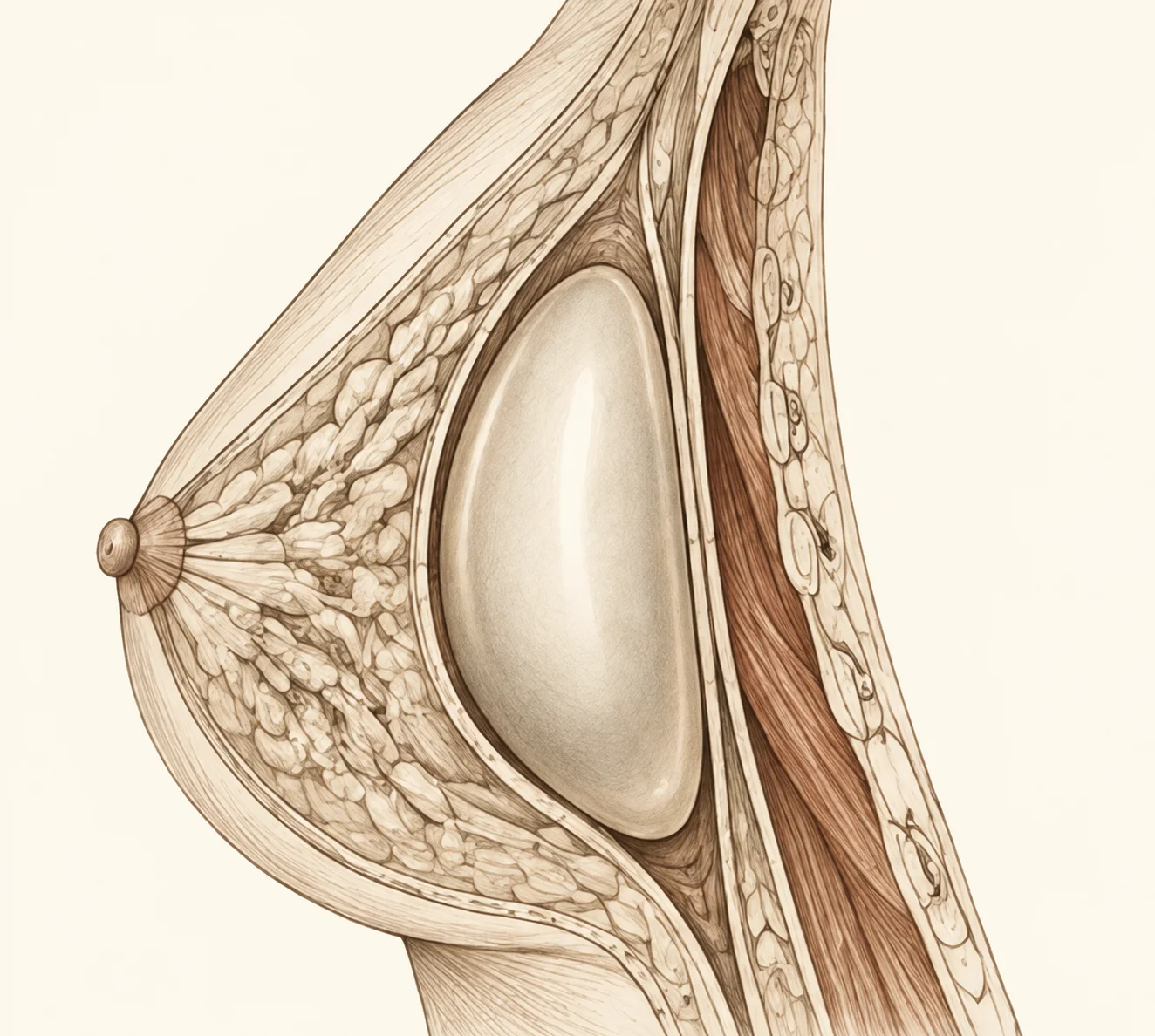
Male breast sagging can arise from several different layers: residual glandular tissue, chest fat, stretched skin after weight loss, ageing, or a previous gynecomastia operation that changed volume without fully addressing the envelope. The word “sagging” describes where the tissue sits. It does not tell us which tissue is creating the descent.
The first distinction is fullness versus loose skin
A chest can look low because there is still substantial tissue behind or around the areola. Another can look low because the gland and fat have largely disappeared after major weight loss, leaving an empty skin envelope.
The first patient may still have a volume-reduction problem. The second has an envelope problem. Liposuction can improve suctionable fat; it cannot remove a large redundant skin envelope.
Gynecomastia is not synonymous with sagging
Gynecomastia surgery is designed around excess male breast tissue, which may include gland, fat or both. A patient can have gynecomastia without major skin descent, and a patient can have significant sagging after weight loss with very little residual gland.
This distinction matters because removing more tissue from an already deflated chest can make the loose skin problem more obvious.
Two men with the same low areola can need opposite operations
One man has a heavy glandular chest with a low nipple–areola complex. Another has very little residual tissue but a broad sheet of loose skin after major weight loss. Their nipples may sit at similar heights.
The first may need reduction of underlying tissue with skin management depending on severity. The second may need a lifting or excisional approach rather than more volume removal. Nipple position alone does not tell me which operation belongs underneath it.
Liposuction has a clear ceiling
Gynecomastia liposuction is useful when fat is a meaningful component and the skin has enough capacity to adapt. It cannot remove a firm subareolar gland and it cannot reliably shrink a large redundant envelope.
Using more liposuction to solve loose skin can create a thinner chest beneath the same hanging envelope. The visible problem may then look worse because the tissue that was supporting the skin has been removed.
Major weight loss creates a different male chest
After substantial weight loss, the chest can contain thin skin, residual fat, displaced areolae and lateral chest redundancy that extends toward the axilla or upper back. The problem is no longer confined to the breast mound.
In selected patients, a broader body-contouring discussion such as upper body lift may become relevant when redundancy extends beyond the chest. The scar burden is correspondingly larger because the amount of skin being removed is larger.
Scars are part of male chest reshaping when the envelope is truly excessive
Men are often particularly concerned about visible chest scars, which is understandable. But a large loose skin envelope cannot be removed through the same tiny access used for liposuction.
I would rather discuss an honest scar that can correct the anatomy than offer a “scarless tightening” promise that cannot remove the redundant tissue. The scar-to-benefit ratio is part of the indication.
Pectoral muscle sets the frame underneath the surgery
Chest contour depends on the pectoralis muscle and rib cage as well as fat, gland and skin. Surgery can reveal or refine the existing frame; it cannot create pectoral muscle that is not present.
This is important for men expecting a bodybuilding chest from tissue removal alone. A flatter chest and a muscular chest are not synonymous results.
Hormonal and medication-related causes belong before surgery when enlargement is active
If male breast enlargement is new, progressive, tender, markedly asymmetric or associated with medication or hormonal concerns, the cause may need medical evaluation before aesthetic surgery.
Operating on the appearance of an active process can create an unstable result. The cosmetic plan is strongest when the underlying driver is understood or has become stable.
Previous gynecomastia surgery changes the revision threshold
A man may present with residual skin, contour irregularity, recurrent fullness or a low areola after previous surgery. The current chest is not simply the original anatomy with less tissue; it contains scar and altered support.
Revision should identify whether the remaining problem is volume, crater deformity, scar, skin redundancy or nipple–areola position. Repeating the first operation automatically is rarely the best logic.
What a natural male chest result means to me
I want the chest to lie more smoothly over the pectoral frame, the nipple–areola complex to sit in a believable relationship with that frame and the transition to the lateral chest to remain natural.
I do not want a hollowed subareolar crater, an over-tightened skin envelope or a chest that looks surgically flattened. A small amount of normal tissue is often part of the natural male contour.
Skin quality determines whether reduction will reveal or worsen the sagging
A younger chest with elastic skin can sometimes adapt after fat or gland reduction. A chest with thin, stretched skin after major weight loss may not contract enough to follow the new contour. The same amount of tissue removal can therefore improve one patient and exaggerate laxity in another.
This is why skin is assessed before deciding how much volume to remove. The more the envelope has lost its ability to retract, the less sensible it becomes to treat the problem as a pure liposuction or gland-excision case.
What I assess before treating male breast sagging
I separate gland, fat and skin; assess nipple–areola position, pectoral frame, chest-wall asymmetry, weight stability, recent or planned weight change, prior gynecomastia surgery, scars and any new atypical breast finding.
Only then does the procedure become obvious. Some patients need gynecomastia surgery. Some need mainly skin excision or a broader upper-body correction. Some need no further reduction at all. The correct plan follows the tissue that is actually hanging.