

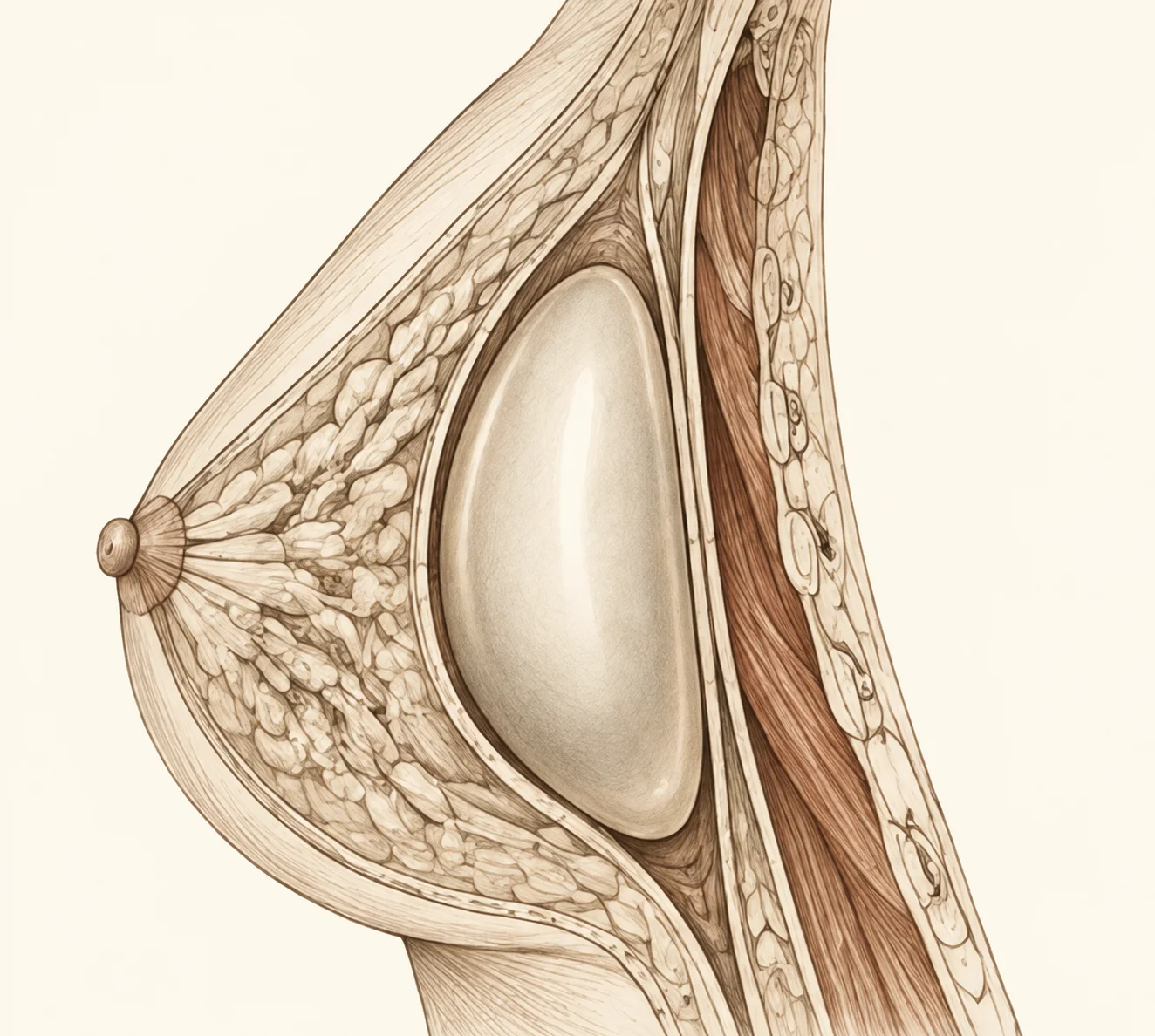
Gynecomastia is usually described as chest fat. That description is wrong often enough to change the operation.
The male chest can be enlarged by glandular tissue, by fat, by skin laxity, or by a combination of the three. They look similar from the outside and they respond to entirely different plans. Treating gland-dominant gynecomastia with liposuction alone can under-deliver; treating fat-dominant fullness with aggressive excision can create contour deformity. The correct plan is mechanism-led, which means the diagnosis is the operation’s first and most consequential step.
What the operation is designed to do
Gynecomastia surgery, or male breast reduction, reduces excess breast tissue and improves male chest contour. Depending on anatomy it may involve liposuction, direct excision of gland tissue, and in selected cases skin tightening or skin excision where laxity is significant.
The goal is a flatter, more proportionate chest with a natural nipple–areola contour — one that looks natural in motion and in athletic posture, not only standing still. The aim is controlled refinement rather than maximal removal, because over-resection in this region produces a deformity that is harder to live with than the original fullness.
Three contributors, sitting in different places
Gland tissue often sits directly beneath the areola and creates a puffy nipple appearance. Fat tends to be more diffuse across the chest. Skin laxity is a separate finding again, and it can persist after the tissue underneath has been reduced — particularly after weight loss. Chest wall shape and native asymmetry sit beneath all three and influence the final result regardless of what is removed.
The diagnosis determines the tool
Because the three contributors occupy different positions and behave differently, each has a characteristic appearance and each has a characteristic failure when treated with the wrong instrument.
What is actually dominant, and what follows from it
| Finding | Gland-dominant | Fat-dominant | Skin-dominant |
|---|---|---|---|
| Where it sits | Directly beneath the areola | Diffuse across the chest | In the envelope itself, over whatever remains beneath |
| How it reads | A puffy nipple, often firmer to the touch | A generally fuller, softer chest | Loose, draping fullness — frequently after weight loss |
| What the correction addresses | Direct excision of the gland, usually through a periareolar incision | Liposuction, conservatively dosed and blended | Skin tightening or skin excision, with additional scars |
| If the wrong tool is used | Liposuction alone under-delivers, and the areolar puffiness persists | Aggressive excision creates a contour deformity | Reducing the tissue underneath leaves the excess skin behind |
The wrong tool fails in two opposite directions
This is what makes gynecomastia unusually unforgiving of a generic plan. A gland treated as fat produces an under-correction — the chest is smaller but the puffiness under the areola remains, which is often the exact feature the patient came in for. Fat treated as gland produces the opposite error: a hollow or a step-off where too much was excised from a layer that should have been thinned evenly. Neither is a technical failure in execution. Both are the consequence of choosing the instrument before establishing the mechanism.
Scars are part of the plan, not a footnote to it
Scar trade-offs belong in the conversation before surgery. Some cases can be treated with minimal incisions. Others require a periareolar incision for gland excision. If skin is redundant, additional scars may be necessary.
Individual tissue behaviour influences scar quality and the risk of pigmentation change, which is why scar outcome is discussed as a range rather than as a promise. The relevant question is not how to avoid scars but which scar footprint the dominant finding actually requires.
A smaller chest with a puffy nipple is still an unsuccessful operation
The most common disappointment in this procedure is not an obvious complication. It is a chest that measures smaller and still reads the same, because the glandular disc under the areola was never addressed. Patients describe it as looking better in a shirt and unchanged without one. That outcome is predictable in advance from the examination — which is the argument for accepting a periareolar scar when the gland is dominant rather than choosing the scarless plan and hoping the anatomy cooperates.
I do not select the technique before the diagnosis
Examination evaluates tissue feel, distribution and the degree of areolar puffiness, and in uncertain cases further evaluation is appropriate. That sequence matters because the technique is not a preference — it is a conclusion. When a plan is built around a preferred incision or around avoiding one, the anatomy has to be forced to fit it, and that is where both under-correction and over-resection come from. Many cases are genuinely mixed, and a mixed diagnosis produces a combined plan rather than a compromise between two single ones.
When the chest is not the problem to operate on
Chest fullness can be driven by medication or by a hormonal issue that requires medical evaluation. Where that has not been investigated, surgery is not the first step — not because the operation would fail technically, but because it would treat the appearance of a process that is still active.
This is the one circumstance in this procedure where the correct answer may be a different specialty rather than a different surgical plan.
What gynecomastia surgery is not
It is not a weight-loss procedure. It does not guarantee perfect symmetry. And it does not produce a bodybuilder chest where pectoral development is minimal — the operation removes what should not be there and reveals the chest wall and muscle underneath. It cannot add what was never built.
Recovery, and why the early chest misleads
Recovery variability should be expected. Swelling and firmness occur, the chest can feel tight, and it can look uneven early. Compression is commonly used. Early appearance is not final appearance, and the contour refines over weeks to months.
Recovery is a sequence, not a single date.
-
Early phase
Swelling, firmness and tightness are expected
The chest feels tight and firm rather than soft. What is visible at this stage reflects swelling and compression more than the result of the operation.
-
Interim unevenness
The chest can look asymmetric before it looks settled
Uneven appearance during this phase is common and is not in itself evidence of an asymmetric result. Swelling rarely resolves at the same rate on both sides.
-
Contour refinement
The shape becomes readable over weeks to months
Firmness softens and the contour refines. I avoid fixed timelines, because healing depends on the surgical scope and on individual tissue behaviour.
Revision, and why the first plan should be conservative
Under-correction, contour irregularity or persistent areolar puffiness can be addressed. But revisions are less predictable because scar planes are altered, and the tissue no longer behaves as it did the first time.
This asymmetry between the first and second operation is the practical reason for conservative initial planning: a plan that leaves refinement available is stronger than one that has to be corrected in less predictable tissue.
What should be weighed in the decision?
The central trade is a flatter, more proportionate chest in exchange for a scar footprint determined by which component is dominant — not by preference.
- Trade-off: where the gland is dominant, a periareolar scar is what makes the correction possible. Avoiding it accepts a persistent puffy nipple.
- Trade-off: where skin is redundant, meaningful improvement requires additional scars.
- Trade-off: conservative tissue removal protects contour and accepts a less dramatic reduction; aggressive removal risks a deformity that is harder to correct than the original fullness.
- Limitation: risks include hematoma, contour irregularity, asymmetry, changes in nipple sensation, scarring issues, and under- or over-correction.
- Limitation: it is not a weight-loss procedure.
- Limitation: it does not guarantee perfect symmetry. Chest wall shape and native asymmetry influence the result.
- Limitation: it does not produce a bodybuilder chest where pectoral development is minimal.
- Limitation: scar visibility and the risk of pigmentation change vary with individual tissue behaviour.
- Limitation: skin laxity can persist after tissue reduction, especially after weight loss.
- Limitation: results can be durable, and weight gain, certain medications or hormonal changes can affect the chest over time.
- Limitation: revisions for under-correction or irregularity are less predictable because scar planes are altered.
- Alternative: where an underlying hormonal or medication cause has not been evaluated, medical assessment comes before surgical planning.
- Alternative: where fat is clearly dominant, liposuction alone may be sufficient and excision is unnecessary.
- Alternative: where laxity is severe, a plan based on tissue removal alone should be reconsidered in favour of one that addresses the envelope.
- Alternative: combination with other contour procedures is possible in selected cases, and must respect safe operative time and recovery limits rather than convenience.
- Alternative: where expectations require a scarless or perfectly symmetric chest, resetting the expectation protects the outcome more than proceeding does.
How to think about the decision
The question worth answering before surgery is not which technique you prefer. It is which component is dominant in your chest, what scar footprint that component requires, and whether anything hormonal or medication-related should be evaluated first.
When properly indicated, gynecomastia surgery is quietly transformative: improved confidence in clothing, a flatter chest contour, and a more masculine silhouette. The best outcomes come from accurate diagnosis, conservative tissue removal and individualised scar planning — in that order.
How do you know if my gynecomastia is gland or fat?
Examination evaluates tissue feel, distribution, and the degree of areolar puffiness. Some cases are mixed. In uncertain cases, additional evaluation may be appropriate. Diagnosis guides technique.
Will liposuction alone fix it?
Sometimes, if fat is dominant. If gland tissue is dominant, liposuction alone may under-deliver, especially under the areola.
Should I address weight or medication before surgery?
If chest fullness may be driven by a medication or a hormonal issue, that should be evaluated first — operating on the appearance of an active process is not a stable plan. Weight matters for a different reason: significant weight change alters both the fat component and the skin envelope, and after weight loss laxity can persist once the tissue underneath has been reduced. Where either factor is unsettled, sequencing them before surgery produces a more durable result.
Will there be scars?
Often there are small liposuction entry scars. If gland excision is needed, a periareolar scar may be required. Scar visibility varies with individual tissue behaviour.
When is gynecomastia surgery not the right answer?
It is not always the right answer when an underlying hormonal or medication cause has not been evaluated, or when expectations require perfect symmetry or a guarantee.
How variable is recovery?
Swelling and firmness vary. The chest can feel tight. I avoid fixed timelines because healing depends on surgical scope and individual tissue behaviour.
What are the main risks?
Risks include hematoma, contour irregularity, asymmetry, changes in nipple sensation, scarring issues, and under- or over-correction.
Can gynecomastia come back after surgery?
Results can be durable, but the chest is not sealed against future change. Weight gain, certain medications and hormonal changes can all affect it over time, and where an underlying cause was never identified it can continue to act. This is one of the reasons a hormonal or medication contribution should be evaluated before surgery rather than after — it affects how stable the result is likely to be.
Can this be combined with other contour procedures?
Yes, in selected cases, but combination planning must respect safe operative time and recovery limits.
What if I have loose skin?
If skin laxity is significant, tissue removal alone may leave excess skin. Skin tightening or excision may be discussed depending on severity.
How long-lasting are results?
Results can be durable, but weight gain, certain medications, or hormonal changes can affect the chest over time.
What should I realistically expect?
You should expect a flatter, more proportionate chest, not a scarless or perfectly symmetric chest.