
Precision
Every millimeter matters. Every tissue plane has a purpose; approximate accuracy is not enough.
Competencies
Education, certification, experience, and professional stance… Trust is built not on shiny phrases, but on verifiable qualifications.
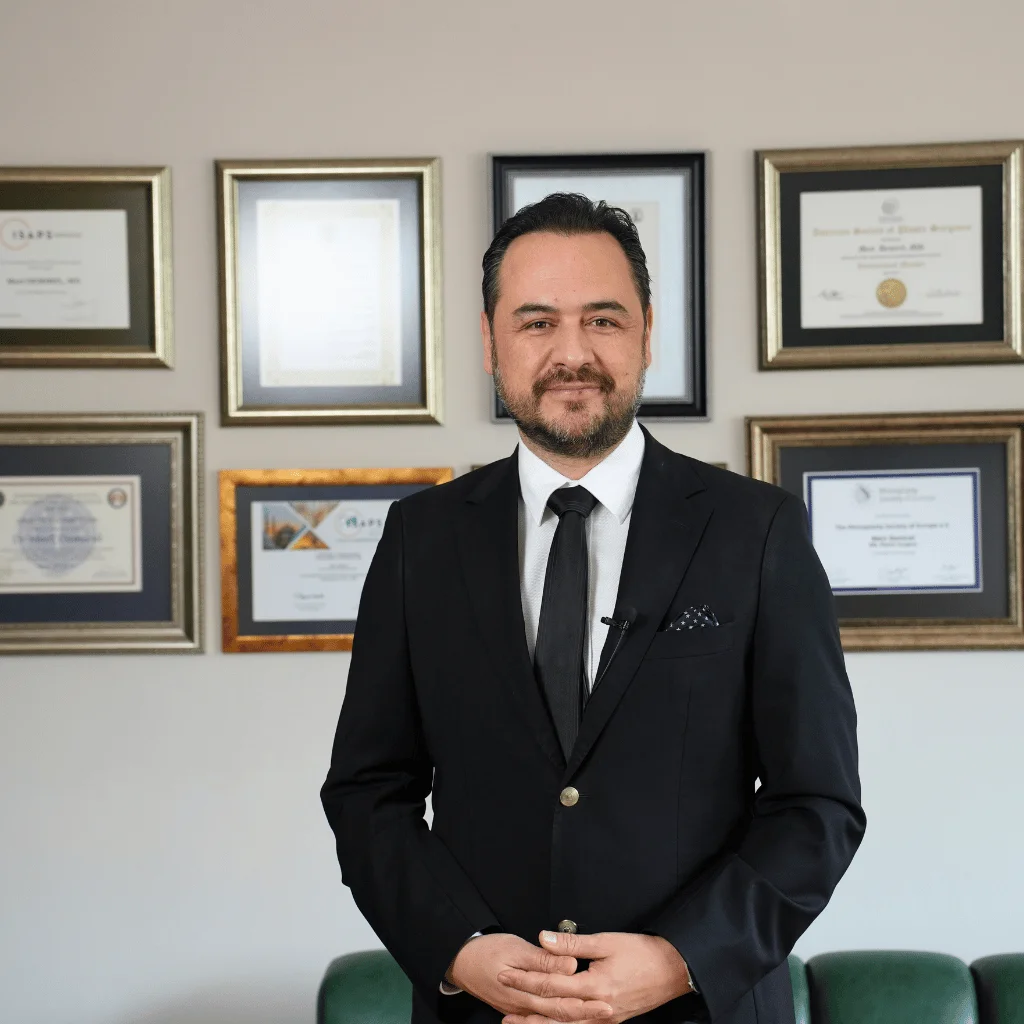
Knowledge
builds
trust.
Why do qualifications matter?
“Why should I trust you?”
The answer to this question isn’t about how dramatically you can present a procedure; it’s about how you define the problem, how you discuss risks, and how you think years ahead.
As Op. Dr. Mert Demirel, I have built my medical career of over twenty years on correct problem definition, honest candidacy evaluation, safe practice, and realistic expectation management.
Aesthetic surgery is not guided by trends,
but by clinical standards.
Educational journey
Every stage deepened the perspective on anatomy, tissue behavior, function, ethics, and complication management.
Ankara University Faculty of Medicine. A solid foundation on anatomy, clinical sciences, and medical ethics.
Ankara University Plastic, Reconstructive and Aesthetic Surgery specialization training.
Advanced microsurgery training at the University of Zurich; precision, vascular safety, and respect for tissue.
European Board Certification. Independent verification of knowledge, clinical judgment, ethics, and patient safety.
The legacy of microsurgery training
Microsurgery training brings four lasting values to aesthetic practice: precision, vascular understanding, technical patience, and respect for tissue.
Every millimeter matters. Every tissue plane has a purpose; approximate accuracy is not enough.
Blood flow is part of tissue survival, healing quality, and long-term stability.
Speed in the operating room is not a virtue in itself. Anatomy demands slowing down when necessary.
Gentle handling, minimal trauma, and anatomical preservation are prerequisites for predictable outcomes.
European Board Certification / 2015
The European Board of Plastic, Reconstructive and Aesthetic Surgery provides a common and rigorous European standard for knowledge, clinical competence, ethical behavior, and patient safety in plastic surgery.
Certification consists of written and oral exams that measure not only theoretical knowledge but also clinical thinking under pressure, surgical planning, anticipating risks, and evaluating alternatives.
Clinical focus
The freedom to adapt the technique to the patient requires clinical depth to work with different anatomies and expectations.
Breast augmentation, mastopexy, reduction, revision, and implant-related surgery. Candidacy evaluation, tissue quality, and long-term stability are priorities. The Chestnut Technique is a scientific extension of this pursuit.
Primary, revision, and functional rhinoplasty. The nose is a structural whole where aesthetics and respiratory function are evaluated together.
Facelift, structural facial balance, blepharoplasty, fat grafting, and complementary treatments. The goal is an identity-preserving, rested, and balanced appearance.
Abdominoplasty, diastasis repair, liposuction, and combined procedures within safety limits. Multiple tissue layers of the body are read together.
Botulinum toxin, dermal fillers, mesotherapy, and microneedling radiofrequency. Each is meaningful only when matched with the underlying mechanism and goal.
International experience
I gained observational experience in evidence-based practice, patient safety protocols, and outcome documentation in the USA; and in body contouring, breast surgery, and the idea of natural proportion in Brazil.
These experiences gave me the freedom to adapt the strong principles of different traditions to the individual’s anatomy, rather than applying a single technique to everyone.
Professional philosophy
Diplomas and certificates are just titles if they do not reflect on daily practice. The real equivalent is the five steps re-executed in every case.
What is the actual anatomical situation that triggers the person’s concern?
Why does the anatomy look or function this way?
Surgical, non-surgical, waiting, or doing nothing…
Is the expected benefit proportionate to the risks taken?
Honest outcome ranges that account for biological variability, not promises.
Summary of qualifications
| Qualification | Detail |
|---|---|
| Medical degree | Ankara University Faculty of Medicine |
| Specialization | Plastic, Reconstructive and Aesthetic Surgery — Ankara University (2010) |
| Advanced training | University of Zurich, Switzerland — advanced microsurgery |
| Board certification | EBOPRAS — European Board of Plastic, Reconstructive and Aesthetic Surgery (2015) |
| Memberships | ISAPS · ASPS |
| Clinical experience | 14+ years private clinical practice · 20+ years medical career |
| Focus areas | Breast surgery · rhinoplasty · facial rejuvenation · body contouring · non-invasive procedures |
Let’s start together
Use this information as a starting point. Come with your questions; in consultation, not only do I evaluate you, but you also evaluate me.
Private consultation
Your enquiry is saved first. Then WhatsApp opens so you can continue when convenient.
Dr. Mert Demirel
Anatomy first. Proportion over excess. Decisions built to remain coherent over time.
Private consultation
We'll save your enquiry first, then continue on WhatsApp.


