“Excess body fat” sounds like one tissue problem, but fat is distributed in compartments with different biological and surgical relevance. Some is subcutaneous and pinchable. Some lies deeper around the abdomen. Some is diffuse across the body, while some persists disproportionately in specific regions despite stable weight. The word “fat” is therefore only the beginning of the assessment.
Diffuse fat and local fat are different treatment categories
A patient whose concern is broad overall adiposity is different from a patient at a stable weight with a persistent lower-abdominal or flank deposit. The first problem is systemic in scale. The second may be local enough for contour surgery.
This distinction protects the patient from using multiple-area liposuction as a substitute for a whole-body change that surgery was never designed to create.
Subcutaneous fat is the layer liposuction can actually reach
Liposuction acts on selected subcutaneous fat. The amount that can be removed safely is constrained by the region, tissue quality, total operative plan and the need to leave a smooth layer beneath the skin.
The operation is sculptural rather than simply subtractive. Removing more is not automatically better. Once the contour has been improved, further reduction can increase irregularity, laxity or overcorrection faster than it improves shape.
Deep abdominal fullness can persist after superficial fat is reduced
An abdomen can project because of visceral fat, abdominal-wall shape, muscle separation, organ position and posture as well as subcutaneous fat. Liposuction changes only part of that system.
This is why I examine the abdomen from the side and assess what can be pinched, how the wall behaves and whether skin is also redundant. If deeper projection dominates, the patient should know that the external contour has a treatment ceiling.
Fat distribution can be disproportionate even when total weight is stable
Genetics, sex, age and hormonal patterns influence where fat preferentially accumulates. Some people remain relatively lean through the upper body while carrying more through the hips or thighs. Others retain flank or lower-abdominal deposits after weight loss.
This is the anatomy where body contouring can be most useful: not because the patient has “too much fat” in a general sense, but because one compartment remains visually out of proportion with the rest of the frame.
Skin determines whether removing fat will improve or expose the problem
Skin with good elasticity may redrape after moderate volume reduction. Thin, stretched or previously weight-expanded skin may not. In that situation, removing fat can reveal or exaggerate laxity.
I therefore do not assess fat without the envelope over it. The same amount of fat can be a good liposuction target in one patient and a poor isolated target in another.
After major weight loss, residual fullness can be a mixed problem
The patient may have local fat, loose skin and folds created by the interaction between them. Treating only the fat can make the skin redundancy more obvious. Treating only the skin can leave a heavy contour if meaningful fat remains.
When laxity is broad and circumferential, body lift may become part of a different discussion. The operation is justified by the envelope, not by the desire to remove more total body fat.
Multiple areas do not automatically belong in one operation
It is common for patients to identify abdomen, flanks, back, thighs and arms all at once. Each may contain a legitimate contour issue. That does not mean the safest or best plan is to treat every area in one session.
Operative burden, recovery, blood loss, fluid shifts and the total scale of tissue treatment all matter. The fact that fat exists in several regions is not, by itself, an indication for maximal combination surgery.
Weight change after contouring can alter the result
Remaining fat cells can change in size with future weight gain or loss. Surgery can permanently remove selected cells from treated areas, but it does not make the body immune to future weight change.
A stable baseline therefore makes contour planning more predictable. I want the operation to refine the body the patient expects to live in rather than a temporary point on the way to another weight.
The best contour often requires leaving some fat
A completely fat-free plane is not an aesthetic goal. Subcutaneous fat contributes to smooth transitions, softness and the way skin moves over muscle. Removing too much can create depressions, tethering or a skeletonised appearance.
I prefer controlled reduction that makes one region relate better to its neighbours. Body contouring should improve proportion without making the treatment itself obvious.
Regional fat can change how the whole body is perceived
A relatively small disproportion at the flanks, lower abdomen or lateral thighs can alter the way the waist or legs are read even when total body fat is not especially high. This is why body contouring can create a strong visual effect without removing a large amount of tissue.
The opposite is also true. Removing substantial fat from several regions does not guarantee a proportionate result if the dominant silhouette problem was never identified. Distribution matters more than raw volume.
Fat removal does not automatically create muscle definition
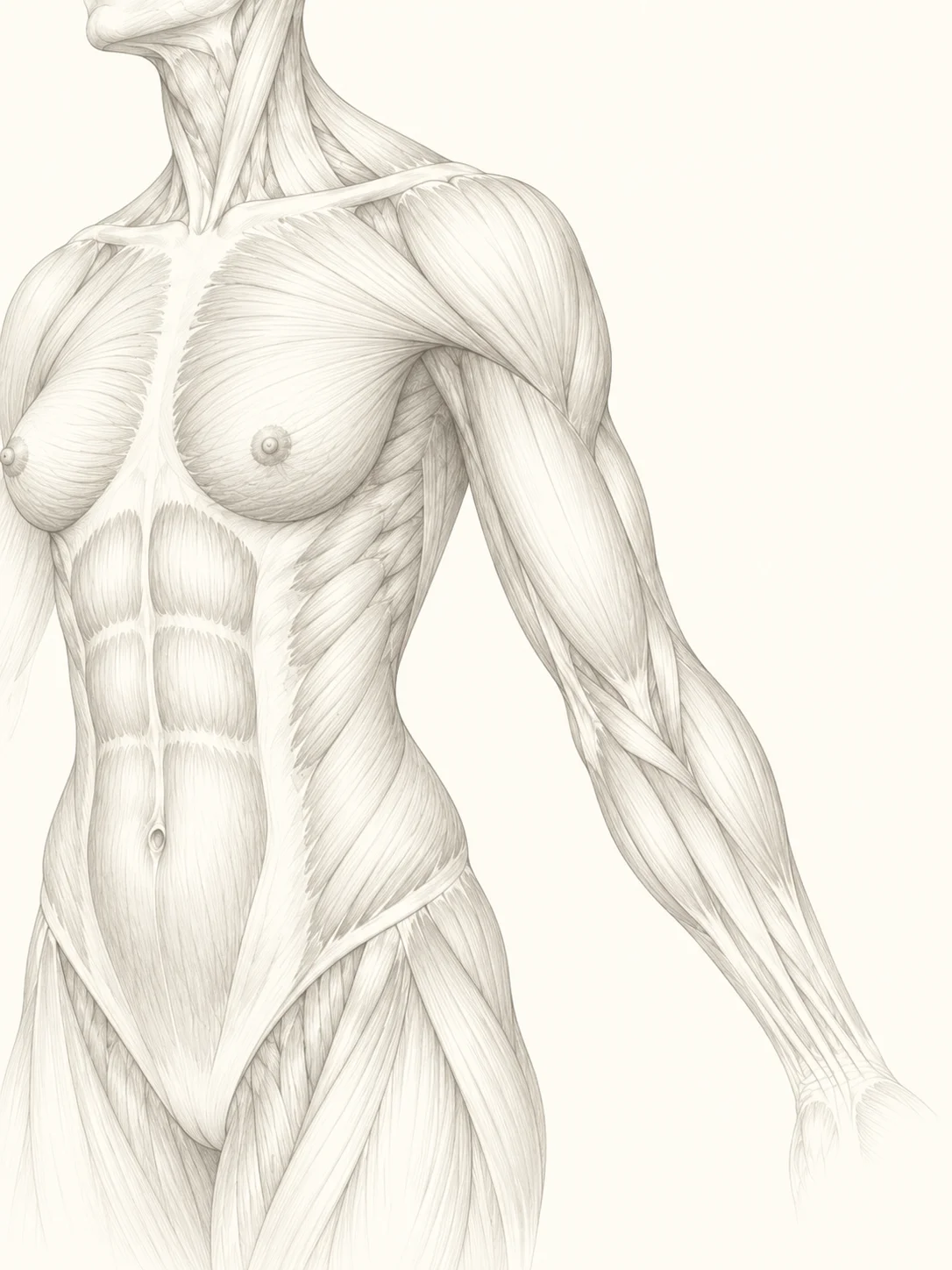
Muscle shape, skeletal frame and skin thickness determine how much definition can become visible after fat reduction. A patient with limited muscular development will not acquire an athletic contour simply because the overlying fat is reduced.
I want expectations to reflect the body underneath the fat. Surgery can reveal existing structure more clearly; it does not manufacture that structure.
What I assess before calling fat “excess”
I look at total distribution, pinchable subcutaneous thickness, deeper abdominal projection, skin elasticity, previous weight loss, scars, asymmetry, adjacent regions and future weight plans.
The outcome of that assessment may be local liposuction, skin-removal surgery, weight-management support, staged treatment or no operation. “Excess body fat” becomes a useful concern only after we determine which part of that fat lies within the reach of surgery.