

Before travel
Use remote assessment to clarify candidacy, questions and what information is needed before making travel decisions.
Location / International Care
A location guide for patients comparing surgeon, clinic, travel planning, consultation and follow-up as one connected decision.
A destination is part of the care plan
Use remote assessment to clarify candidacy, questions and what information is needed before making travel decisions.
Consultation, treatment setting and practical logistics should form one clear plan rather than separate tasks.
Follow-up should be discussed before travel, including how questions and clinical checks will be handled after you return home.
Patient journey
Start with your question and relevant background.
Clarify suitability, options and the information needed.
Coordinate timing around the medical plan, not the other way around.
Know the check-up and communication pathway before returning home.
Plastic surgery in Istanbul should be evaluated in the same way as plastic surgery anywhere else: by looking first at the surgeon, the indication, the treatment environment, the quality of consultation and the plan for recovery. The city may make international treatment possible, but it cannot replace those clinical foundations.
Search results often turn a medical decision into a comparison of destinations, packages and prices. That order should be reversed.
Begin with the surgeon who would be responsible for your care. Understand their specialist training, experience in the operation you are considering, clinical philosophy and approach to patient selection. The useful question is not simply whether a clinic performs a procedure, but how it decides when that procedure is appropriate and when it is not.
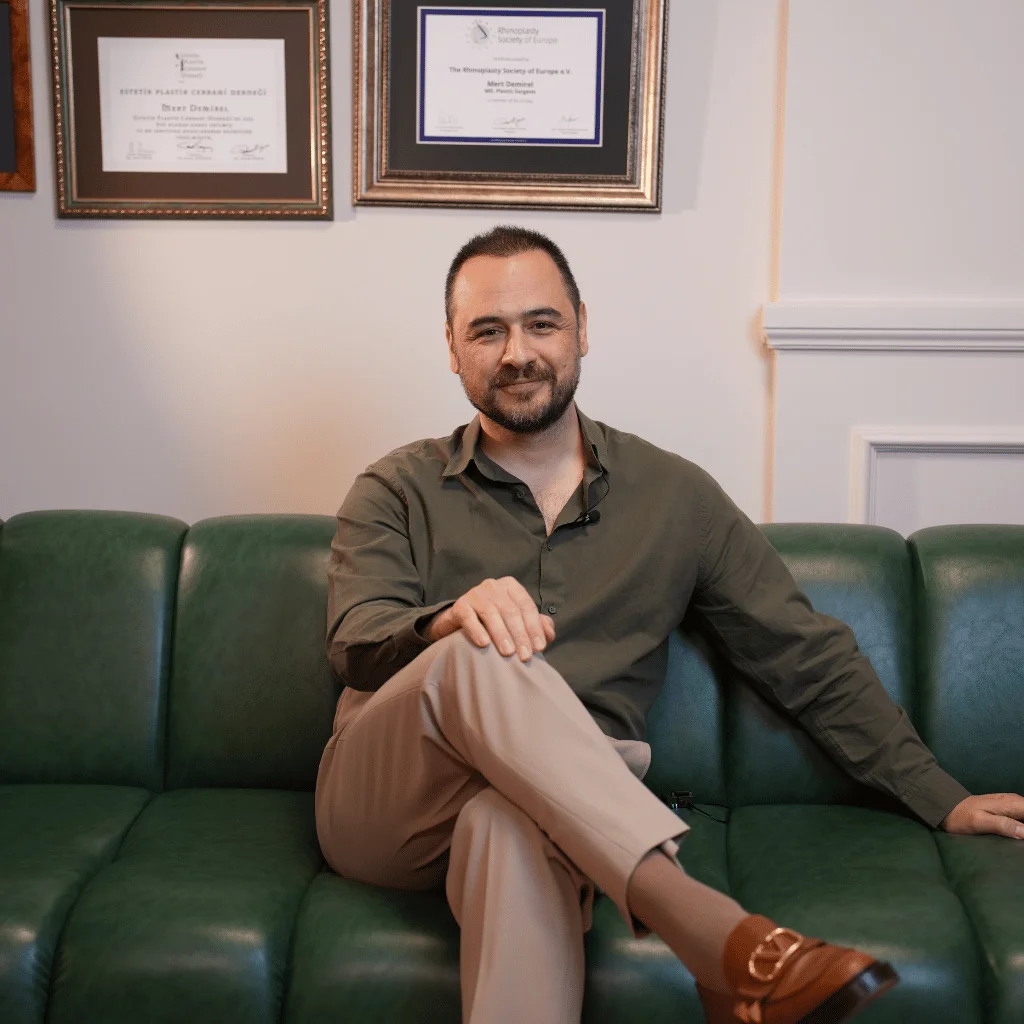
Dr. Mert Demirel’s practice is built around a decision-first approach: understand the anatomy and the problem, define what change would be coherent, and then decide whether surgery is justified.
A patient may arrive asking for a facelift, implant, rhinoplasty or liposuction because that is the language they encountered online. Consultation has to move one step backwards and ask what is actually creating the concern.
Breast shape can involve volume, skin envelope, nipple position, tissue quality and previous implants. Facial ageing can involve skin, connective tissues, fat distribution and structural support. Abdominal change may involve skin excess, fat distribution and abdominal-wall laxity. A nose has to be considered in relation to both facial balance and function.
The correct procedure follows that analysis; it should not precede it.
The site organises information into procedure families so that patients can compare options without treating every operation as an isolated product.
Breast surgery includes questions of volume, position, reduction, lift and revision. Facial surgery includes rhinoplasty, eyelid surgery and different approaches to facial rejuvenation. Body contouring addresses problems such as abdominal laxity, excess skin, localised fat and changes after pregnancy or weight variation.
Browse the Procedures section when you already know the procedure family. If you know what bothers you but not the operation name, begin with Concerns. If your starting point is anatomical, use Body Areas.
International patients do not need to wait until arrival in Istanbul to begin the clinical conversation. A remote first assessment can organise medical history, photographs where appropriate, previous surgery and expectations.
This can help determine whether travelling for further assessment is reasonable and what questions still need to be answered.
It cannot replace physical examination. The final surgical plan must remain open to modification when the surgeon examines tissue quality, scars, asymmetries and other findings directly.
Patient safety begins with deciding whether an operation should take place. A medically unsuitable patient, an unrealistic goal or the wrong operation cannot be corrected by a sophisticated operating theatre.
The assessment therefore needs to include health, anatomy, previous procedures, expectations, recovery capacity and the trade-offs of treatment.
Sometimes the responsible outcome of consultation is a smaller procedure, another approach, further investigation, postponement or no surgery.
If surgery is recommended, ask where the operation will take place, who will provide anaesthesia and what medical evaluation is required beforehand.
The procedure, patient health and expected postoperative needs determine the appropriate clinical environment. International treatment should not make this process less transparent.
The Patient Safety Guide provides a broader framework for evaluating these questions.
“Natural” is frequently used as a style claim. Clinically, it depends on a much more demanding set of decisions: proportion, tissue behaviour, structural support, restraint and respect for the patient’s existing identity.
A result can be subtle yet anatomically inappropriate, or visibly significant yet harmonious. The aim is not to apply the smallest possible change but to choose a change that remains coherent with the person and their anatomy.
A patient who has already undergone surgery brings another layer of information into the decision. Existing scars, altered anatomy, implants, previous tissue removal and the reason for dissatisfaction all have to be understood before a revision plan is made.
Revision should not be presented as a reset button. Some problems can be substantially improved, some can only be partially corrected, and sometimes further surgery would add more risk than benefit.
A useful quotation comes after enough clinical information exists to define the likely treatment. Price can vary with the operation, complexity, previous surgery, combined procedures, hospital pathway and other case-specific requirements.
For that reason, a generic low headline price should not be used as evidence that two treatment plans are clinically equivalent.
When comparing quotations, understand what medical pathway each one actually represents rather than comparing the final number alone.
The correct surgical date is not simply the first available date. Consider work, childcare, physical activity, travel and the amount of support you will have during the early recovery period.
Different operations have different restrictions and different timelines. Before confirming travel, understand what the first days are likely to involve and when the surgeon expects postoperative reviews.
See the Pre-operative Guide and Post-operative Care library for the procedure-specific document system.
The journey should be built around the medical plan. Accommodation needs to work for recovery. Transfers need to account for mobility. The return flight should leave enough time for the required postoperative reviews and the patient’s actual recovery.
There is no meaningful universal promise such as “all plastic surgery patients can fly home after the same number of days.” Procedure type and individual recovery matter.
The Travel to Istanbul Guide explains this part of the pathway in more detail.
International care does not end at the airport. Before leaving Istanbul, understand the remote follow-up schedule, which changes should be reported to the clinic and when local medical assessment would be necessary.
Routine questions can often be managed through the agreed follow-up pathway. Severe or rapidly worsening symptoms should not wait for online communication; urgent care should be sought where the patient is physically located.
The value of consultation is not that it moves a patient toward surgery as quickly as possible. It is that each stage should remove uncertainty: defining the problem, testing the indication, understanding alternatives and limitations, and building a safe practical plan around the medical decision.
If you are considering plastic surgery in Istanbul, begin with the question you are trying to answer. The procedure name can come after the anatomy and priorities are understood.
Dr. Mert Demirel
Anatomy first. Proportion over excess. Decisions built to remain coherent over time.
Private consultation
Leave your number to start a private conversation. The enquiry is saved first, then you can continue on WhatsApp.
Private consultation
Start with your number and your question. We can then continue on WhatsApp.
Private consultation
We'll save your enquiry first, then continue on WhatsApp.


