


Before travel
Use remote assessment to clarify candidacy, questions and what information is needed before making travel decisions.
Location / International Care
A location guide for patients comparing surgeon, clinic, travel planning, consultation and follow-up as one connected decision.
A destination is part of the care plan
Use remote assessment to clarify candidacy, questions and what information is needed before making travel decisions.
Consultation, treatment setting and practical logistics should form one clear plan rather than separate tasks.
Follow-up should be discussed before travel, including how questions and clinical checks will be handled after you return home.
Patient journey
Start with your question and relevant background.
Clarify suitability, options and the information needed.
Coordinate timing around the medical plan, not the other way around.
Know the check-up and communication pathway before returning home.
Istanbul can be part of a well-structured plastic surgery journey, but the city itself is not the treatment plan. The useful question is not simply whether to travel to Istanbul. It is whether the surgeon, clinical setting, timing, recovery plan and follow-up pathway make sense together for you.
International patients often begin by comparing countries and cities. That is understandable: travel time, accessibility, accommodation and cost all matter. But geography becomes clinically meaningful only when it is connected to the people and systems responsible for your care.
The first decision should therefore concern the medical pathway. Who will assess you? What can be understood before travel? What still requires physical examination? Where would treatment take place? How much local recovery is appropriate? How will follow-up continue after you return home?
Istanbul should be evaluated through those questions rather than as a medical tourism product in isolation.
A remote first assessment can help organise the conversation before travel. Your concern, relevant medical history, previous operations and photographs where appropriate can provide useful orientation. Possible approaches, major limitations and the information still required can then be discussed.
Remote assessment is a starting point, not a substitute for examination. Tissue quality, scars, asymmetry, three-dimensional anatomy and some functional findings may need to be assessed in person. The final plan should therefore remain capable of changing when new clinical information appears.
For that reason, flights and accommodation should not create pressure to preserve a preliminary surgical plan.
Dr. Mert Demirel’s clinic is located in Caddebostan, Kadıköy, along the Bağdat Caddesi area. Consultation, examination and clinic-based parts of the patient journey are organised from here.
For an international patient, location is more than an address. It affects airport transfers, accommodation, how easily you can attend postoperative reviews and how demanding everyday movement may be during recovery.
Choose accommodation with the early postoperative period in mind rather than treating it primarily as a sightseeing base.
An in-person consultation allows the preliminary discussion to be tested against actual anatomy. This is where measurements, tissue behaviour, previous scars and physical findings can be assessed more reliably.
The aim is not to confirm surgery simply because the patient has travelled. A responsible examination may confirm the original direction, modify it, recommend an alternative or show that treatment should be postponed or avoided.
Read the Consultation Guide before beginning the process if you would like to understand what information is useful during assessment.
Consultation and postoperative clinical reviews may take place at the practice, while operations that require an operating theatre follow the appropriate surgical and anaesthesia pathway.
Before surgery, you should understand where the operation is planned, who will be responsible for anaesthesia, what preoperative assessment is required and what postoperative monitoring is expected.
These questions matter regardless of whether surgery takes place close to home or in another country.
There is no single responsible stay duration for every plastic surgery patient. A limited procedure and a combined operation do not create the same recovery demands. Individual health, early healing, postoperative reviews and the journey home can also change the appropriate timing.
Instead of asking for the shortest possible stay, ask what should be clinically satisfactory before departure. Your return ticket should support that plan rather than define it.
The Travel to Istanbul Guide covers accommodation, local logistics, companions and the flight home in greater detail.
Istanbul is active, crowded and geographically large. Early recovery may involve restrictions on walking, lifting, prolonged sitting, exercise or positioning depending on the operation.
The first postoperative days should therefore be intentionally simple. Hospital or clinic reviews, rest, nutrition, movement within the limits of your plan and access to the clinical team are more important than building a tourism itinerary around surgery.
Once recovery progresses, normal activities can be reintroduced according to the instructions relevant to your procedure.
A return flight is not just a logistical event after surgery. The operation, the length of the journey, mobility, individual risk factors and the stage of recovery all matter.
Tell the clinical team about your actual route home, including connections and long-haul sectors where relevant. The appropriate timing should be discussed for your individual treatment rather than inferred from another patient’s itinerary.
Before returning home, understand which postoperative checks should occur locally and how communication will continue afterwards. Know what can be reviewed remotely, what photographs may be requested and which symptoms should lead you to seek medical assessment where you live.
Distance makes clarity more important, not less important.
You can use the Post-operative Care, Recovery and Warning Signs guides to understand how these parts of the pathway fit together.
Compare surgeons before packages. Compare clinical standards before hotel benefits. Compare the quality of consultation before the speed of booking. Compare the follow-up pathway before deciding how quickly you want to fly home.
A responsible international patient journey should remain recognisably medical from first contact to final follow-up.
Travelling for surgery can be organised safely and calmly when the order of decisions remains clear: assessment first, indication second, treatment planning next, and logistics around those medical decisions.
If you are still comparing your options, start with the question rather than a package or procedure name. The purpose of the first conversation is to determine what should be evaluated next.
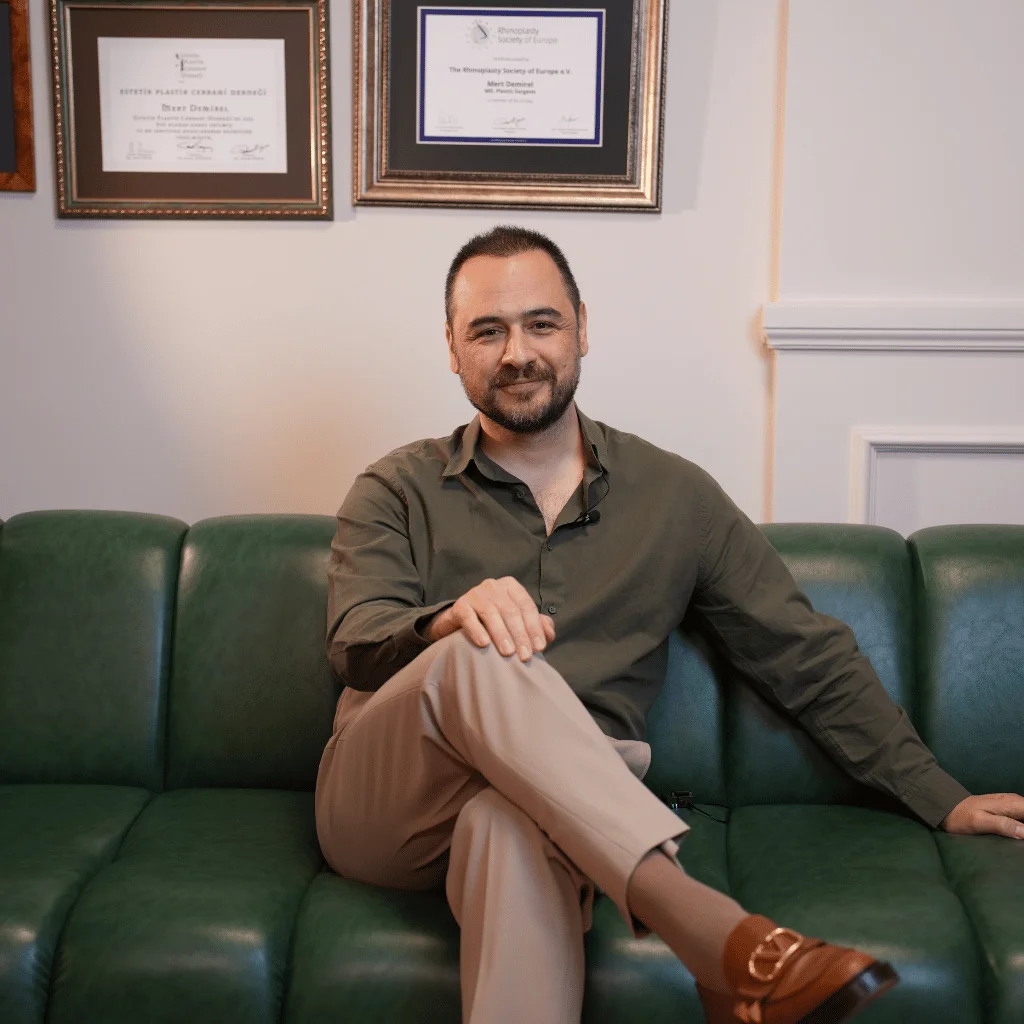
Dr. Mert Demirel
Anatomy first. Proportion over excess. Decisions built to remain coherent over time.
Private consultation
Leave your number to start a private conversation. The enquiry is saved first, then you can continue on WhatsApp.
Private consultation
Start with your number and your question. We can then continue on WhatsApp.
Private consultation
We'll save your enquiry first, then continue on WhatsApp.


