
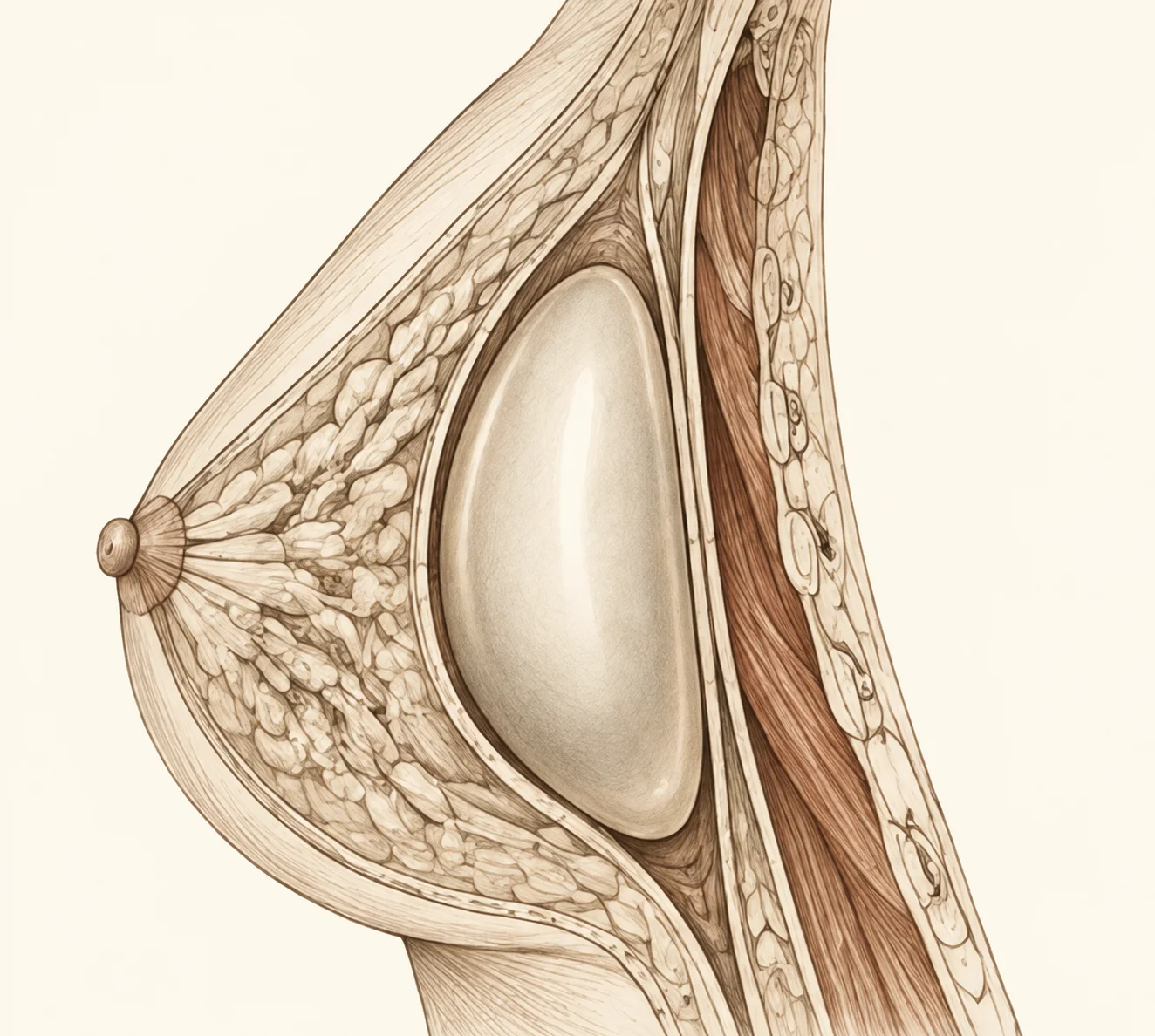
A wide gap between the breasts can be completely normal anatomy. The breasts sit on separate footprints over the rib cage, and the sternum creates a natural central boundary. Some patients have a wider sternum, laterally positioned breast footprints or less medial breast tissue. Others notice a wider gap after augmentation because the implants sit too laterally or because implant width does not match the breast base. The same visual space can therefore come from native anatomy or from implant mechanics.
Cleavage is not a fixed distance between two breasts
The appearance of cleavage changes with bra support, posture, arm position, breast volume and how the breast tissue compresses. A photograph taken in a push-up bra is not a reliable map of unsupported breast anatomy.
I therefore assess the breasts without external compression. The central question is how the native breast footprints relate to the sternum and whether the gap represents normal chest anatomy or a correctable displacement.
A wide sternum cannot be made narrow by breast surgery
The breast sits over the chest wall. If the sternum and medial breast origins are naturally broad, there is a limit to how close the breasts can safely sit without creating an artificial contour.
An implant can add medial volume only within the boundaries of the pocket and tissue envelope. It cannot move the sternum or safely erase every natural central distance.
Two patients with the same gap can need opposite advice
One patient has never had surgery and has naturally lateral breast footprints with little medial tissue. Another had augmentation and now has implants that have drifted laterally. Their front-view photographs may show a similar central gap.
The first patient may need expectation-setting more than pocket surgery. The second may have a genuine malposition that can be evaluated for revision. The visible gap is the same; the treatment category is different.
Bigger implants do not automatically create better cleavage
A wider implant can occupy more of the chest, but implant width has to match the breast base and tissue capacity. Choosing an implant mainly to fill the central gap can create excessive lateral width, tissue stretch or an implant edge that does not belong to the breast footprint.
Breast augmentation should therefore be planned around the entire breast and chest, not around one central photograph. Cleavage is an outcome of anatomy and implant selection, not a stand-alone implant-size target.
Medial pocket release has a safety limit
It is tempting to think that moving the pocket closer to the sternum will simply bring the breasts together. But the medial pocket boundary helps preserve a natural separation between the breasts.
Over-dissection medially can create an unnatural central contour or loss of normal implant separation. I would rather leave a small natural gap than solve one concern by creating a more difficult reconstructive problem.
Fat transfer can refine selected medial contour without moving the chest wall
In selected anatomy, fat transfer to breasts may add modest soft-tissue volume to selected regions. Its role is contour refinement rather than guaranteed creation of deep cleavage.
The sternum and breast footprint still define the central architecture. Fat can soften a transition; it cannot safely convert every naturally wide chest into a narrow-cleavage chest.
A wide gap after augmentation may indicate lateral malposition
If the breasts were initially more central and progressively moved outward, or if the implants shift excessively toward the axilla, the concern may be part of implant malposition rather than natural spacing.
In that situation, breast implant revision may involve pocket repair, implant reassessment and correction of associated breast-envelope issues. The goal is to restore the intended footprint, not simply force the implants as close together as possible.
Breast asymmetry can make the gap look wider on one side
One breast may originate farther from the sternum, have a different base width or sit on a different rib-cage contour. The central gap then looks asymmetric even when each breast is individually proportionate.
Breast asymmetry correction can address selected differences, but the patient should understand which part belongs to soft tissue and which part belongs to the chest wall. The underlying skeleton remains part of the final result.
Cleavage in clothing is partly a garment effect
Bras can move the breast tissue medially and create a cleavage pattern that does not exist naturally without support. Some implant patients expect that same compressed look when standing unsupported.
I think expectations improve when these two states are separated. Surgery can improve breast proportion and medial fullness within anatomical limits. It does not permanently reproduce the mechanical effect of a push-up garment.
The endpoint should preserve a believable central chest
I want the breasts to relate naturally to the sternum, with enough medial fullness to suit the frame but without erasing the normal central boundary. A completely closed gap is not an automatic sign of successful augmentation.
In some bodies, a visible space between the breasts is the anatomically correct result. The objective is proportion, not conformity to one cleavage photograph.
Nipple direction can make the central gap look larger than it is
Breasts with laterally directed nipples can appear farther apart even when the medial breast footprint is not unusually wide. Conversely, a centrally directed nipple can create the impression of closer cleavage without changing the actual distance between the breast bases.
This is another reason I avoid planning from the gap alone. Breast base, nipple orientation and chest wall have to be read together. Moving volume medially without respecting the native direction of the breast can create a full central chest while the breast itself still looks as though it is pointing away from the midline.
What I assess before calling the gap “too wide”
I look at sternum width, breast footprint, medial tissue thickness, implant position if present, chest-wall asymmetry, breast base width, nipple orientation, bra-supported versus unsupported appearance and any previous implant surgery.
That usually tells us whether the gap is mainly native anatomy, limited breast volume, asymmetry or implant malposition. The plan can then stay within the structure that is actually responsible rather than trying to make the chest wall behave like another person’s.