Fat transfer to the breasts is usually framed as natural augmentation, and sometimes as implants without implants. The phrase is appealing and it sets the wrong expectation.
Fat transfer is a biologic graft. Some of the transferred fat will not survive, and retention varies between individuals. The procedure is best understood as a contour refinement and modest augmentation tool — not a guaranteed cup-size change. Understanding that distinction is what separates patients who are satisfied from patients who were promised something the biology does not deliver.
What the operation actually does
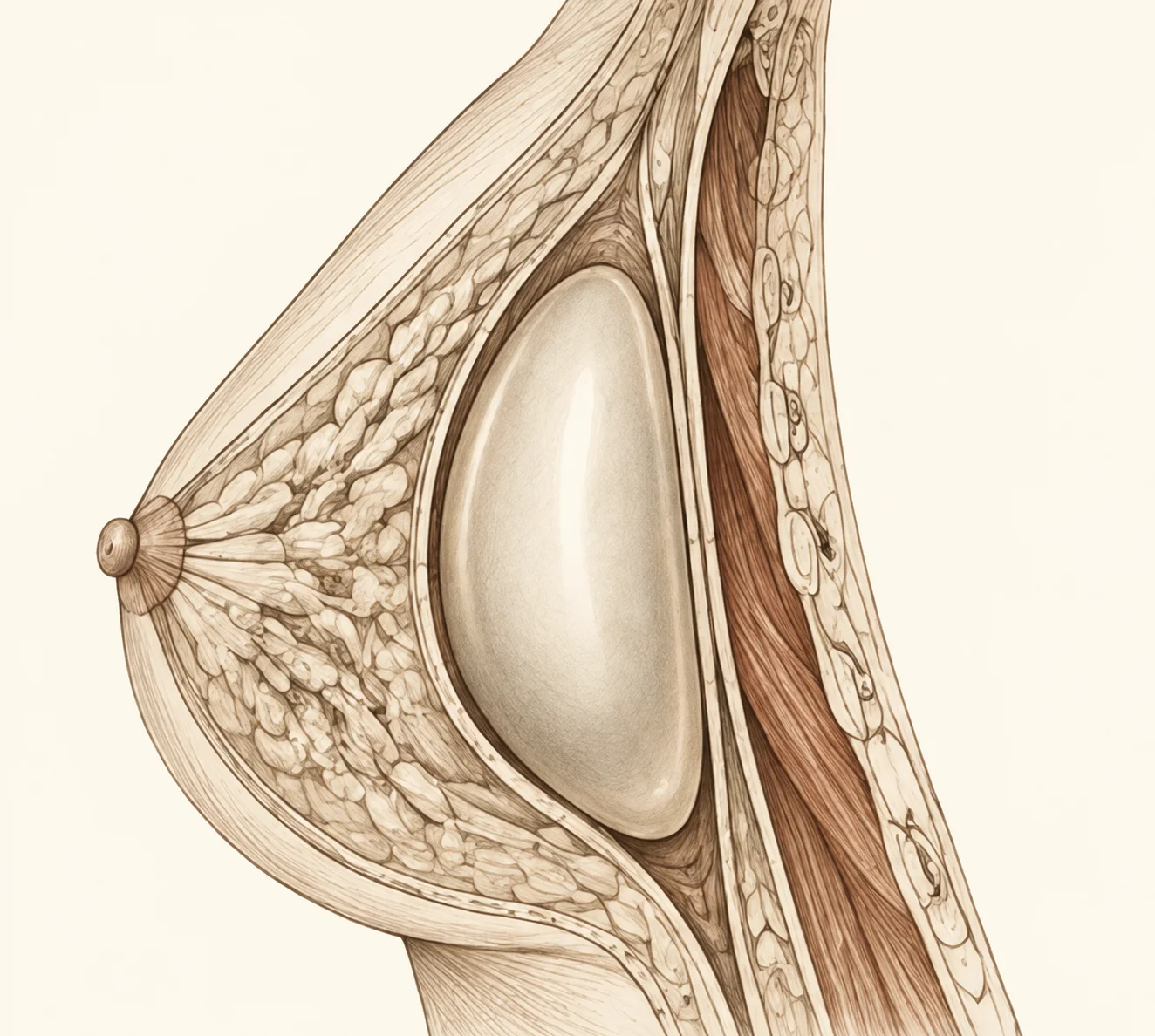
Fat transfer to the breasts is a procedure in which fat is harvested from donor areas via liposuction, processed, and then injected into the breasts to improve volume and shape.
The donor step is not preparation for the real operation. It is part of the design, because the final aesthetic result is influenced by the contouring of the surrounding areas as much as by what is added to the breast. A patient who is pleased with the breast and unhappy with the flank has not had a successful operation.
This is a two-part operation, and the donor area is half of it.
Almost all of the discussion around fat transfer concentrates on the breast, which is understandable and clinically incomplete. The operation is really a two-part problem: donor-area contouring through liposuction, and conservative grafting that respects tissue capacity. Those two halves can conflict, and in very lean patients they conflict directly — taking enough fat to matter risks leaving the donor area irregular, while taking only what the donor area can spare may not be enough for a meaningful transfer. That conflict is why candidacy is assessed from both ends rather than only from the breast, and why the answer for some patients is that this particular operation does not fit them, regardless of how much they prefer the idea of using their own tissue.
Candidacy is decided by donor reserves and by the envelope
The anatomical complexity begins with candidacy, and it has two independent components. Not every patient has enough donor fat for meaningful augmentation. In very lean patients, aggressive harvesting can create donor irregularity without providing enough fat for a satisfying transfer — the worst of both halves.
Skin quality matters just as much. A tight envelope tolerates only a certain volume, regardless of how much fat is available. A lax envelope may need lifting rather than volume, in which case adding graft addresses the wrong mechanism. Both questions have to be answered before a volume goal can be discussed at all.
Fat transfer and implants answer different questions
| Feature | Fat transfer | Implants |
|---|---|---|
| Scale of change | Usually modest, and variable between patients | Suited to larger size changes when those are the goal |
| Predictability of volume | Variable — retention differs between individuals and cannot be specified in advance | The added volume is a known quantity from the outset |
| Upper pole projection | Does not reliably create implant-like upper pole projection in all anatomies | The usual route to that specific appearance |
| What else the operation involves | Donor-area liposuction, which contributes to the overall aesthetic result | No donor site, so the change is confined to the breast |
| Where the choice actually comes from | These are not ranked options. Where the goal is proportionate refinement using your own tissue and adequate donor fat exists, fat transfer fits. Where the goal requires a large size increase or defined upper pole projection, staging or implants are the honest answer — and saying so is more useful than attempting the change with a graft | |
The envelope decides how much can be accepted
Tissue capacity is a physical limit rather than a preference, and it sets the ceiling on the operation independently of donor availability. A tight envelope will tolerate only a certain volume; pushing past that does not produce a larger breast so much as a compromised graft. This is also why cleavage has natural limits — it is determined by chest width and natural spacing, so grafting can soften transitions in selected anatomy but cannot move the breasts closer together. Conservative distribution across appropriate planes is the plan that respects both constraints at once.
Why overfilling is a safety question, not only an aesthetic one
Tissue capacity and safety guide graft volume together. Overfilling beyond what the breast tissues can accept increases the risk of oil cysts, fat necrosis and irregularity.
That is a different category of consequence from an aesthetic disappointment. It means the upper limit of the operation is not set by ambition or by what the patient would prefer — it is set by what the tissues can safely take. The safest plan is conservative distribution across appropriate planes, and where larger goals are desired, staged treatment is the route rather than a larger single session.
Retention is variable, so the plan is described differently
Individual tissue behaviour influences how much graft survives and how swelling resolves, which is why I avoid fixed-volume promises and often discuss staged treatment when larger goals are desired. In practice this changes what a consultation produces. Instead of a number, you should leave with an understanding of your donor reserves, your envelope’s capacity, and the range of change that is realistic for your anatomy. If retention turns out to be limited, a second session can be considered once results stabilise — provided donor fat remains, which is itself a reason not to exhaust the donor areas in the first operation. If irregularities occur, correction must be conservative.
What it does not do
It is not a weight-loss procedure. It is not a guaranteed, fixed-size outcome. It does not reliably create implant-like upper pole projection in all anatomies, and it does not guarantee symmetry.
It is also not the right answer when donor fat is insufficient, when the goal requires a large size increase, or when a lift is needed for significant ptosis. In that last situation the issue is the position of the envelope rather than the volume within it, and volume does not correct position.
Here the ceiling is set by safety, not by taste
In most contouring operations, restraint is an aesthetic judgement — I hold back because the more conservative result usually looks better and ages better. In breast fat transfer the argument is firmer than that. Exceeding what the tissues can accept raises the risk of oil cysts and fat necrosis, so the limit is a clinical one and it is not negotiable against a patient’s preference for more. This is why I would rather stage a larger goal across sessions than deliver it in one, and why I am direct when the honest answer is that implants suit the goal better. The most responsible expectation is proportionate enhancement: improved shape, softer transitions and better proportion, without the risks of overfilling.
Recovery is a sequence, not a single date.
- Dual-site early phaseSwelling occurs in donor and recipient areas
Two regions are healing at once, and patients frequently underestimate the donor sites because their attention is on the breast. Swelling and bruising vary between individuals.
- Misleading-size phaseEarly size is not final size
The breast looks larger than it will remain. This is the phase in which patients feel most confident about the result and have the least reliable information about it.
- Settling over monthsThe contour becomes clearer as tissues settle
Shape reads correctly only once the tissues have settled over months. I avoid fixed timelines because healing depends on individual tissue behaviour, which also governs how much graft is retained.
What should be weighed in the decision?
This operation trades predictability and scale for the use of your own tissue and a second area of contour improvement. The balance depends on donor reserves, envelope capacity and how modest the goal is.
- Trade-off: some of the transferred fat will not survive, and retention varies between individuals.
- Trade-off: the increase is usually modest, so large size goals require staging or a different approach.
- Trade-off: fixed-volume promises cannot be made, so the plan is expressed as a realistic range rather than a size.
- Trade-off: the operation includes donor-area liposuction, so swelling and healing occur at two sites.
- Trade-off: the donor areas should not be exhausted in the first session, because a second session depends on remaining donor fat.
- Trade-off: early size is misleading, and the contour only reads correctly once tissues have settled over months.
- Limitation: risks include fat necrosis, oil cysts, calcifications, contour irregularity, asymmetry, and variable retention.
- Limitation: overfilling beyond what the tissues can accept increases the risk of oil cysts, fat necrosis and irregularity — so the upper limit is a safety limit.
- Limitation: it is not a guaranteed, fixed-size outcome and not a guaranteed cup size.
- Limitation: it does not reliably create implant-like upper pole projection in all anatomies.
- Limitation: it does not guarantee symmetry.
- Limitation: it is not a weight-loss procedure.
- Limitation: cleavage is limited by chest width and natural spacing, so transitions can be softened but spacing cannot be changed.
- Limitation: a tight envelope tolerates only a certain volume, independently of donor availability.
- Limitation: in very lean patients, aggressive harvesting can create donor irregularity without yielding enough fat for a satisfying transfer.
- Limitation: where irregularities occur, correction must be conservative.
- Limitation: results can be durable with weight stability, but the breasts still change with ageing, pregnancy and weight change.
- Alternative: where the goal requires a large size increase or defined upper pole projection, implants are the more coherent answer.
- Alternative: where significant ptosis is present, a lift addresses envelope position, which volume does not.
- Alternative: where both volume and envelope position need correcting, combining with a breast lift can be appropriate in selected cases.
- Alternative: where donor fat is insufficient, this is not the right operation regardless of preference for using your own tissue.
How to think about the decision
The decision is well founded when donor reserves have been assessed as a real constraint rather than assumed; when the envelope has been examined and the question of whether a lift is needed has been settled; when the goal has been framed as proportionate enhancement rather than a size; when variable retention has been accepted as a property of biology; and when the safety ceiling on graft volume has been explained rather than treated as conservatism.
When properly indicated, fat transfer can provide a natural-looking breast enhancement with soft transitions and improved proportion. The best outcomes come from careful donor selection, conservative grafting and realistic expectation setting. An in-person assessment is the safest way to define donor availability, skin quality and realistic volume goals based on your own tissue behaviour.
Am I a good candidate for fat transfer to the breasts?
Good candidates typically want a modest volume increase, have adequate donor fat, and have tissue quality that can accept grafting safely. I assess donor reserves, breast envelope, skin elasticity, and baseline asymmetry. A good candidate accepts that individual tissue behaviour influences retention.
How much bigger can I get with fat transfer?
The increase is usually modest and varies. Large size changes may require staging or implants. The most responsible expectation is proportionate enhancement, not a guaranteed cup size.
Why is the donor area described as part of the design?
Because the final aesthetic result is influenced by the contouring of the surrounding areas as well as by the breast. Donor-area liposuction is half of the operation rather than a preliminary step.
Will the fat survive permanently?
Some of the transferred fat can be long-lasting if it survives, but retention is variable. I avoid fixed promises.
What are the main risks?
Risks include fat necrosis, oil cysts, calcifications, contour irregularity, asymmetry, and variable retention. Conservative grafting reduces risk.
Why not simply transfer more fat in one session?
Because overfilling beyond what the breast tissues can accept increases the risk of oil cysts, fat necrosis and irregularity. The upper limit is set by tissue capacity and safety, not by the volume available.
When is fat transfer not the right answer?
It is not always the right answer when donor fat is insufficient, when goals require a large size increase, or when a lift is needed for significant ptosis.
How variable is recovery?
Swelling and bruising vary. Early size is not final size. I avoid fixed timelines because healing depends on individual tissue behaviour.
Can fat transfer improve cleavage?
In selected anatomy, it can soften transitions, but cleavage is limited by chest width and natural spacing.
Can this be combined with a breast lift?
Yes, in selected cases. Combination can be appropriate when both volume and envelope position need correction.
What if I have implants and want a more natural result?
Fat transfer can sometimes refine implant edges or transitions, but planning is individualised.
How long-lasting are results?
Results can be durable with weight stability, but the breasts still change with ageing, pregnancy, and weight change.