
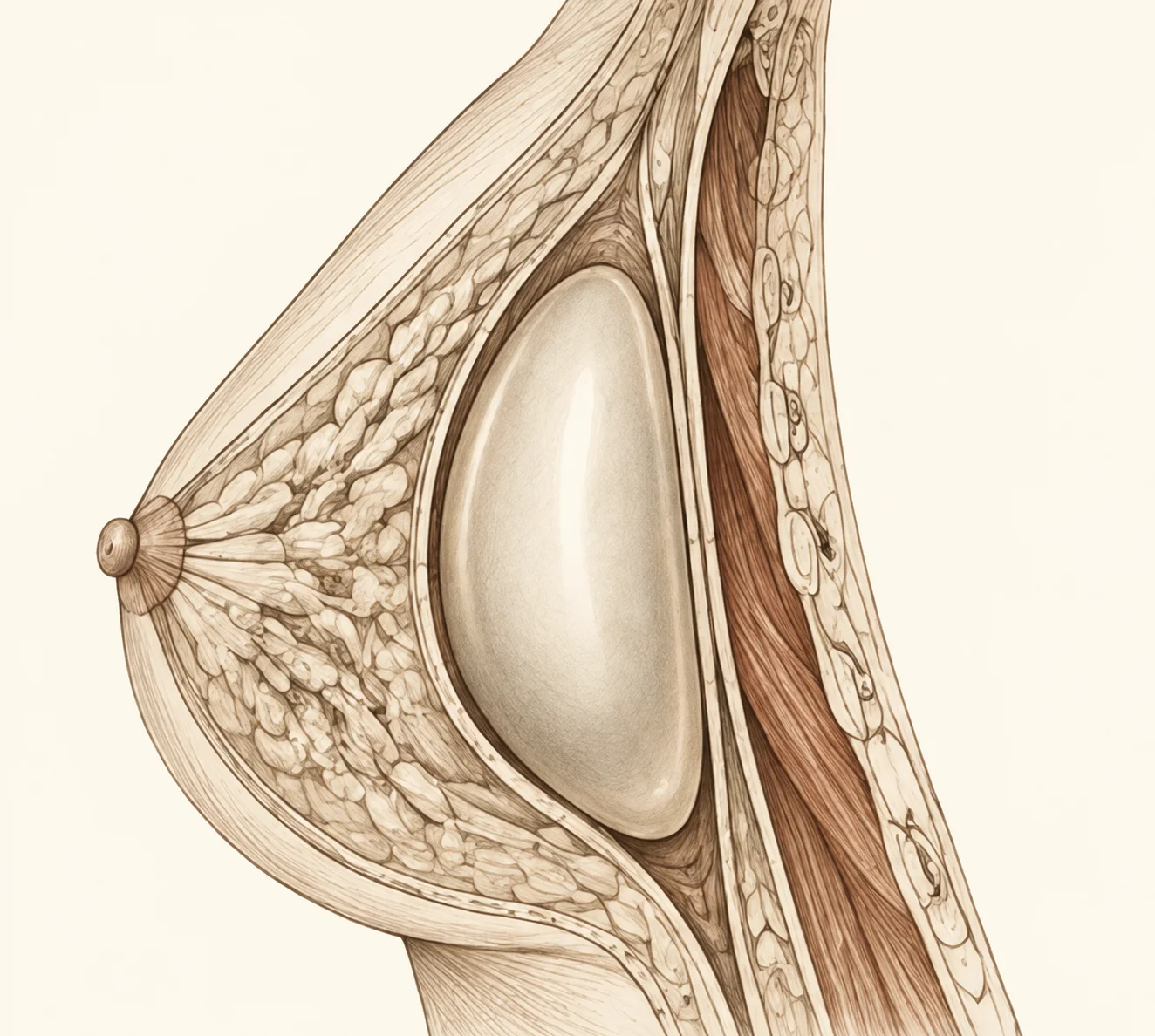
Some patients expect their breasts to become smaller after breastfeeding and are surprised when substantial volume and weight remain. Others begin pregnancy with large breasts and finish with an even heavier, lower breast because the skin envelope has stretched around persistent tissue. “Large after breastfeeding” therefore has two questions inside it: how much volume remains, and how much of the burden now comes from position and envelope?
Persistent volume and post-pregnancy ptosis often travel together
A heavy breast places more load on skin and ligaments. Pregnancy can enlarge the breast further, and the envelope may not fully retract afterward. The result can be a breast that is still large but also longer, lower and more difficult to support.
That is different from a deflated post-pregnancy breast. Here the main problem is not lack of volume. Adding more volume would usually move in the wrong direction.
Reduction after breastfeeding is more than a size operation
Breast reduction can reduce weight and volume when those are meaningful concerns. But the operation also has to reshape the remaining breast and usually reposition the nipple–areola complex when descent is present.
I think of this as three linked tasks: reduce load, rebuild shape and restore a proportionate position. Removing tissue without redesigning the envelope can leave the breast smaller but structurally unresolved.
Symptoms matter, but they should still be interpreted carefully
Neck and shoulder strain, bra-strap grooving, difficulty exercising, skin irritation and clothing limitations can all be relevant in a patient with heavy breasts. These symptoms are not automatically caused only by breast weight.
When the breast is a meaningful contributor, reduction has a functional objective as well as an aesthetic one. The endpoint is then improved daily burden and proportion, not simply the smallest achievable cup size.
Two large post-breastfeeding breasts can need different reductions
One patient may have dense residual breast tissue and relatively strong skin. Another may have more skin redundancy, marked ptosis and a lower nipple position. Equal tissue removal would not create equivalent results.
The scar pattern, nipple movement and amount of reduction need to follow the envelope. The patient’s request for “two sizes smaller” is useful as a goal, but it cannot replace anatomical planning.
A lift may be part of reduction, not an optional add-on
When a large breast is also low, reduction alone is not simply removing tissue from inside an unchanged skin bag. The envelope itself has to be reduced and reshaped.
This is why reduction and lifting are often integrated. The breast becomes lighter and the remaining tissue is placed into a new relationship with the nipple and fold.
Waiting for perfect post-breastfeeding stability can be practical rather than ceremonial
The breast continues to change after lactation ends. Glandular tissue can involute, weight can shift and the skin can partially retract. Operating while those changes are still evolving makes the target less stable.
I prefer the breast to have reached a reasonably settled baseline before final planning. The exact interval is individual; the principle is that surgery should treat the mature post-pregnancy anatomy rather than a temporary transition.
Future pregnancies can alter the result again
Another pregnancy can enlarge remaining tissue and stretch the envelope. This does not automatically make surgery inappropriate before all future pregnancies are complete.
It does mean the patient should understand that a later pregnancy may create new ptosis, volume change or asymmetry and may change whether revision is eventually desired.
Breastfeeding priorities influence technique and timing
Reduction surgery can affect the ability to breastfeed and can alter nipple sensation. The degree depends on anatomy, surgical design and how much tissue needs to be moved or removed.
If future breastfeeding is a high priority, I want that information before the operation is designed. A technically possible maximal reduction may not be the right operation for a patient whose functional priorities point toward a more conservative plan or different timing.
Weight loss and breast reduction solve different parts of the problem
If overall body weight is still decreasing significantly, some breast volume may also change. But large glandular breasts can remain disproportionate even at a stable healthy weight, and skin excess can persist after weight loss.
I do not use weight loss as a universal substitute for breast reduction. I use weight stability to understand what tissue is likely to remain and what part of the breast burden surgery can actually change.
Breast health remains separate from the cosmetic history
A new unilateral enlargement, lump, skin change, persistent focal pain or spontaneous nipple discharge should not be assumed to be a harmless consequence of breastfeeding. Appropriate breast assessment comes first.
A post-breastfeeding history explains the context; it does not eliminate the need to investigate a new breast finding.
“I want my old size back” is useful history, not a surgical measurement
Patients often know that the breast felt manageable before pregnancy and became persistently heavier afterward. That comparison is clinically valuable because it clarifies the direction of change and what daily burden the patient wants reduced.
It still does not tell me exactly how much tissue should be removed. The current breast has its own base width, nipple position, skin quality and chest relationship. The target should recover proportion and comfort rather than chase a remembered cup label that may no longer correspond to the present anatomy.
What I consider a successful post-breastfeeding reduction
I want the breast to feel lighter, sit in a more coherent position, fit the torso better and reduce the practical burden that led the patient to surgery. I do not want a breast reduced so aggressively that proportion, tissue viability or future options are sacrificed simply to maximise the immediate size change.
The best result is not “as small as possible after pregnancy”. It is a breast whose remaining volume and envelope are finally matched to one another again.