

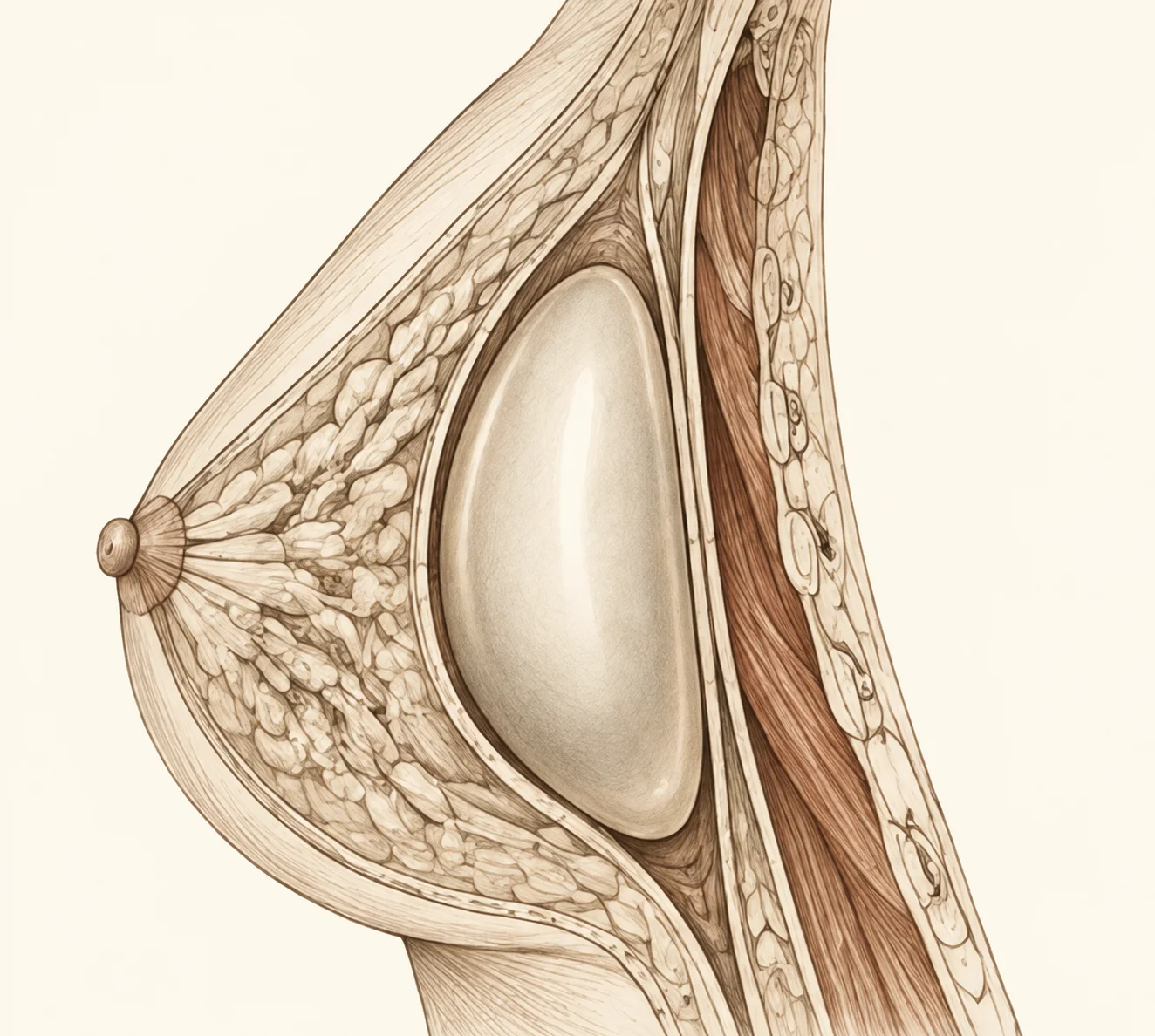
Breast reduction is usually described as making the breasts smaller. That description names one of three things the operation does and hides the two that decide the result.
A reduction is simultaneously a weight reduction, a shape redesign, and a nipple–areola repositioning procedure. Both the appearance and the symptom relief depend on how well those three components are integrated — not on how aggressively volume is removed. The aim is controlled refinement: improved comfort and proportion, without forcing a high, tight breast that will not age naturally.
Three operations inside one plan
Reduction mammoplasty reduces breast volume and reshapes the breast mound. It typically includes removal of glandular tissue and skin, repositioning of the nipple–areola complex to a more balanced position, and redefinition of the breast footprint on the chest wall.
Patients arrive for two broad reasons. Some have physical symptoms — neck and back strain, shoulder grooving, limitation in daily activity that persists despite stable weight and exercise. Others are concerned with proportion and clothing fit. Both are valid indications when the anatomy supports a responsible plan, and in practice most patients hold some of each.
The nipple–areola complex is the constraint, not the finishing touch
The nipple–areola complex has a blood supply and a sensory innervation that must be respected, and surgical design choices directly influence whether they are. This is the reason reduction planning has to be conservative and anatomy-based rather than driven by a target size. Technical options exist and they differ, but the objective does not change: safe repositioning with predictable healing.
Proportion, not a number
The anatomical complexity begins with proportion. The right size is not a universal number — it depends on chest width, shoulder frame, breast base width, tissue quality and the patient’s own priorities. A volume that suits one frame will look flat on another and inadequate on a third.
This is why the operation has two failure directions rather than one, and why the plan aims deliberately at the middle.
Two ways to get the dose wrong
| Approach | Over-reduction | Measured reduction | Under-reduction |
|---|---|---|---|
| What drives it | A fixed size target, or treating volume removal as the measure of success | Proportion and symptoms assessed against the frame | Caution about scars, or a plan built around avoiding a larger footprint |
| What the breast looks like | Flat, tight, or disconnected from the frame | A stable, proportionate breast mound that suits the chest and shoulder frame | Improved but still carrying more weight than the frame handles comfortably |
| What happens over time | Ages poorly; excess tension raises scar widening and wound-healing risk | Settles from a higher, tighter early shape into a natural contour | Shape may be acceptable while the mechanical burden persists |
| Cost to the patient | An unnatural shape that cannot be reversed by removing less next time | Accepting a scar footprint proportionate to the correction | Symptoms unresolved, and a second operation with narrower margins |
The result depends on integration, not on how much is removed
It is tempting to treat reduction as a quantity problem, because quantity is the one variable that can be discussed before an examination. But a breast that has had a large volume removed without matching envelope design and nipple repositioning is not a smaller version of the same breast — it is a differently shaped breast that happens to weigh less. Symptom relief and appearance both come from the three components working as one plan. Volume removed is an input to that plan, never a measure of it.
Skin quality sets what the envelope will do afterwards
If the envelope is thin or highly stretched, it may relax further after surgery. Individual tissue behaviour influences both scar maturation and long-term settling, and it is not fully predictable from the outside.
Planning should anticipate that rather than fight it. Over-tension increases scar widening and wound-healing risk, and it buys an early appearance at the cost of the long-term one.
A high, tight early result is not evidence of a good operation
Early after surgery the breast usually sits higher and feels tighter than it will eventually look, and that appearance is often mistaken for the achievement. It then settles — and the settling gets read as a failure. It is neither. Tissues remodel, and a plan that avoided over-tension will settle into a natural contour rather than a stretched one. The version of this operation that looks most impressive in the first weeks is frequently the version that was tensioned beyond what the tissue could hold.
Sensation and breastfeeding deserve an explicit conversation
Nipple sensation can change. Most patients have minimal or temporary changes, but the variability is real and sensation outcomes cannot be guaranteed. Surgical design prioritises blood supply and safe repositioning, and those priorities come before fine aesthetic preferences.
Breastfeeding potential can also be affected, depending on technique and how tissue is rearranged. If future breastfeeding is a high priority for you, it should be discussed explicitly and early, because it is a factor in planning rather than a footnote to it. No surgeon should guarantee preserved breastfeeding capability after a reduction.
I plan reduction against proportion and symptoms, not against a bra size promise
A cup size is the most natural thing for a patient to ask for and the least useful thing for me to promise, because bra sizing is not standardised and a number carries no anatomical information about your chest width, base width or tissue quality. What I can commit to is a target defined by your frame and your symptoms, and an honest account of the scar footprint that target requires. A plan built around a letter tends to produce either an over-reduced breast or an unfulfilled promise, and both are avoidable.
What breast reduction is not
It is not a guarantee of perfect symmetry. Baseline asymmetry is normal and healing is variable. It is not a promise of a fixed cup size, because bra sizing is not standardised. And it is not a permanent shield against future breast change — pregnancy, breastfeeding, weight fluctuation and ageing can all change breast tissue over time.
When the timing matters more than the decision
There are circumstances where reduction is not the right answer yet rather than not the right answer at all. If pregnancy is planned soon and the primary concern is size, delaying may be reasonable because the breast is likely to change again. If medical factors increase healing risk, the plan must be more conservative. And if the expectation requires a scarless result, the plan should slow down, because meaningful reduction requires scars.
Recovery, and what to expect while it settles
Recovery variability should be expected rather than treated as a complication. Swelling can be asymmetric, nipple sensation can change temporarily, and scars mature over months. Early shape is not final shape, and realistic expectations about the settling process reliably improve satisfaction and reduce unnecessary worry.
Recovery is a sequence, not a single date.
-
Early phase
Swelling, tightness and asymmetry are common
The breast sits higher and feels tighter than the eventual result. Swelling is frequently uneven between the two sides, which is expected rather than a sign that something has gone wrong.
-
Settling phase
Shape softens and the envelope adapts
Tissues remodel and the early structured appearance gives way to a more natural contour. Individual tissue behaviour determines how much and how quickly.
-
Scar and sensation maturation
Both continue to change after the shape has settled
Scars mature over months and sensation can fluctuate during the same period. I avoid fixed timeline guarantees, because healing depends on individual tissue behaviour and postoperative care.
Revision, and why the first operation matters most
If residual asymmetry or shape issues persist after healing, secondary refinement can be considered. But each revision increases scar burden and reduces predictability, and secondary surgery is more complex because scar planes and blood supply can be altered.
This is the argument for designing the first operation around stable shape, conservative tension and proportionate reduction rather than around the most correction achievable in one pass. Where previous breast surgery exists, the plan must be conservative and individualised, and staging is sometimes the safer route.
What should be weighed in the decision?
The central trade is comfort and proportion in exchange for a scar footprint, planned within limits set by blood supply, sensation and tissue quality.
- Trade-off: meaningful reduction requires scars. If a scarless result is a requirement, this operation is not compatible with it.
- Trade-off: conservative tension protects scar quality and accepts that the breast will settle; higher tension holds an early shape and raises scar widening and wound-healing risk.
- Trade-off: surgical design prioritises blood supply and safe nipple repositioning, which can constrain fine aesthetic preferences.
- Trade-off: a larger reduction relieves more mechanical burden and moves closer to the risks of over-reduction; a smaller one protects shape and may leave symptoms.
- Limitation: it is not a guarantee of perfect symmetry. Baseline asymmetry is normal and healing is variable.
- Limitation: it is not a promise of a fixed cup size, because bra sizing is not standardised.
- Limitation: it is not a permanent shield against future change. Pregnancy, breastfeeding, weight fluctuation and ageing continue to affect breast tissue.
- Limitation: nipple sensation can change. Most changes are minimal or temporary, and sensation outcomes cannot be guaranteed.
- Limitation: breastfeeding potential can be affected, depending on technique and tissue rearrangement. No guarantee of preserved capability is appropriate.
- Limitation: pain can have several causes. Reduction addresses the anatomical burden and cannot guarantee resolution of every symptom.
- Limitation: a thin or highly stretched envelope may relax further after surgery.
- Limitation: scar visibility varies with biology and aftercare. Invisible scars are not a promise anyone can make.
- Limitation: over-reduction produces a flat, tight breast that ages poorly and cannot be corrected by removing less at a later operation.
- Limitation: each revision increases scar burden and reduces predictability, and secondary surgery has altered scar planes and blood supply.
- Alternative: where pregnancy is planned soon and size is the main concern, delaying is often the more sensible plan.
- Alternative: where weight is unstable, waiting until the envelope has stopped changing produces a more durable result.
- Alternative: where medical factors raise healing risk, a more conservative plan — or staging — is appropriate rather than the full correction in one operation.
- Alternative: where expectations are scarless or perfection-based, reframing the plan before surgery protects the outcome more than proceeding does.
How long the result lasts
Results can be durable, but the breast continues to change with ageing, weight fluctuation, pregnancy and hormones. A conservative, proportionate reduction tends to age more naturally than an aggressive attempt to force a fixed shape — which is the practical reason restraint is not a compromise here but a long-term strategy.
How to think about the decision
The questions worth answering before surgery are not about size. They are: how much reduction is anatomically appropriate for your frame, what scar footprint a stable result requires, how important sensation and future breastfeeding are to you, and whether this is the right moment given weight stability and any pregnancy plans.
When properly indicated, breast reduction is transformative in a quiet way: improved comfort, improved posture, and a breast shape that fits the frame more naturally. The best outcomes come from individualised planning, conservative technique and honest expectation setting — in that order.
Am I a good candidate for breast reduction?
Good candidates typically have symptoms or proportion concerns that are consistent and stable, and anatomy that supports safe reduction. I assess breast size, base width, skin quality, degree of ptosis, and overall health. Weight stability matters because significant changes can alter the breast envelope again. A good candidate also accepts scars as part of the trade-off and understands that individual tissue behaviour influences scar maturation and settling.
How do you decide how much tissue to remove?
I plan reduction based on proportion and symptoms, not on a fixed bra size promise. Chest width, shoulder frame, tissue quality, and patient priorities guide the target. Over-reduction can create a tight, flat breast that ages poorly. Under-reduction can leave symptoms. The goal is a stable middle ground.
Should I lose weight before a breast reduction?
If you are planning significant weight loss, it is usually better to do it first. The envelope is part of what is being reshaped, and meaningful weight change alters it again afterwards — which can leave a well-executed reduction sitting on a breast that has since changed. Weight stability is one of the things I assess directly, and where it is not yet stable, waiting produces a more durable result than proceeding does.
Will I have scars?
Yes. Meaningful reduction requires scars. The goal is well-placed scars that mature favourably, but scar visibility varies by biology and aftercare. I do not promise invisible scars.
Can breast reduction improve pain in the neck and back?
Many patients experience improvement when symptoms are driven by breast weight and posture mechanics. However, pain can have multiple causes. The plan should be honest: reduction addresses the anatomical burden, but it cannot guarantee resolution of every symptom.
Will nipple sensation change?
It can. Many patients have minimal or temporary changes, but variability exists. Sensation outcomes cannot be guaranteed. Surgical design prioritises blood supply and safe repositioning.
Can I breastfeed after reduction?
Breastfeeding potential can be affected, depending on technique and tissue rearrangement. If future breastfeeding is a high priority, it should be discussed explicitly. No surgeon should guarantee preserved breastfeeding capability after reduction.
How variable is recovery?
Swelling, tightness, and asymmetry are common early. Scars mature over months. Sensation can fluctuate. I avoid fixed timeline guarantees because healing depends on individual tissue behaviour and postoperative care.
Is a breast reduction the same as a breast lift?
They share the envelope and nipple-repositioning work, and they answer different problems. A lift addresses position and envelope stability without removing meaningful volume. A reduction removes volume as well, because the weight itself is part of the complaint. Many reductions therefore include a lift by necessity, while many lifts involve no reduction at all. Which one applies depends on whether the dominant finding is weight and volume or position and envelope — and that is a classification made on examination, not a preference to be chosen beforehand.
When is breast reduction not the right answer?
It is not always the right answer if expectations are scarless or perfection-based, if weight is unstable, or if medical risk factors make surgery unsafe. Timing may also be wrong if pregnancy is planned soon and the breast is likely to change again.
What if I have had breast surgery before?
Secondary reduction or reshaping is more complex because scar planes and blood supply can be altered. The plan must be conservative and individualised, and staging is sometimes safer.
How long do results last?
Results can be durable, but the breast continues to change with ageing, weight fluctuations, pregnancy, and hormones. A conservative, proportionate reduction tends to age more naturally than an aggressive attempt to force a fixed shape.