
Breastfeeding does not create one predictable breast shape. Some breasts return close to their previous volume. Others lose glandular fullness and are left with more skin than the remaining tissue can fill. In another patient, the nipple and breast mound descend together. All three may be described as “sagging after breastfeeding”, but they are not the same anatomical problem.
The key distinction is deflation versus true ptosis
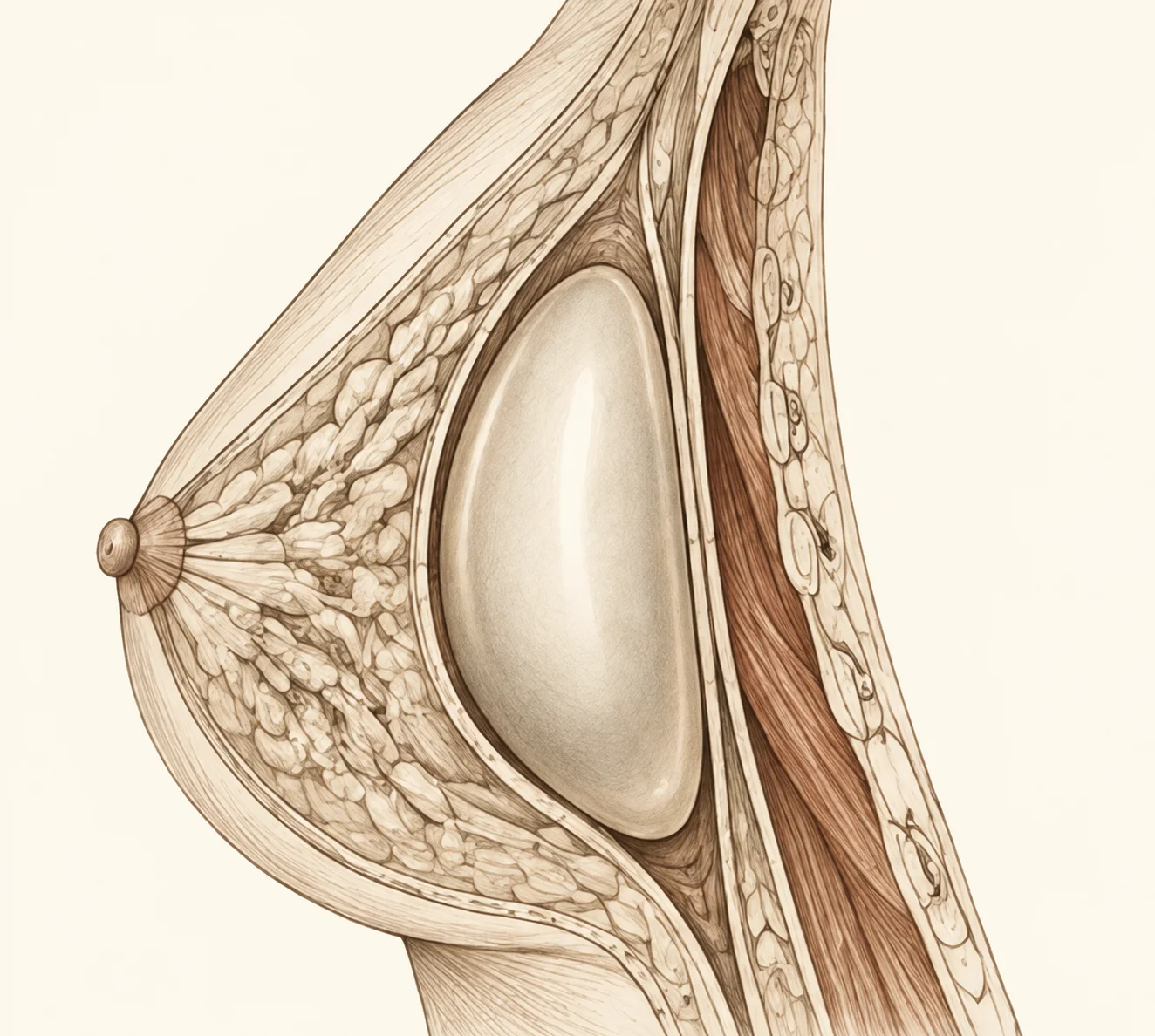
A breast can look empty after pregnancy and breastfeeding because upper-pole volume has reduced, while the nipple remains in a relatively appropriate position. Another breast can have true ptosis, with the nipple and breast mound sitting lower relative to the inframammary fold.
That distinction changes treatment. Volume restoration can improve an empty breast. It cannot reliably reposition a significantly low nipple. A lift can reposition and reshape tissue, but it does not manufacture large amounts of new upper-pole volume.
Two women can finish breastfeeding with opposite problems
One patient has a smaller, deflated breast with loose skin. Another retains substantial breast volume but the tissue has descended. The first may need a discussion about volume and envelope. The second may need lifting with or without reduction.
This is why “post-breastfeeding breast surgery” is not a procedure category. Pregnancy and breastfeeding are events; the anatomy they leave behind determines the plan.
The upper pole can look empty even when the breast is not truly low
Loss of superior fullness can make the breast look older or more deflated, particularly in clothing. The eye reads the empty upper pole and assumes the whole breast has fallen.
I examine nipple position, lower-pole length and the amount of breast tissue that remains. If position is reasonable and the dominant issue is volume loss, augmentation may be enough. If the skin envelope is disproportionately large or the nipple is low, volume alone may create a fuller but still descended breast.
A breast lift reshapes the envelope; it does not reverse pregnancy biology
Breast lift (mastopexy) is relevant when skin redundancy and tissue descent are the dominant changes. The operation can reposition the nipple–areola complex and reshape the mound into a more compact relationship.
It cannot make skin biologically young again, and it cannot guarantee that the breast will remain permanently fixed at its postoperative height. The quality of the remaining envelope continues to influence how the result ages.
Augmentation should answer true volume loss, not be used to avoid every scar
Some patients prefer an implant because they hope added volume will fill loose skin and avoid a lift scar. In mild cases, augmentation can indeed improve deflation enough that no lift is needed.
But when a low nipple and significant envelope excess are present, using a larger implant to stretch the breast into a higher-looking shape adds weight to the same tissues that have already stretched. The attempt to avoid one scar can create a heavier long-term breast.
Future pregnancy changes the timing conversation
A breast operation does not prevent another pregnancy from changing breast volume and skin again. The patient does not need to swear that childbearing is permanently complete before considering surgery, but the likelihood and timing of another pregnancy matter.
If another pregnancy is planned very soon, waiting may protect the stability of the result. If future pregnancy is uncertain or years away, the patient may reasonably decide that current quality of life matters more. This is a timing decision rather than a universal rule.
Breastfeeding history does not tell me what future breastfeeding will be like
Previous successful breastfeeding is useful history, but future lactation after breast surgery depends on procedure, anatomy and individual biology. Lift and reduction procedures can affect ducts and nipple sensation to different degrees.
For a patient who places high value on future breastfeeding, that priority should be stated before technique is chosen. It can legitimately make the plan more conservative.
Asymmetry often becomes more visible after pregnancy
One breast may enlarge more during pregnancy, produce more milk, lose more volume afterward or stretch its envelope differently. The post-breastfeeding breast can therefore be more asymmetric than it was before.
That does not mean the two sides must receive identical procedures. One side may need more lifting or volume change than the other. The aim is improved balance, not procedural symmetry.
Weight stability helps us see the real endpoint
Significant ongoing weight loss can continue to reduce breast volume and alter skin. Planning surgery while the body is still changing can make the chosen operation obsolete before it has had time to settle.
I prefer to assess the breast once weight is reasonably stable. This does not require an arbitrary perfect number; it means the current breast should represent the body the patient actually expects to maintain.
A new unilateral breast change is not automatically “post-breastfeeding”
Pregnancy and breastfeeding can explain many gradual bilateral changes, but they should not be used to dismiss a new lump, skin tethering, spontaneous nipple discharge or a new unilateral distortion. Those findings deserve appropriate breast assessment.
The fact that a patient recently breastfed does not make every subsequent breast change cosmetic.
Trying to recreate the pre-pregnancy breast exactly can be the wrong target
Patients understandably remember the breast they had before pregnancy and may use it as the reference image. That history is useful, but the current chest, skin and breast tissue are no longer identical to that earlier anatomy. The safest plan is not always the one that reproduces every old contour.
I use the pre-pregnancy breast to understand what changed and what the patient values. The actual operation is still planned from the present breast, because that is the tissue that has to heal, support volume and age after surgery.
What I want the patient to understand before choosing surgery
I assess current volume, upper-pole fullness, nipple position, lower-pole length, skin quality, asymmetry, weight stability, pregnancy plans and what the patient misses from the pre-pregnancy breast.
Sometimes the desired result is mainly volume restoration. Sometimes it is a lift. Sometimes it is both. The useful plan reconstructs the relationship between volume and envelope rather than trying to recreate a photograph from before pregnancy at any anatomical cost.