
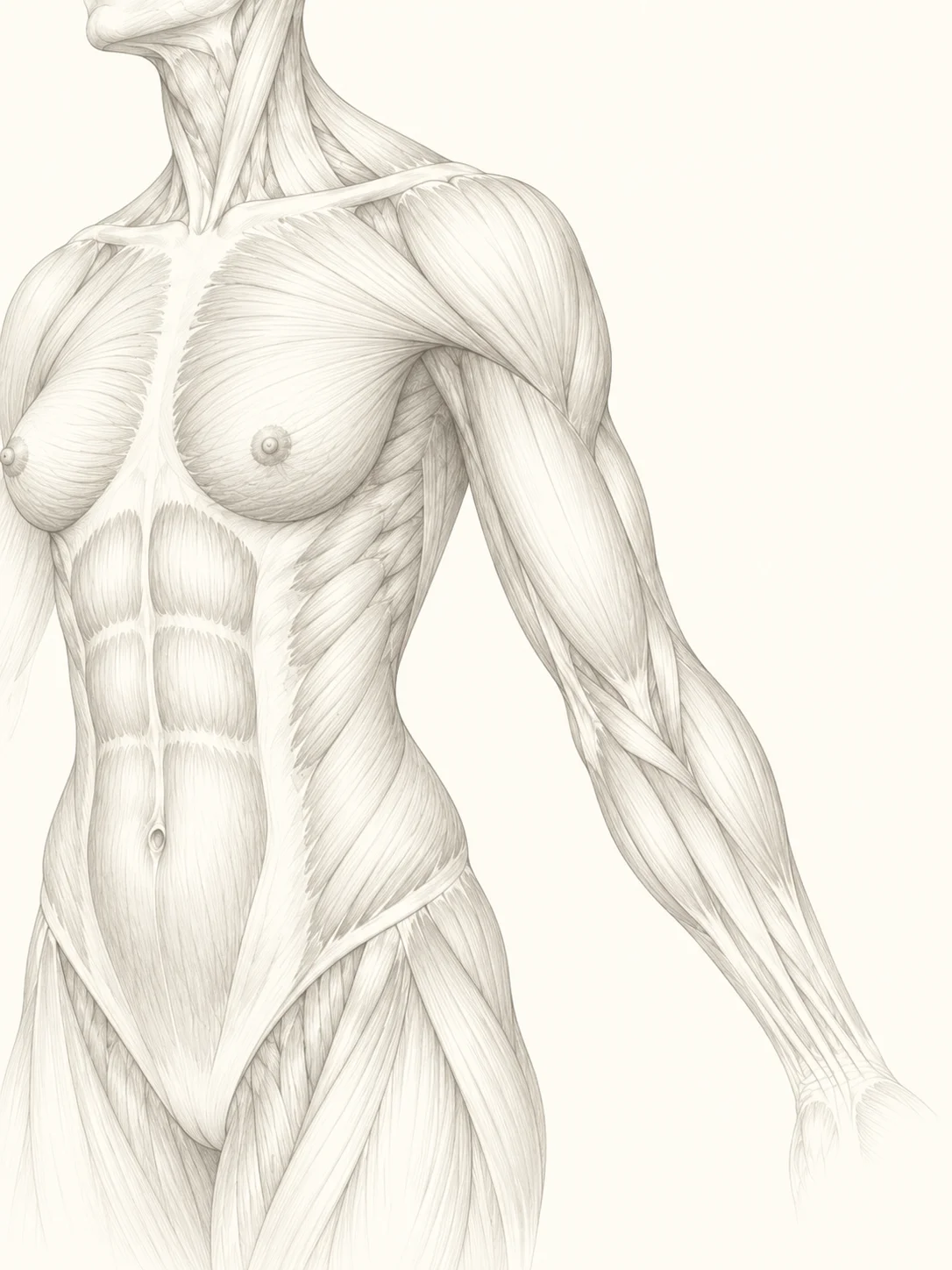
Sagging arms can come from loose skin, residual fat, a combination of both, or a large arm whose volume makes the skin hang more heavily. The complaint often becomes most visible when the arm is lifted and the underside moves independently from the upper-arm frame. Before treatment, I want to know whether the arm needs volume reduction, envelope reduction, or simply better expectation-setting about normal soft-tissue movement.
The arm can be full without being truly sagging
A patient with good skin elasticity may have a large upper arm because of subcutaneous fat but relatively little redundant skin. Another patient may be lean after major weight loss and have a thin, empty envelope that hangs despite very little fat.
These are opposite problems. Liposuction can reduce volume in the first anatomy. It has very little leverage over the second.
Two arms can look equally loose and still require different operations
One patient has moderate fat and mild laxity. Another has extensive skin redundancy extending from the axilla toward the elbow. The amount of visible movement may look similar in one photograph.
Examination tells me how much of the tissue is fat, how much is skin and how far the laxity extends. The procedure should follow those dimensions rather than the single label “bat wings”.
Arm liposuction has a skin-quality requirement
Liposuction can improve a fat-dominant upper arm when the skin is likely to redrape. The strongest results come from reducing disproportion while preserving a smooth layer around the arm.
If the skin is already significantly loose, removing more internal support can make the envelope look emptier. A smaller arm is not automatically a tighter arm.
An arm lift changes the envelope directly
Arm lift becomes relevant when redundant skin is the dominant problem and the expected improvement is large enough to justify the scar required to remove it.
The operation does not make skin biologically young. It removes selected excess and reshapes the remaining envelope. That distinction matters because some relaxation and ageing continue afterward.
The scar-to-benefit ratio is central in brachioplasty planning
Arm-lift scars can be long because the redundant skin itself is long. The exact position and extent depend on anatomy and the correction required.
I do not think a large skin problem should be sold with a “minimal scar” promise. The patient needs to decide whether the improvement in contour and movement is valuable enough to exchange for a permanent scar.
The axilla and lateral chest affect the upper-arm result
Loose tissue may continue into the armpit or lateral chest, particularly after major weight loss. Treating the upper arm alone can leave a visible transition if the neighbouring envelope is also redundant.
I map where the laxity begins and ends before choosing incision length. The operation should stop where the anatomy stops, not where a shorter scar becomes more marketable.
Muscle cannot be created by removing skin
The biceps and triceps establish the frame beneath the soft tissues. An arm lift can reveal that frame more clearly, but it cannot create muscular definition that is not present.
This is important for patients expecting a highly athletic arm after skin surgery. A tighter envelope and a muscular arm are related visually but are not the same biological result.
Weight stability matters particularly after major loss
If weight is still falling, additional skin redundancy may appear. If substantial regain occurs later, the repaired envelope can stretch again.
I prefer arm-lift planning around a reasonably stable body. The operation should consolidate a completed change rather than interrupt one that is still evolving.
Normal arm movement should remain normal
Upper-arm skin moves when the shoulder and elbow move. The goal is not to make the arm rigid or eliminate every fold seen in an overhead pose.
I assess the arm in neutral position and movement because a good result has to function, not just photograph well with the arm held in one standard position.
Previous surgery changes the revision threshold
Residual laxity after previous liposuction or arm lifting can reflect under-correction, scar behaviour, further weight change or an adjacent untreated region. The tissue is no longer primary anatomy.
Revision should identify the specific stable problem rather than simply repeat the first manoeuvre more aggressively. The smaller the remaining concern, the higher the threshold for another scar-producing operation should become.
What I consider a successful arm result
I want the upper arm to relate more cleanly to the shoulder and elbow, move with less distracting tissue excess and remain soft enough to look natural. I do not want an over-tightened envelope or a visibly hollowed arm.
The strongest result is usually the one that removes the dominant excess and leaves normal anatomy behind.
What I assess before recommending treatment
I separate fat from skin, assess elasticity, upper-arm circumference, muscle frame, axillary and lateral-chest extension, weight history, scars, asymmetry and how the tissue behaves during movement.
The answer may be liposuction, arm lift, combined treatment or no surgery when the degree of laxity is too small to justify the scar. The procedure begins only after the dominant layer is clear.