

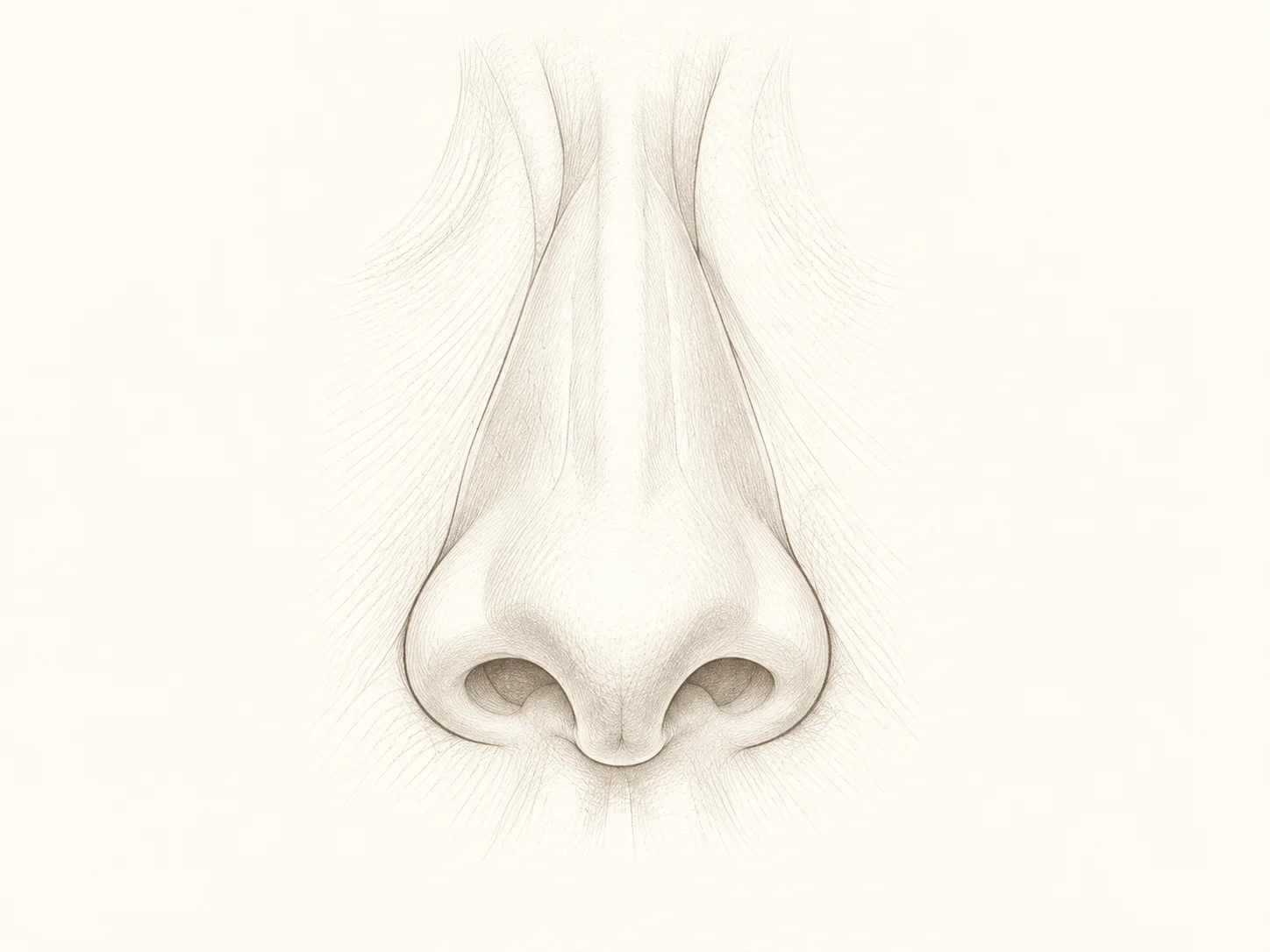
“My nose is too large” sounds like a simple complaint, but size is rarely one measurement. A nose can look large because it is long, highly projected, wide, dorsally prominent, tip-heavy or broad at the alar base. It can also look large because the surrounding facial proportions are relatively small. Before discussing reduction, I want to know which dimension is creating the impression of size — because reducing the wrong part can make the nose less balanced rather than less noticeable.
A large-looking nose can be long, projected, wide or simply dominant in the face
Length describes the vertical relationship from the nasal root toward the tip. Projection describes how far the tip extends forward from the face. Width can come from the nasal bones, middle vault, tip or alar base. Dorsal height can make the profile feel prominent even when the frontal width is modest. These variables interact, but they are not interchangeable.
This is why I do not begin with the question “how many millimetres should we remove?” The first task is to identify which dimensions are genuinely disproportionate and which are simply part of the patient’s normal anatomy. A strong nose can be harmonious. A smaller nose can still look wrong if its length, projection and width no longer relate to one another.
Perceived size depends on the whole facial frame
The nose occupies the centre of the face, so its scale is judged against the forehead, cheekbones, lips and chin. A relatively retruded chin, for example, can make nasal projection appear stronger in profile even when the nose itself is not extreme. Likewise, facial width and midface projection change how nasal width is perceived from the front.
This does not mean that another part of the face should automatically be treated. It means that reduction should be planned in context. If the nose is made smaller without considering the facial frame, the result can lose character or create a new imbalance. The question is not “how small can this nose become?” but “what dimensions would make it belong more quietly to this face?”
The structure that creates prominence also determines how safely it can be reduced
A high dorsal profile may involve bone, cartilage or both. A broad upper third is a different problem from a wide tip. Strong tip projection may reflect cartilage shape and support, while a broad alar base relates to the lower nasal attachments and nostril width. Each region has different structural responsibilities.
Reduction therefore has a ceiling. Bone and cartilage do not exist only to create appearance; they also provide support and contribute to the internal airway. Removing too much can trade one aesthetic concern for instability, pinching, collapse or breathing difficulty. A durable reduction is one that leaves enough structure to support the shape that has been created.
Assessment should define the dominant dimension before choosing a technique
Frontal, profile, oblique and basal photographs answer different questions. The profile helps show dorsal height, length and projection. The frontal view shows width, deviation and the relationship between the tip and the rest of the face. The basal view helps assess alar width and tip geometry. No single photograph should dictate the plan.
I also ask what the patient means by “large.” Some are troubled almost entirely by a dorsal hump. Others dislike a long or drooping tip. Some want less width from the front but are comfortable with the profile. These distinctions change the operation because the best result often comes from selective reduction rather than making every dimension smaller.
Rhinoplasty can reduce selected dimensions, but the operation should remain structural rather than simply reductive
When the nose is genuinely disproportionate, rhinoplasty can reduce dorsal height, adjust nasal width, refine or deproject the tip and change length when the anatomy allows. These changes need to be coordinated. Reducing the dorsum without controlling the tip can leave the profile disconnected; narrowing the bones without respecting the middle vault can create functional or contour problems.
If alar-base width is an important independent component, alar base reduction may sometimes be considered as part of the plan. It should not be used simply because the patient has described the entire nose as “wide.” The alar base deserves treatment only when it is actually contributing to the disproportion and when the likely scar and nostril-shape changes are justified.
Filler can change the outline of a nose, but it cannot make a large nose smaller
Non-surgical rhinoplasty with filler can camouflage selected depressions or create a straighter visual line in carefully chosen cases. It works by adding material. For a patient whose main concern is excessive size, projection or width, that mechanism needs to be stated clearly: filler may alter perception, but it does not reduce the nasal framework.
This is an important marketing distinction because “non-surgical nose job” is often presented as though it were a less invasive version of reduction rhinoplasty. It is not. It is a different tool with a different biological action and a different ceiling.
The smallest possible nose is not the most natural result
Over-reduction can erase features that belong to the face and can make the nose look operated rather than refined. It can also weaken support structures that matter for long-term stability. I prefer to think in terms of dominance: which part of the nose is drawing too much attention, and how much change is needed before the face — rather than the nose — becomes the first thing you see?
That endpoint is individual. Some patients need meaningful structural reduction. Others need a modest change in projection or dorsal height. And some discover during assessment that the nose is within a balanced range and that the perceived problem has been amplified by photographs, comparison or a single viewing angle. “No treatment” remains a legitimate outcome of an aesthetic consultation.
When is a consultation useful for a large-looking nose?
A consultation is useful when the nose feels dominant from several angles, when one dimension such as length, projection or width can be identified as the main concern, when breathing symptoms coexist, or when the patient is considering a reduction but is unsure how much change would still look like their own face.
The aim is to turn the word “large” into an anatomical description. Once we know whether the issue is dorsal height, length, projection, width, tip shape, alar base or facial proportion, the treatment conversation becomes much more precise. That is the point at which a procedure can be evaluated on its actual benefits, limits and trade-offs rather than on the promise of simply making the nose smaller.