

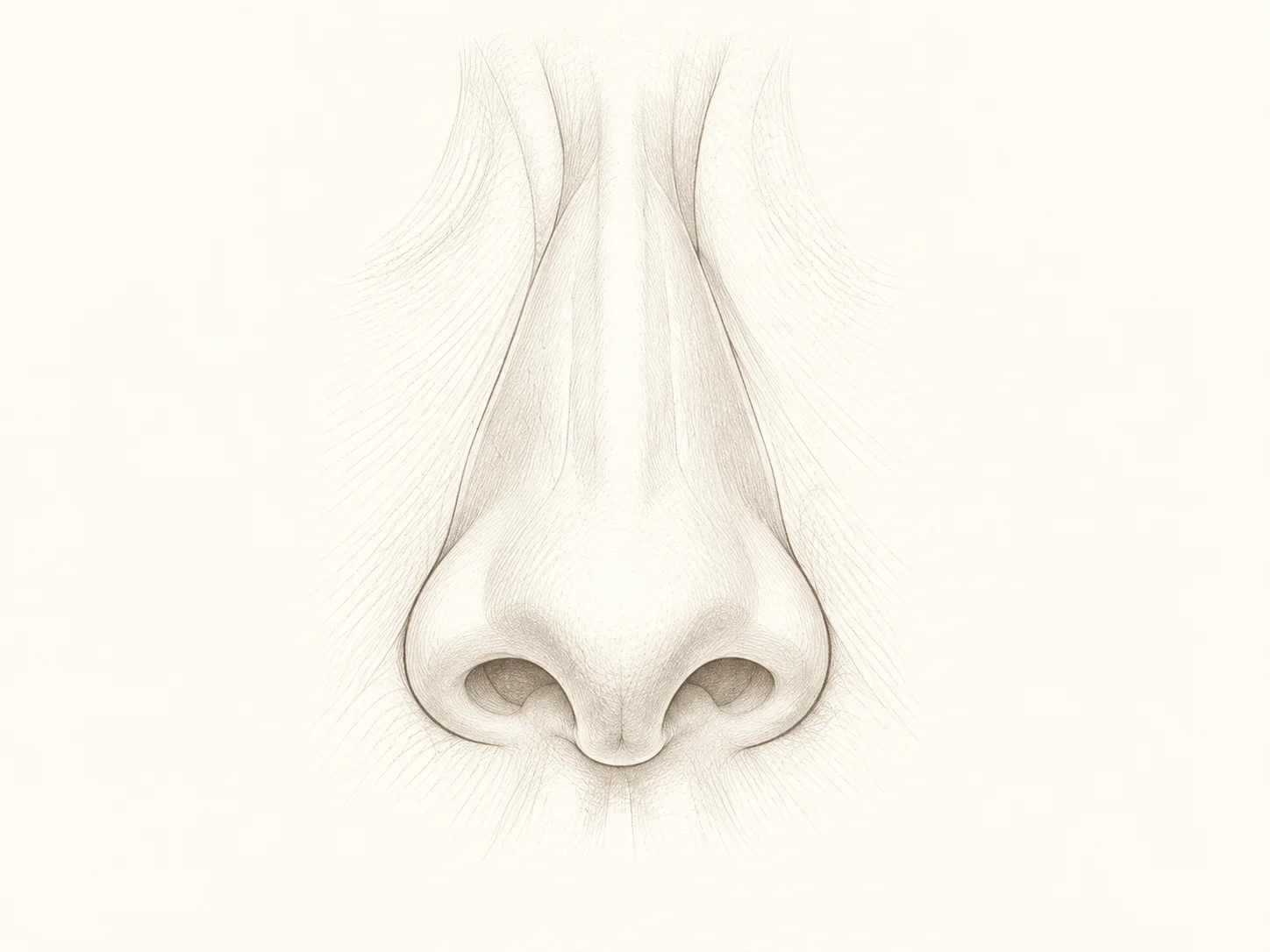
Target
Treatment / Non-Surgical
Non-Surgical Rhinoplasty (Filler)
A focused treatment page built around indication, mechanism, expected experience and realistic limits.
Individual assessment
Indication first
Realistic expectations
Clinical focus
Treat the right mechanism — not simply the visible sign.
Treatment snapshot
Primary goalIndividual indication
AppointmentVaries by treatment
DowntimeDepends on method and area
SessionsPersonalized plan
ResultsTreatment-specific timeline
These are orientation points, not promises. Timing and suitability depend on the treatment, anatomy and individual response.
Mechanism
Which method matches the underlying issue?
Plan
What intensity, timing and follow-up make sense?
Non-surgical rhinoplasty has a conceptual limitation built into the treatment itself.
Filler adds material.
That sounds obvious, but it is the most important fact in deciding whether filler belongs in a nose.
A small dorsal irregularity can sometimes be camouflaged by adding volume immediately above or below it. A low radix can be raised. Selected tip relationships can be altered visually. Small postoperative contour defects may sometimes be softened.
But a filler cannot physically remove a dorsal hump. It cannot narrow broad nasal bones. It cannot reduce a bulbous tip by subtracting cartilage. It cannot make large nostrils smaller, and it cannot correct an internal obstruction responsible for impaired breathing.
So I do not begin a filler-rhinoplasty consultation by asking how straight we can make the profile.
I begin with the more important question: does this nose require addition, or are we about to use addition to disguise a problem that fundamentally requires reduction, repositioning or functional surgery?
Non-surgical rhinoplasty is a camouflage procedure before it is a reshaping procedure
The word rhinoplasty suggests that the nose itself is being reconstructed.
That is true in surgery.
With filler, the intervention is different.
We are changing selected external contours by placing material within the soft tissues. When this is done well, light reflects differently from the bridge, transitions appear smoother and the relationship between radix, dorsum and tip can look more coherent.
This can create a surprisingly strong visual change from a relatively small quantity of material.
The change is still additive.
Filler can make a line straighter by adding to the line.
It cannot make a structure smaller by pretending the added volume is subtraction.
That distinction determines almost every appropriate indication and almost every inappropriate one.
A dorsal hump is a good example of why visual correction and anatomical correction are different
A patient may have a convexity along the nasal dorsum and ask for the hump to disappear.
Surgical rhinoplasty can reduce a true bony or cartilaginous hump when that is appropriate.
Filler cannot.
What filler may be able to do is increase the height of an adjacent depression or low radix so that the profile line appears smoother.
The hump is still anatomically present.
The silhouette has changed because material has been added around it.
For a relatively small dorsal irregularity, that trade-off can be very worthwhile.
For a nose that already appears large or highly projected, adding enough filler to hide a substantial hump can make the nose objectively larger even if the line looks straighter.
That is where camouflage stops being refinement and begins fighting the anatomy.
A straighter nose can become a larger nose
This is one of the most important discussions before treatment.
Patients naturally focus on the feature they dislike.
If that feature is one dorsal bump, smoothing it can feel like the entire objective.
But a nose exists in three dimensions.
Adding filler to the radix increases projection there. Adding filler along the dorsum increases tissue volume. Adding material to the tip changes projection and potentially length as well as contour.
The profile may improve while the frontal view becomes wider or the total nasal volume increases.
I therefore judge the result from several views.
A treatment that succeeds in one photograph and creates a less coherent nose from another angle is not a complete result.
The radix can change how large the entire nose appears
The radix is the upper starting point of the nasal dorsum between the eyes.
If it is relatively low, the transition from forehead to nose can create a profile in which the central dorsum or hump appears more dominant.
Careful augmentation of a genuinely low radix can smooth that transition.
Sometimes this makes the nose appear more proportionate even though volume has technically been added.
This is one of the situations in which additive treatment can create a visual impression of less irregularity rather than simply more nose.
But radix augmentation also changes the relationship between the nose, forehead and eyes.
It should therefore follow facial analysis rather than one standard injection point used on every profile.
The tip needs a diagnosis before it needs projection
A patient can describe the nasal tip as drooping, undefined or too round.
Those words can arise from very different anatomy.
A tip may have limited projection. It may rotate downward dynamically during smiling. The cartilaginous framework may create width or bulbosity. The columella and upper lip relationship may alter the way rotation is perceived.
Filler can modify selected contour relationships.
It cannot shrink broad tip cartilage.
And adding projection to a tip that is already sufficiently projected can make the nose more dominant.
Tip filler should solve a tip deficit.
It should not be the automatic response to every patient who points at the end of the nose.
A drooping tip can have several mechanisms
Some tips appear relatively under-rotated at rest.
Others descend more noticeably during smiling because muscular activity influences the columella and tip complex.
These are not necessarily the same treatment problem.
Selected filler placement can alter the visual relationship between dorsum, columella and tip.
In a patient with a strong dynamic component, neuromodulation may occasionally have a limited complementary role.
A structurally drooping or significantly under-supported tip may require surgical modification if meaningful and durable repositioning is the goal.
I do not want filler quantity to increase simply because the wrong mechanism has been selected.
The frontal view is where over-treatment often reveals itself
A beautifully smooth profile can be seductive.
It is also insufficient.
The nasal dorsum should remain appropriately narrow from the front. Tip definition should not be purchased at the cost of visible bulk. Small asymmetries should be judged against the risk and volume required to correct them.
This is one reason I am reluctant to chase every millimetric irregularity with filler.
The more material placed around a narrow three-dimensional structure, the easier it becomes for refinement to turn into enlargement.
My endpoint is therefore not a perfectly straight digital line.
It is a nose that remains proportionate from the front, oblique and profile views simultaneously.
The whole profile matters because the nose does not create facial proportion by itself
A nose can look dominant partly because another structure is relatively under-projected.
The chin is the clearest example.
A recessed chin can make the central face and nose appear more prominent in profile. Changing the nose alone may improve one relationship while leaving the underlying facial imbalance largely unchanged.
This does not mean every rhinoplasty patient needs chin filler.
It means I want the entire profile considered before deciding which structure deserves intervention.
If a small chin correction provides the visual balance the patient is actually seeking, adding increasing amounts of filler to the nose may be the less logical route.
The treatment should follow the relationship, not the feature that first attracted attention.
Filler does not improve nasal breathing
This boundary needs to remain absolute in the consultation.
Nasal obstruction can involve the septum, turbinates, internal or external nasal valves and other functional structures.
Hyaluronic-acid filler placed externally does not correct those mechanisms.
A patient may dislike the appearance of the nose and also have difficulty breathing.
Those are two legitimate concerns.
They should not be merged into one non-surgical treatment simply because the patient would prefer to avoid surgery.
Functional symptoms deserve appropriate ENT or surgical assessment.
A previous rhinoplasty makes filler treatment more complex rather than simpler
Small contour defects after surgery are one of the reasons patients seek non-surgical rhinoplasty.
In selected patients, filler can be a useful way to soften a minor depression or asymmetry without proceeding directly to revision surgery.
But the operated nose is not an untouched nose.
Scar tissue can alter tissue planes. Previous osteotomies and cartilage work change structural relationships. Vascular pathways may be displaced or less predictable, and the skin envelope may have different mobility.
Recent systematic review evidence suggests filler can be effective after rhinoplasty, but also indicates increased concern for complications such as skin necrosis in this altered anatomy.
A postoperative irregularity may be small.
The anatomy required to treat it safely is not necessarily simple.
Previous surgery raises my threshold for treatment rather than lowering it.
A previous filler treatment also changes the starting anatomy
A patient may return because the nose looks as though the previous correction has faded.
That does not establish that all previous filler has disappeared.
Residual hyaluronic acid can remain, particularly after repeated treatments. Tissue relationships may also have changed around earlier product.
Adding the same amount on every visit can therefore gradually enlarge the nose.
This is particularly problematic when the original purpose was camouflage.
If each maintenance treatment adds a small amount above and below the same hump, the long-term strategy can slowly become “keep making the nose larger so that it still looks straight”.
At some point, reassessment or even reduction of previous HA may make more sense than another top-up.
Nasal filler is a high-risk filler treatment because the vascular anatomy is unforgiving
The nose contains a dense arterial network with connections to the ophthalmic circulation.
Accidental intravascular injection or vascular compression can compromise blood supply to nasal skin.
Severe complications can include tissue ischemia and necrosis. Through vascular connections, filler embolisation can also cause visual loss and, very rarely, cerebral complications.
These events are uncommon.
The potential consequence is large enough that rarity does not reduce their clinical importance.
A 2024 systematic review including 9,657 nonsurgical-rhinoplasty patients found very high overall satisfaction, but still identified serious arterial occlusion in a small fraction of cases. :contentReference[oaicite:0]{index=0}
This is why I treat the nose differently from a region in which a small aesthetic imperfection has a lower procedural downside.
“Safe injection point” is language I use very cautiously in the nose
Anatomical teaching often describes preferred tissue planes and safer approaches.
That information is valuable.
But no point in the nose becomes vascularly irrelevant because a diagram has coloured it green.
Vessels vary. Previous procedures alter anatomy. Tissue can move under pressure. Injection depth can change during a procedure.
I prefer the concept of risk reduction rather than a safe zone.
Detailed anatomical knowledge, low-volume controlled placement, continuous attention to tissue behaviour and the ability to recognise an adverse vascular event immediately all matter.
No technique makes the consequence impossible.
Small volume is part of both design and safety
The nose often requires much less filler than patients expect.
That is a strength.
A millimetric contour change can influence the entire profile.
I prefer to exploit that sensitivity rather than treat the nose as another one-syringe region.
Small incremental placement makes it easier to stop when the visual objective has been reached.
It also reduces the pressure to use material simply because product remains in the syringe.
The correct nasal dose is the amount the anatomy needs.
The syringe size is irrelevant to that decision.
Hyaluronic acid has an important practical advantage because it can be enzymatically reduced
Hyaluronic-acid fillers dominate modern nonsurgical rhinoplasty literature and practice. In the 2024 systematic review, they represented the overwhelming majority of reported treatments. :contentReference[oaicite:1]{index=1}
One reason is the availability of hyaluronidase.
If an aesthetic correction is excessive or inappropriate, HA can often be reduced.
More importantly, hyaluronidase is central to emergency management when HA-related vascular compromise is suspected.
This makes HA more controllable than a permanent filler.
It does not make the treatment casually reversible.
Visual loss or tissue ischemia are time-sensitive medical complications, not ordinary aesthetic dissatisfaction that can simply be undone whenever convenient.
A reversible material does not make an unnecessary nose injection necessary
This is where reversibility can distort decision-making.
A patient may have a very small contour issue and think there is little downside because HA can be dissolved.
But a marginal aesthetic indication still carries the vascular risk of the injection itself.
Hyaluronidase is valuable because medicine requires contingency planning.
It should not lower the threshold for treating a nose that was already proportionate.
The safest filler complication remains the injection that never needed to happen.
Needle and cannula are tools, not competing safety guarantees
Different practitioners use needles, cannulas or combinations according to the anatomical target and technique.
A blunt cannula may reduce certain penetration risks in some situations, but it is not incapable of entering or damaging vessels.
A needle provides precise placement but also requires detailed control of depth and direction.
I do not think the patient should select a provider based on the statement that one instrument makes vascular complications impossible.
The important variables are anatomical knowledge, technique, material control and emergency preparedness.
Aspiration does not prove that an injection is safe
Aspiration is sometimes discussed as a test before filler placement.
A negative aspiration can create false reassurance because small facial vessels may collapse, the needle position can shift and several technical variables influence whether blood returns to the syringe.
I therefore do not use one negative test as permission to inject a large bolus.
Safety comes from the entire method.
No isolated manoeuvre removes the need for cautious placement.
Swelling makes the early nose an unreliable measurement
The nose can swell after injection.
Minor asymmetry may appear. Bruising and tenderness can occur. Needle entry itself can temporarily alter the contour.
This is why I do not want to chase every early irregularity with immediate additional filler.
The nose needs time to reveal what is product and what is tissue response.
A small residual deficit can be treated later if necessary.
An overfilled nose created by repeated early corrections is harder to justify.
Perfect symmetry is a particularly dangerous endpoint in a high-risk region
Human noses are not perfectly symmetrical.
The underlying nasal bones, cartilage, septum and facial skeleton themselves can be asymmetric.
Filler can improve selected visible differences.
But there is a point at which each additional fraction of a millimetre requires more product in a region where the expected visual benefit has become extremely small.
I do not think anatomical risk should remain constant while aesthetic benefit approaches zero.
At some point, the correct residual asymmetry is the one we decide to leave alone.
Maintenance should not slowly convert camouflage into accumulation
The aesthetic effect of HA filler changes over time.
Repeat treatment can be reasonable when a useful correction has genuinely diminished.
I still reassess from zero.
Does the nose actually need more material?
Is residual product present?
Has the patient’s goal changed?
Would surgery now make more sense than repeatedly augmenting a structure they originally wanted to make smaller?
A maintenance protocol that never asks these questions can gradually transform a conservative nonsurgical correction into progressive nasal enlargement.
What a good non-surgical rhinoplasty result means to me
I want the treatment to solve a small problem with a small intervention.
A dorsal line may become smoother. A low radix can become more coherent with the forehead. A selected contour defect can stop attracting attention. A carefully chosen tip relationship may improve.
I do not want the patient to leave with more nose simply because every irregularity was theoretically injectable.
I do not want one excellent profile photograph to hide a wider frontal view.
I do not want filler to postpone functional evaluation in a patient who cannot breathe properly.
And I do not want the label “non-surgical rhinoplasty” to create an expectation that filler can perform subtraction.
The best result is not a nose that looks filled.
It is a nose in which a carefully selected additive correction makes the overall architecture look more coherent.
When non-surgical rhinoplasty makes sense to me
I am most comfortable recommending HA filler when the desired change is genuinely additive or camouflaging and can be achieved with conservative volume.
A small dorsal irregularity, low radix, selected contour asymmetry or carefully chosen postoperative defect may fit that category.
I become much more cautious when the patient wants a substantially smaller nose, narrower bones or nostrils, major tip reduction, functional breathing improvement or camouflage of a deformity that would require significant added volume.
I also use a higher threshold in previously operated or heavily filled noses.
A technically injectable nose is not automatically a filler nose.
Possible and appropriate remain different words — particularly in anatomy where the consequence of getting that distinction wrong can be much larger than the aesthetic problem we started with.
Frequently asked questions
What is non-surgical rhinoplasty?
It is the use of injectable filler, most commonly hyaluronic acid, to modify selected external nasal contours without surgical reconstruction.
Can filler make my nose smaller?
No. Filler adds volume. It can sometimes make a hump or irregularity appear less prominent by changing surrounding contour, but it does not physically reduce nasal bone, cartilage or soft tissue.
Can filler remove a dorsal hump?
It cannot remove the hump anatomically. Selected smaller humps can sometimes be camouflaged by adding volume around them so that the profile line appears straighter.
Can non-surgical rhinoplasty narrow the nose?
It cannot narrow broad nasal bones or reduce wide nostrils. Adding filler can actually increase width if too much product is used.
Can filler lift a drooping nasal tip?
Selected contour relationships can be altered and a modest visual tip change may be possible in appropriate anatomy. Structural or significant tip droop may require another treatment, including surgical assessment.
Can it fix breathing problems?
No. Filler does not correct septal deviation, turbinate enlargement, nasal-valve dysfunction or other internal causes of obstruction.
Is nasal filler dangerous?
The nose is considered a high-risk filler region because its vascular network communicates with the ophthalmic circulation. Most treatments do not produce major complications, but rare vascular occlusion can cause skin necrosis, visual loss or other serious injury.
Can I have filler after surgical rhinoplasty?
Sometimes, particularly for selected small postoperative contour defects. Previous surgery alters tissue planes and vascular anatomy, so candidacy and technique require additional caution.
Can old nose filler still be present?
Yes. Hyaluronic acid may persist longer than the visible correction suggests. Maintenance should therefore begin with reassessment rather than automatically repeating the previous volume.
Can nose filler be dissolved?
Hyaluronic-acid filler can often be reduced with hyaluronidase. This is valuable for aesthetic correction and is central to management of suspected HA vascular compromise, but it does not make every complication instantly or completely reversible.
How much filler is normally needed?
There is no universal amount. The nose often responds visually to relatively small quantities, and I prefer incremental treatment based on anatomy rather than treating one syringe as a standard dose.
How long does the result last?
Persistence varies with filler properties, treatment area, volume and individual tissue behaviour. Repeat treatment should be based on actual recurrent contour need rather than one fixed interval.
When is surgical rhinoplasty more appropriate?
Surgery becomes more coherent when meaningful reduction, narrowing, cartilage or bone repositioning, substantial tip change or functional correction is required. It is also worth discussing when filler camouflage would require enough added volume to make the nose larger than the patient wants.

Dr. Mert Demirel
Plastic, Reconstructive & Aesthetic Surgery
Anatomy first. Proportion over excess. Decisions built to remain coherent over time.
Next step
The best treatment is the one that matches the right indication.
You do not need to choose a device, injectable or technique before asking the question. Start with what you would like to improve.
Private consultation
Let’s start with your question.
Leave your number first. We can then continue privately on WhatsApp.


