
Target
Treatment / Non-Surgical
Nasal Tip Filler
A focused treatment page built around indication, mechanism, expected experience and realistic limits.
Individual assessment
Indication first
Realistic expectations
Clinical focus
Treat the right mechanism — not simply the visible sign.
Treatment snapshot
Primary goalIndividual indication
AppointmentVaries by treatment
DowntimeDepends on method and area
SessionsPersonalized plan
ResultsTreatment-specific timeline
These are orientation points, not promises. Timing and suitability depend on the treatment, anatomy and individual response.
Mechanism
Which method matches the underlying issue?
Plan
What intensity, timing and follow-up make sense?
The nasal tip is a small structure with a disproportionately large influence on the face. A change of only a few millimetres in projection, rotation or the relationship between the tip and columella can alter the entire profile. That sensitivity is what makes filler useful in selected noses, but it is also what makes careless treatment immediately visible. The tip does not need much added volume before refinement becomes enlargement.
For that reason, I do not interpret “I want my tip lifted” as an injection plan. A drooping-looking tip can result from insufficient projection, genuine under-rotation, dynamic downward movement during smiling, a long caudal septal relationship, weak support or simply the way the dorsum and chin frame the tip in profile. A bulbous tip may be wide because of cartilage anatomy rather than lack of filler. These mechanisms can all be described by the same patient sentence while requiring very different solutions.
Nasal tip filler is therefore an additive contour treatment, not a miniature surgical rhinoplasty. It can support, camouflage and alter selected visual relationships. It cannot make broad cartilage narrower or remove projection that is already excessive. Before adding anything, I want to know whether the tip needs something added at all.
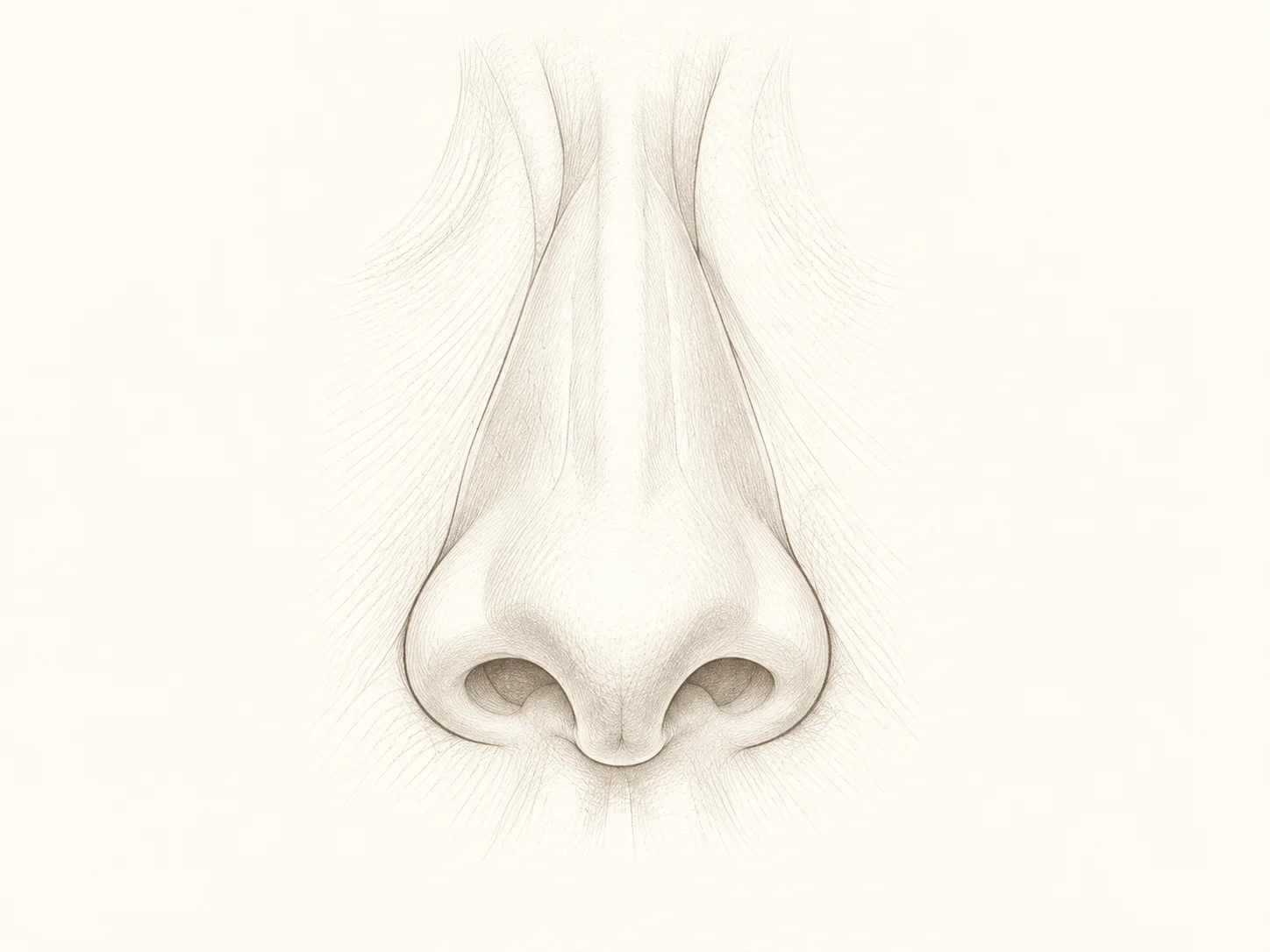
The nasal tip is a three-dimensional structure, not a point at the end of the dorsum
When patients look at the nose in profile, the tip can appear like a single endpoint. Anatomically it is much more complex. The lower lateral cartilages, domes, medial crura, columella, septal relationship, skin envelope and surrounding soft tissues all contribute to how the tip projects and rotates. The same apparent droop can therefore emerge from very different combinations of structure and soft tissue.
This is why I examine the tip from the front, profile, oblique and basal views. A treatment that produces a sharper profile but widens the tip from the front has not necessarily improved the nose. Likewise, adding projection can create the impression of greater rotation in one patient and simply make an already prominent nose longer in another. The tip should remain coherent from every view in which the patient actually lives, not only in the single photograph where the filler effect looks most dramatic.
The closer a treatment comes to the centre of the face, the more important this three-dimensional discipline becomes. Small volume changes have large visual consequences, and a small design error is difficult to hide.
Projection and rotation are related, but filler does not change them in the same way surgery does
Projection describes how far the tip extends forward from the face. Rotation describes the orientation of the tip, often understood through the nasolabial relationship and the direction in which the tip points. Surgical rhinoplasty can alter cartilage support and reposition structures directly. Filler works by adding soft-tissue volume around those structures, so its effect is primarily optical and supportive rather than true cartilaginous reconstruction.
In a mildly under-projected tip, carefully placed additional support can improve definition and make the tip sit more convincingly in profile. In selected anatomy, changing the relationship around the columella or tip can also create the visual impression of modest upward rotation. But this effect has a ceiling. If a significantly drooping tip requires major structural rotation, adding enough filler to simulate that change can make the nose larger and increasingly unnatural.
This is where I think the word “lift” needs restraint. A tip can look slightly more elevated because the geometry around it has changed. That is not the same mechanical event as surgically rotating and supporting the cartilaginous framework.
A bulbous tip is usually a reduction problem before it is a filler problem
A wide or bulbous nasal tip commonly reflects the shape, width and divergence of the lower lateral cartilages together with skin thickness. The patient may ask for more definition because the tip looks round. Adding a small amount of filler to a genuinely under-projected central tip can occasionally create better light reflection and make the tip appear more defined, but the underlying width has not been reduced.
This distinction becomes important when the patient wants a visibly narrower tip. Filler adds tissue. If the major complaint is excessive width, repeatedly adding product in an attempt to manufacture a sharper central highlight can eventually increase overall tip volume. The photograph may show a brighter central point while the nose itself has become larger.
I would rather explain that boundary early. Some bulbous tips are surgical anatomy. The fact that filler can be placed in the region does not mean an additive treatment is the appropriate method for a patient whose goal fundamentally requires subtraction or cartilage reshaping.
A drooping tip should be assessed both at rest and during smiling
Some patients have a tip that is relatively under-rotated even at rest. Others look reasonably balanced until they smile, at which point the tip moves downward and the upper lip changes around the columella. Dynamic muscle activity, including the depressor septi nasi in selected patients, can contribute to that movement. The distinction matters because a static filler solution and a dynamic muscle problem are not identical.
A very small amount of neuromodulator can sometimes have a role when excessive dynamic tip depression is clearly muscular. Filler may still be useful if projection or structural contour also needs support. But I do not automatically combine the two, and I do not use one treatment to compensate for a mechanism belonging to the other.
Most importantly, a dynamic tip should be judged in movement. A nose that looks beautifully refined in a static profile photograph may still behave exactly as before when the patient smiles. If movement is part of the complaint, movement has to be part of the assessment.
The relationship between tip and columella is more important than chasing one fashionable angle
Aesthetic discussions of the nasal tip often reduce planning to numerical angles. Measurements can be useful, but they do not create one universal ideal. Sex, ethnicity, facial profile, upper-lip position, chin projection and the rest of the nose influence what degree of rotation and projection looks coherent.
I do not want every tip pushed upward toward the same social-media profile. An over-rotated nose can expose too much nostril, shorten the apparent nose excessively and disrupt the relationship between columella and upper lip. A treatment should improve the patient’s architecture rather than move every patient toward one template.
This is especially relevant with filler because the material is additive. If the target angle requires repeated augmentation to create the illusion of rotation, the cost may be an increasingly bulky columella or tip. At that point the measurement has begun to dominate the face rather than describe it.
Frontal refinement and profile projection can work against each other
The profile rewards projection. The frontal view is less forgiving of added width. This is one of the central trade-offs in nasal tip filler. A small amount of centrally placed volume may create a cleaner tip-defining highlight, but excessive or poorly distributed material can broaden the soft-tissue envelope and reduce the very definition the patient wanted.
This is why I am cautious with the idea that a poorly defined tip simply needs “more structure”. Sometimes the lack of definition is caused by thick skin or broad cartilage. Those tissues do not become narrow because a filler has high structural strength. Material properties can help support a contour, but they cannot repeal the anatomy surrounding the material.
A good tip result therefore has to survive frontal photography. If the tip is only improved when the face is turned sideways, I have not finished evaluating it.
Tip filler can make a nose appear shorter or longer depending on the geometry it creates
Patients sometimes ask whether tip filler can shorten a long nose. Physically, filler cannot subtract nasal length. But a carefully changed tip relationship can alter where the eye perceives the endpoint of the nose and how the dorsum flows into it. In a selected patient, this can make the profile look better proportioned without the actual skeletal or cartilaginous length having been reduced.
The opposite can also happen. Increasing tip projection can make the nose appear longer, particularly in a patient whose tip was already prominent. This is why I avoid universal claims that filler “lifts and shortens” the nose. The same additive intervention can create different visual effects depending on the starting architecture.
The correct question is not whether the filler can create one particular illusion. It is whether that illusion improves the total profile from the front and side without requiring enough material to make the nose objectively larger than the patient intended.
Chin projection can change how the nasal tip is perceived without touching the nose
The tip exists within the facial profile, not in isolation. A recessed chin can make both the dorsum and tip appear more dominant because the lower boundary of the profile sits farther back. A patient may therefore ask for a smaller or more refined nose when part of what they are seeing is a relationship between nose and chin.
This does not mean every nasal-tip consultation should become a chin-filler consultation. It means I want to know whether the nose is truly the structure that needs additional material. In some patients, adding even more projection to the tip would move the profile in the wrong direction, while a carefully considered correction elsewhere would improve balance without enlarging the nose.
That is one reason full-profile assessment is central to my planning. The most obvious feature is not automatically the structure that should be treated.
Previous rhinoplasty changes both the aesthetic target and the vascular uncertainty
Patients who have undergone surgical rhinoplasty may later develop a small tip depression, asymmetry or area of under-projection. Filler can be attractive because a minor defect may not justify revision surgery. Large clinical series and systematic reviews show that HA filler can successfully correct selected postoperative nasal irregularities with high satisfaction. :contentReference[oaicite:8]{index=8}
But the operated nose is more complex. Scar tissue changes tissue planes, and the normal vascular anatomy may no longer follow the patterns described in an unoperated nose. The skin envelope can also be thinner or less mobile after surgery. This means a tiny postoperative defect can require a higher, not lower, level of caution.
I do not interpret “it is only a small touch-up” as evidence that the procedure is simple. Sometimes the smallest visible irregularity exists in the least predictable tissue.
The nasal tip belongs to one of the highest-consequence filler regions
The nose has a rich vascular network with connections to the ophthalmic circulation. Vascular occlusion can cause tissue ischemia and necrosis, and filler entering the relevant arterial pathways can very rarely produce visual loss or other severe complications. Modern systematic review data show that most nonsurgical rhinoplasty complications are minor, yet serious arterial events remain a real part of the risk profile. :contentReference[oaicite:9]{index=9}
This is why the treatment threshold matters as much as the injection technique. A technically possible refinement of one millimetre is not automatically worth a high-consequence intervention. The smaller the aesthetic benefit becomes, the more carefully I want to weigh it against the fact that the anatomical risk has not become proportionally smaller.
I therefore avoid the language of absolutely safe nasal injection points. Anatomical knowledge, conservative volume, controlled technique and emergency preparedness can reduce risk substantially, but no diagram can make the vascular network disappear. Risk reduction is the correct concept; risk elimination is not.
Hyaluronic acid is useful because controllability matters in a high-risk structure
HA is by far the most commonly reported material in contemporary nonsurgical rhinoplasty literature. One practical reason is that its aesthetic volume can be reduced with hyaluronidase, and hyaluronidase is central to management when HA-related vascular compromise is suspected. In a region where millimetres matter, that additional controllability is clinically valuable. :contentReference[oaicite:10]{index=10}
But I am careful with the word reversible. An aesthetically excessive tip can often be dissolved. A time-sensitive vascular event cannot be treated as though the patient simply disliked the shape and can return whenever convenient. Reversibility of the material does not reverse time.
This is why HA’s correct role is to give the physician a correction and emergency-management tool, not to lower the threshold for unnecessary nasal treatment.
A small amount can be enough because the tip is visually sensitive
The nasal tip is one of the places where dose should come from geometry rather than syringe economics. A small addition can change projection and highlight significantly. Once that change has occurred, using the rest of the syringe simply because it exists can rapidly move the result past its aesthetic endpoint.
I prefer staged judgement. The tip should be reassessed from multiple views after each meaningful change rather than treated according to a predetermined volume. If the relationship is already better, stopping is part of the procedure. Restraint is not incomplete treatment.
This is especially important because swelling can make the early result look more projected and symmetric than the final settled contour. Chasing tiny irregularities immediately can turn temporary edema into permanent overcorrection.
Maintenance should not slowly transform tip support into nasal enlargement
Patients often return because the original improvement appears to have diminished. Some filler may nevertheless remain. If the same volume is added at each visit without reassessment, the nasal tip can gradually become bulkier while each individual treatment seems conservative in isolation.
This is particularly problematic when the original goal was refinement. A maintenance strategy that makes the structure progressively larger has drifted away from the reason treatment began. Old filler, scar tissue and the current profile should all be considered before repeating an earlier plan.
Sometimes the appropriate maintenance dose is smaller. Sometimes dissolving residual product is more coherent. And sometimes the anatomy has reached the point where surgery offers a cleaner structural solution than continuing to add material to a nose the patient never wanted enlarged.
What a good nasal-tip filler result means to me
I want a small structural relationship to improve without the nose announcing that material has been added. Projection may become more appropriate, the tip-defining point may read more clearly or a mild asymmetry may become less distracting. The result should still look narrow enough from the front and coherent with the dorsum, columella, upper lip and chin.
I do not want to create the most projected or most upturned tip technically possible. I do not try to treat broad cartilage with more gel, and I do not call a major structural droop corrected simply because the profile photograph has been improved by camouflage.
Tip filler is most convincing when a genuinely small additive deficit receives a genuinely small additive correction. Once the anatomy requires subtraction, narrowing or significant repositioning, continuing to add filler is not conservative treatment. It is simply the wrong direction.
Frequently asked questions
What can nasal-tip filler change?
It can improve selected projection, contour, mild asymmetry and visual tip support by adding a small amount of material. The exact effect depends on the starting cartilage, skin envelope and relationship between tip, dorsum and columella.
Can filler lift a drooping nasal tip?
It can create a modest visual improvement in selected anatomy, particularly when under-projection or contour relationships contribute to the droop. Significant structural under-rotation usually requires a different treatment, often surgical.
Can nasal-tip filler make a bulbous tip smaller?
No. A bulbous tip commonly reflects cartilage width and skin thickness. Filler can occasionally improve central definition but cannot physically narrow broad cartilage and can make the tip larger if overused.
Can filler make the nose shorter?
It cannot physically shorten nasal bone or cartilage. By altering tip geometry it may change the visual impression of length in selected patients, but this remains an additive camouflage effect.
Can Botox be used for a drooping tip?
A neuromodulator can occasionally help when excessive dynamic downward movement during smiling has a significant muscular component. It does not replace structural correction when the tip is under-rotated at rest.
Is nasal-tip filler safe?
Most treatments produce only temporary swelling, tenderness or bruising, but the nose is a high-consequence vascular region and rare complications include skin necrosis and visual loss. Appropriate indication, anatomy and emergency preparedness are therefore essential.
Why is hyaluronic acid commonly used?
HA allows precise small-volume contouring and can be reduced with hyaluronidase when necessary. That controllability is particularly valuable in the nose, although it does not make the procedure risk-free.
Can I have tip filler after rhinoplasty?
Selected postoperative irregularities can be corrected with HA, but scarred surgical anatomy is less predictable and may carry greater vascular and skin risk. Previous surgery therefore raises the threshold for treatment.
How much filler is required?
Often very little. The nasal tip is highly sensitive to small changes, so dose should follow the geometry required rather than one standard syringe volume.
Will filler make my nose bigger?
Physically, yes: filler adds volume. A well-selected small correction can make the nose look better proportioned or more refined despite that addition, but excessive treatment can make it objectively and visibly larger.
Can old nasal filler remain for years?
Yes. Residual HA may persist beyond the period in which the original cosmetic effect feels obvious. Maintenance should therefore begin with reassessment rather than automatic replacement of the previous volume.
When is surgical rhinoplasty more appropriate?
Surgery is more coherent when the goal requires substantial narrowing, deprojection, cartilage reshaping, major rotation or another subtractive or structural correction that filler cannot create without excessive added volume.
When would you recommend no nasal-tip filler?
I would avoid it when the desired change fundamentally requires reduction, when the existing tip is already adequately projected, when the expected benefit is extremely small relative to the vascular risk or when previous filler or surgery creates an anatomy that cannot be treated with an acceptable margin of confidence.

Dr. Mert Demirel
Plastic, Reconstructive & Aesthetic Surgery
Anatomy first. Proportion over excess. Decisions built to remain coherent over time.
Next step
The best treatment is the one that matches the right indication.
You do not need to choose a device, injectable or technique before asking the question. Start with what you would like to improve.
Private consultation
Let’s start with your question.
Leave your number first. We can then continue privately on WhatsApp.


