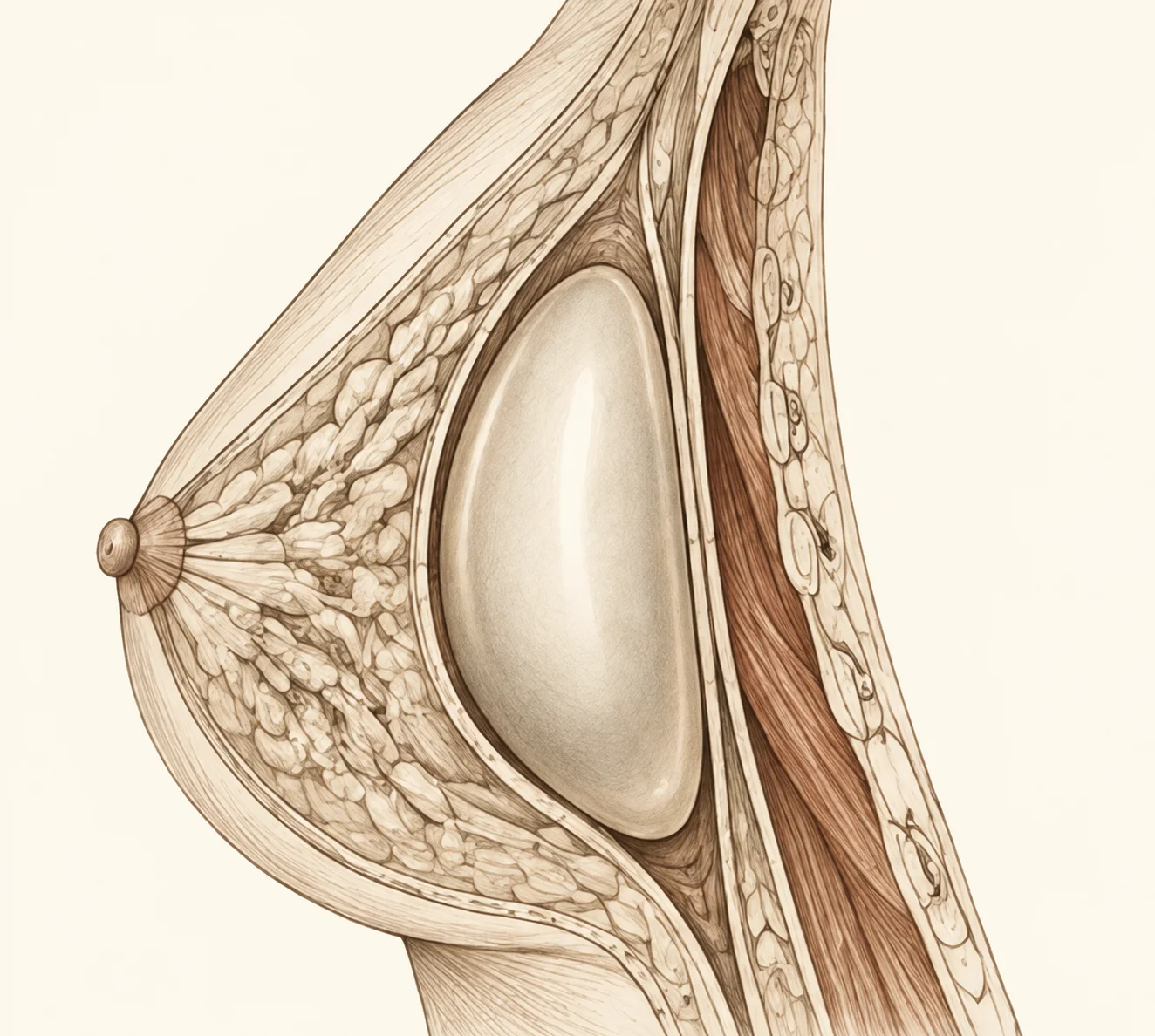
What patients are usually describing
The request is usually for a smoother, more continuous curve from hairline to brow. What patients notice is that the upper third reads flat in profile, or that side lighting in photographs exposes a plane where they expect a curve. It is rarely described as a dramatic concern; it is described as an imbalance.
Forehead contour contributes substantially to facial balance, so that observation is usually accurate. What is less often accurate is the assumption that the forehead is a surface to be filled. It is a structural region with bony shape, sinus anatomy and soft-tissue thickness, and those three things determine what will look natural.
What forehead augmentation actually is
Forehead augmentation refers to procedures that increase forehead contour, using either structural augmentation — such as an implant — or volumetric augmentation, such as fat grafting. Which of those is appropriate depends on anatomy and goals rather than on preference.
The objective is to improve forehead shape and the transitions into the brow and temples. It is not to produce a template curvature. A forehead that has been augmented toward an ideal shape without reference to the brow, nose and midface will read as an addition rather than as the patient’s own structure.
A forehead can look flat without being flat.
Some foreheads are genuinely flat or concave at the skeletal level. Others appear flat because of hairline shape, because the brow is prominent, or simply because of how light falls in a particular photograph. Others have soft-tissue deficiency rather than a bony one. These are four different findings and they lead to different recommendations, one of which is no augmentation at all.
How the method is chosen
Method choice follows the dominant limitation. Where the deficiency is structural, an implant provides structural change — but it requires precise sizing and careful edge control, because the soft tissue has to drape over something that does not move. Where the deficiency is in the soft tissue, fat grafting provides a softer contour change, at the cost of biologic variability in what is retained.
Individual tissue behaviour affects both routes. In fat grafting it influences swelling and retention. With an implant, it influences how the overlying tissues drape and therefore how visible any edge becomes. Thin tissue is the least forgiving anatomy in either case.
Sinus anatomy and tissue thickness set the boundaries
The forehead is not uniformly solid, and the shape of the underlying structures limits what can be changed and where. Soft-tissue thickness then determines how any structural change reads at the surface: the same augmentation produces a smooth result under thicker tissue and a detectable one under thin tissue.
Choosing between the available routes
The three columns below are not three products. They are three answers to the question of what is actually limiting the contour, and the third is the one most often overlooked.
Structural, volumetric, or a different operation entirely
| Feature | Implant-based augmentation | Fat grafting | The concern is not contour |
|---|---|---|---|
| Dominant limitation | True skeletal flatness or concavity | Soft-tissue deficiency | Forehead height, hairline shape or brow dominance |
| Nature of the change | Structural; can be long-lasting | Softer contour change; biologic | Augmentation would not address the mechanism |
| Main technical demand | Precise sizing and edge control | Conservative distribution; retention is variable | Correct diagnosis before any surgery |
| Principal risk | Visible edges, especially in thin tissue | Irregularity and unpredictable retention | An operation performed for the wrong problem |
What happens conceptually
The plan begins with facial analysis rather than with a chosen method: the forehead is assessed in relation to the brow, nose and midface, and the dominant limitation is identified. The augmentation is then designed to the smallest degree that resolves the imbalance, with attention concentrated on the transitions at the brow and temples rather than on the central prominence.
Where forehead augmentation is combined with other facial surgery — which is often reasonable — the combination has to be planned as a whole, because several structural changes at once will shift overall facial balance in ways that are not obvious when each is considered separately.
Height and contour are two different complaints
A patient who feels their forehead is too tall has a proportion problem, and augmentation does not address it — hairline lowering does. A patient who feels their forehead is too flat has a contour problem. These are frequently confused at consultation, partly because both are described as “my forehead bothers me”. Separating them is the first useful thing the examination does, because performing the wrong one leaves the original concern intact and adds a new commitment.
What it can change, and what it cannot
It can refine upper-face balance by improving contour transitions in a restrained way. What it cannot do is guarantee symmetry — most faces are asymmetric and the objective is improved balance rather than a matched pair. It does not replace hairline lowering when forehead height is the real concern. And it is not the right answer when the brow region is dominant and requires different structural work, or when brow and sinus anatomy make the requested change unrealistic.
The limits deserve stating directly. The safest changes are moderate. Over-augmentation creates an obvious result, and thin tissue reveals edges. Settling is staged, and volume planning should be cautious.
The initial design should be the conservative one
Revision here is more complex than the first operation, because scar planes are altered and the tissue no longer behaves as it did. That asymmetry between a first procedure and a second is why I design conservatively at the outset rather than aiming for the maximum defensible change. A forehead that needs a little more later is a manageable situation. A forehead that has been over-augmented is not.
Recovery is a sequence, not a single date.
- Early phaseSwelling prominent in the upper face
Swelling can be marked in this region, and numbness can occur. The contour at this stage bears little relation to the eventual one.
- Staged-settling phaseEarly contour is not final
The contour settles progressively rather than at a single point, and the pace differs between implant-based and graft-based augmentation.
- Assessment phaseJudged over months
The result is judged over months. With fat grafting this is also when retention becomes apparent and any further conservative session can be considered.
Recovery variability depends on method as well as on the individual. I avoid fixed timelines for that reason.
What should be weighed in the decision?
These points belong in the decision itself, not in the aftercare conversation.
- Trade-off: an implant gives structural, potentially long-lasting change but requires exact sizing and edge control.
- Trade-off: fat grafting gives a softer, more forgiving contour but with variable retention.
- Trade-off: a conservative design is less dramatic but substantially safer to live with.
- Trade-off: combining with other facial surgery can be efficient but shifts overall facial balance and requires whole-face planning.
- Limitation: visible edges are a real risk, particularly where soft tissue is thin.
- Limitation: asymmetry and contour irregularity can occur.
- Limitation: infection is a recognised risk.
- Limitation: over-augmentation is the main cause of an obvious result and is difficult to reverse.
- Limitation: the procedure does not guarantee symmetry.
- Limitation: it does not address forehead height; that is a hairline question.
- Limitation: brow and sinus anatomy can make a requested change unrealistic.
- Limitation: fat grafting retention is variable, so the result cannot be quantified in advance.
- Limitation: revision is more complex than the primary procedure because scar planes are altered.
- Limitation: soft tissues continue to age regardless of the structural change.
- Limitation: dissatisfaction is a genuine risk where expectations were unrealistic at the outset.
- Alternative: fat grafting instead of an implant, where the deficiency is in the soft tissue.
- Alternative: hairline lowering, where forehead height rather than contour is the concern.
- Alternative: structural work at the brow, where the brow region is the dominant feature.
- Alternative: treating a different region entirely, where the forehead is not what is creating the imbalance.
- Alternative: doing nothing, which is a reasonable conclusion when the forehead only appears flat.
How to think about the decision
Ask whether your forehead is structurally flat or only reads that way, and ask what specifically on examination supports the answer. Then ask which method is being proposed and why that one rather than the other. A plan that can explain the choice in terms of your bony contour and your tissue thickness is a plan you can evaluate; a plan that begins with the method is not.
When properly indicated, forehead augmentation refines upper-face balance quietly. The outcomes that hold up come from careful facial analysis, conservative augmentation design and individualised planning.
Who is a good candidate for forehead augmentation?
Good candidates typically have a true forehead contour deficiency that has bothered them consistently, and realistic expectations about subtlety. I assess forehead shape, brow anatomy, soft-tissue thickness and overall facial proportions. A good candidate accepts that individual tissue behaviour influences swelling and how the final contour reads.
Is fat grafting or an implant better?
Neither is universally better. Fat grafting is softer and biologic with variable retention. Implants provide structural contour but require precise sizing and edge control. The best choice depends on anatomy and goals.
How do you tell whether my forehead is genuinely flat?
By examining the bony contour in relation to the brow, hairline and midface rather than relying on photographs. Hairline shape, brow prominence and lighting can all make a normal forehead read as flat.
Will it look natural?
It can, when augmentation is conservative and transitions are smooth. Over-augmentation is the main reason results look obvious.
When is forehead augmentation not the right answer?
When the concern is forehead height rather than contour, or when brow and sinus anatomy make the desired change unrealistic.
How variable is recovery?
Swelling and numbness can occur, and early contour is not final. I avoid fixed timelines because healing depends on method and individual tissue behaviour.
What are the main risks?
Asymmetry, contour irregularity, visible edges — especially with thin tissue — infection, and dissatisfaction if expectations are unrealistic.
Can it be combined with other facial surgeries?
Yes, often, but combinations should be planned carefully because multiple structural changes can shift overall facial balance.
Can it be revised if I want less?
Revision may be considered if augmentation is excessive or irregular, but it is more complex because scar planes are altered. This is why the initial design should be conservative.
What if I have facial asymmetry?
Most faces have asymmetry. The goal is improved balance, not perfect symmetry.
How long-lasting are results?
Structural changes can be long-lasting. Fat grafting retention is variable. Soft tissues continue to age in either case.
What should I realistically expect?
Improved forehead contour and smoother transitions — not a dramatic change in identity.