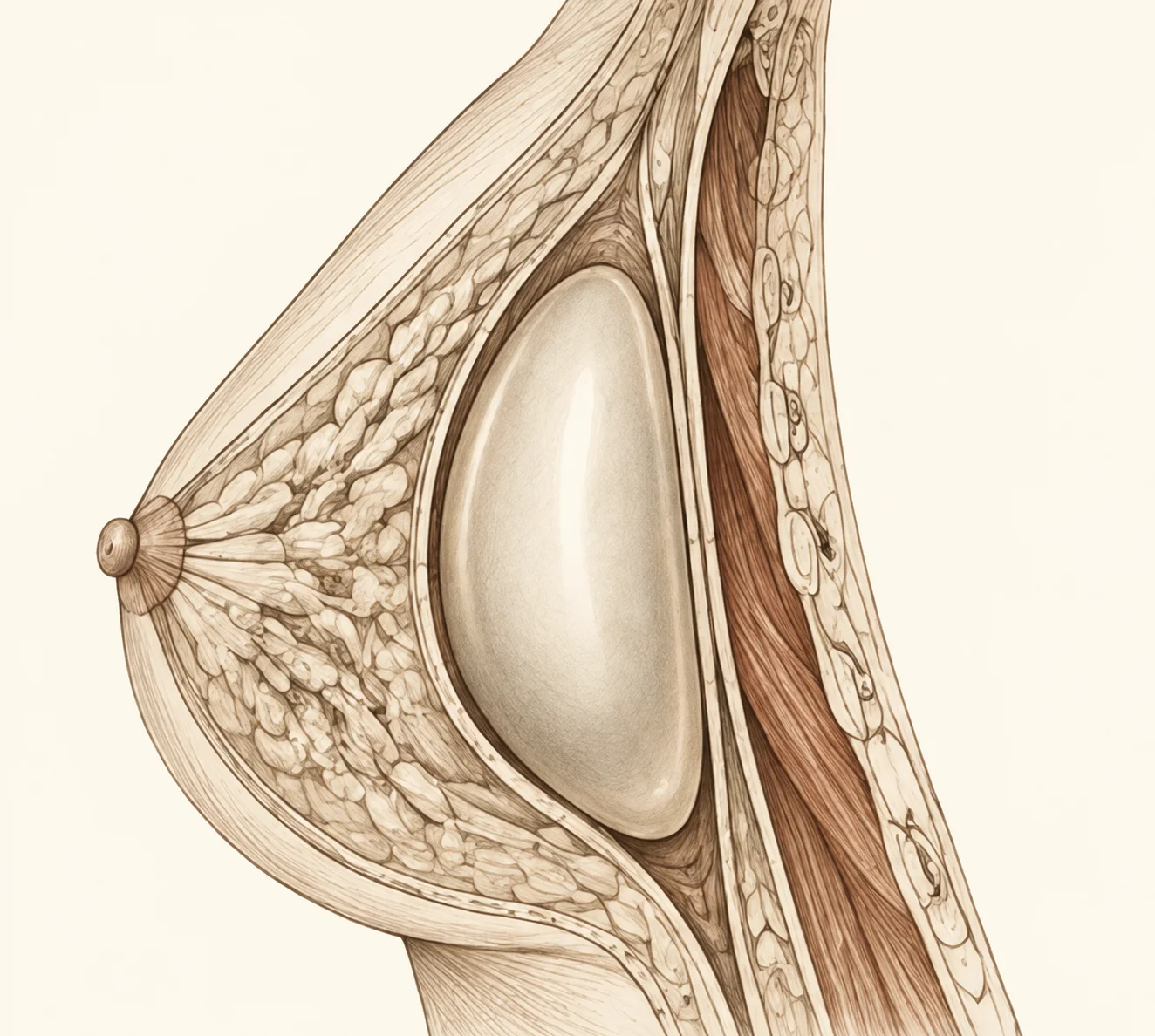
When a facial implant looks obvious or feels uncomfortable, the issue is rarely only the implant. It is more often a mismatch between size and anatomy, the mechanics of the pocket it sits in, and the way soft tissue drapes over a fixed structure.
That distinction matters because it changes what the operation is. Removal or revision is not simply taking an implant out or swapping it for another. It is correcting the structural and soft-tissue mechanics that produced the problem in the first place.
What the operation actually covers
Facial implant removal or revision refers to surgical procedures performed to remove a facial implant, or to modify the implant strategy when the result is unsatisfactory. That can include removal, replacement with a different size or shape, correction of the pocket, and management of capsule or scar tissue.
Common implant sites are the chin, the cheek or malar region, and the jawline. The correct plan depends on where the implant sits, how thick the tissue coverage is, and — most importantly — the specific reason for dissatisfaction.
The mechanism is the diagnosis
Dissatisfaction with a facial implant is usually specific rather than general: a sharp edge, asymmetry, an unnatural highlight, discomfort, or a face that reads implant-led. Each of those complaints has more than one possible cause, and the cause determines the operation.
A prominent implant edge may reflect thin tissue coverage, or over-sizing. Asymmetry may reflect baseline skeletal asymmetry, differences between the two pockets, or implant malposition. Discomfort may reflect capsule behaviour, nerve irritation, or positional conflict with natural movement. Each scenario requires a different revision logic.
Treating every problem as “exchange the implant” is how revisions repeat.
This is the pattern I see most often in patients arriving for a second or third correction. The complaint was real, the surgery was performed competently, and the mechanism was never identified — so a differently sized implant was placed into a pocket that was itself the problem, or a malposition was addressed by changing the implant rather than the pocket. The result is a cycle in which each operation improves something and leaves the underlying mechanics untouched. And the cycle is costly in a specific way: each additional operation increases scar planes and reduces predictability. That is why the first revision should be treated as the structural one, rather than as the first of several small adjustments.
Three mechanisms, three different revisions
| Feature | Visible edge or over-prominence | Asymmetry or malposition | Discomfort |
|---|---|---|---|
| What the patient describes | A sharp edge, an unnatural highlight, or a face that reads implant-led | One side sits differently, or the implant appears off-position | The implant feels uncomfortable, or conflicts with natural movement |
| Possible mechanisms | Thin tissue coverage, or over-sizing relative to the anatomy | Baseline skeletal asymmetry, differences between the pockets, or implant malposition | Capsule behaviour, nerve irritation, or positional conflict with movement |
| What the revision usually addresses | Downsizing, removal, or improving tissue coverage rather than changing shape alone | Pocket correction — the implant may be appropriate and simply badly positioned | Individualised capsule management, or reconsidering whether an implant suits this anatomy |
| Why the mechanism has to be named first | The same visible complaint can arise from different causes, and each cause has a different correction. Where the mechanism is not identified, the default becomes exchanging the implant — which resolves only the subset of cases in which the implant itself was genuinely the problem | ||
Soft tissue has to drape over something that does not move
An implant is a fixed structure beneath tissue that is not fixed. Everything that goes right or wrong aesthetically happens at that interface. Where coverage is thick, the same implant reads as structure; where it is thin, the same implant reads as an edge. After removal, the area may look flatter than expected, and small contour irregularities can become visible as tissues re-drape into a space that has changed shape. Individual tissue behaviour then influences swelling, scar maturation and how quickly the contour looks stable — which is why soft tissue behaviour sets the limits of what any revision can promise.
Sometimes the right answer is a flatter face
In some cases the safest solution is removal and acceptance of a more natural baseline. That is not a failure of the revision — it is often the most durable outcome available, particularly where tissues are thin or unstable and where the alternative is a continuing cycle of adjustment. It is also not always the right answer to keep increasing implant size when the tissues cannot support it; sometimes the responsible plan is downsizing, removal, or moving to a different technique category altogether. If augmentation is still genuinely wanted, the coherent next step may be a smaller, better-matched implant, a different pocket strategy, or a different structural approach such as bony correction or fat grafting. What the plan should not do is chase trends.
Capsule and scar management is individualised
Capsule behaviour varies. Some capsules are thin and quiet and have no bearing on the contour. Others influence it directly, and a distorted pocket left in place can compromise the result even after the implant question has been settled.
The judgement here runs in both directions: more dissection is not automatically better, but leaving a distorted pocket can compromise contour. More removal is not automatically better either. This is one of the areas where a general policy does more harm than an individual assessment.
I plan revision on a long horizon, not a short one
Revision work requires a long-horizon view, and that shapes how I approach a first consultation. My priority is not the fastest visible improvement — it is a stable result that does not require another operation to maintain. So I want three things established before I operate: the true mechanism of the dissatisfaction, the most conservative correction that addresses it, and whether any structural deficiency still genuinely needs correcting at all. Where a patient has already had several revisions, predictability has decreased with each one, and the plan has to prioritise stability and natural contour over fine aesthetic preferences. The face should end up looking coherent, not like a series of corrections.
Recovery is a sequence, not a single date.
- Early phaseSwelling and firmness are expected
Both vary between individuals and with the scope of the surgery performed. Early contour is not final contour, and this is the least informative period for judging the result.
- Prolonged-firmness phaseFirmness can persist longer than patients expect
Persistent firmness is common in revision work and does not in itself indicate a problem. Individual tissue behaviour influences swelling, scar maturation and how quickly the contour begins to look stable.
- Contour stabilisationThe face refines over weeks to months
After removal in particular, tissues re-drape gradually and the contour needs time to settle into its new shape. I avoid fixed timelines because healing depends on individual tissue behaviour and surgical scope.
What should be weighed in the decision?
Revision surgery is more complex than primary surgery, and it is being performed in tissues that have already been operated on. The balance depends on how clearly the mechanism has been identified and how conservative the correction can be.
- Trade-off: each additional operation increases scar planes and reduces predictability, so the number of revisions matters as much as their quality.
- Trade-off: after removal, the area may look flatter than expected, and that flatter baseline may be the more stable outcome.
- Trade-off: small contour irregularities can become visible as tissues re-drape.
- Trade-off: capsule management cuts both ways — more dissection is not automatically better, but leaving a distorted pocket can compromise contour.
- Trade-off: swelling and firmness can persist, and contour stabilises over weeks to months rather than immediately.
- Trade-off: correcting the mechanism conservatively may mean accepting a less refined result than a further intervention might theoretically achieve.
- Limitation: risks include bleeding, infection, sensory changes, asymmetry, contour irregularity, and the need for further revision.
- Limitation: it is not a guarantee of returning to a pre-implant face.
- Limitation: it is not a guarantee of perfect symmetry, and baseline skeletal asymmetry may have been part of the original problem.
- Limitation: it does not guarantee that all contour concerns can be solved without trade-offs.
- Limitation: soft tissue behaviour sets limits on what any plan can achieve, independently of technique.
- Limitation: where multiple revisions have already been performed, predictability is lower and the plan must prioritise stability over fine preferences.
- Limitation: results can be durable when the mechanism is corrected, but ageing and tissue changes continue.
- Alternative: where the implant is appropriate but malpositioned, pocket correction rather than exchange may be the correct operation.
- Alternative: where size or shape mismatch is the issue, exchange for a smaller, better-matched implant may be appropriate.
- Alternative: where the implant is fundamentally incompatible with the anatomy or the goals, removal may be the most responsible option.
- Alternative: where structural change is still wanted, bony correction or fat grafting may be a more coherent approach than another implant.
- Alternative: where fat grafting is used to soften transitions or improve coverage, it is biologic and must be planned conservatively rather than relied on to guarantee coverage.
- Alternative: where tissues are thin or unstable, downsizing or removal is safer than increasing implant size.
How to think about the decision
The decision is on solid ground when the mechanism of dissatisfaction has been named specifically rather than described generally; when it is clear whether the implant, the pocket, the coverage or the capsule is the actual problem; when the possibility that removal alone is the best answer has been genuinely considered; and when the plan is built around one structural correction rather than a series of small changes.
When properly indicated, facial implant removal or revision can restore a calmer facial contour and improve comfort. The best outcomes come from precise diagnosis, conservative correction, and individualised planning that respects tissue behaviour and long-term facial harmony. An in-person assessment is the safest way to define the mechanism of dissatisfaction and the most conservative path to a stable result.
Why do patients seek facial implant removal or revision?
Common reasons include implants that look too prominent, visible edges, asymmetry, malposition, discomfort, or results that feel unnatural over time. Some patients’ preferences change. Others discover the implant was compensating for a skeletal issue better addressed differently. Revision planning starts with mechanism, not assumption.
Do you always need to remove the implant?
Not always. If the implant is appropriate but malpositioned, revision may focus on pocket correction. If size or shape mismatch is the issue, exchange may be appropriate. If the implant is fundamentally incompatible with the anatomy or goals, removal may be the most responsible option.
Why did my first revision not solve the problem?
Often because the mechanism was not identified and the implant was exchanged instead. A prominent edge, an asymmetry and discomfort each have several possible causes, and exchanging the implant only helps where the implant itself was the cause.
Will the face look “sunken” after removal?
It can look flatter, especially if the implant was providing significant projection. Whether that is a problem depends on your baseline anatomy and goals. Some patients prefer the natural baseline. Others may consider an alternative structural plan.
How do you manage capsule or scar tissue?
Capsule behaviour varies. Some capsules are thin and quiet. Others influence contour. Management is individualised. More removal is not automatically better.
When is revision not the right answer?
It is not always the right answer to keep increasing implant size when tissues are thin or unstable. Sometimes the responsible plan is downsizing, removal, or using a different technique category.
How variable is recovery?
Swelling and firmness vary, and contour stabilises over weeks to months. I avoid fixed timelines because healing depends on individual tissue behaviour and surgical scope.
What are the main risks?
Risks include bleeding, infection, sensory changes, asymmetry, contour irregularity, and the need for further revision. Revision surgery is more complex than primary surgery.
Can facial implant revision be combined with fat grafting?
Yes, in selected cases. Fat grafting can soften transitions and improve tissue coverage, but it is biologic and must be planned conservatively.
Could a different approach suit my anatomy better than an implant?
Sometimes. Where an implant has been compensating for a structural issue, bony correction or fat grafting may be a more coherent approach. That is a diagnostic question rather than a preference.
What if I have had multiple revisions?
Predictability decreases with each surgery. The plan must prioritise stability and natural contour rather than chasing fine aesthetic preferences.
How long-lasting are results?
Results can be durable when the mechanism is corrected, but ageing and tissue changes continue. Conservative revision tends to remain more natural over time.