Cheek augmentation is usually approached as “more cheekbones,” and sometimes described as a simple way to add them.
The midface, however, is not a single point of projection. It is a complex region where bone, fat compartments and eyelid support interact. A small structural change can look refined. An excessive or poorly positioned implant can look artificial — particularly as the face ages.
The question that has to be answered before an implant is considered
Midface aesthetics depend on skeletal projection, soft-tissue thickness, and how the cheek transitions into the lower eyelid and nasolabial region. An implant can improve structure, but only when the limitation is genuinely skeletal.
If the issue is soft-tissue descent or volume loss, a different strategy may be more appropriate. That is the whole decision, and it is made before implant design is discussed rather than after.
What the operation actually does
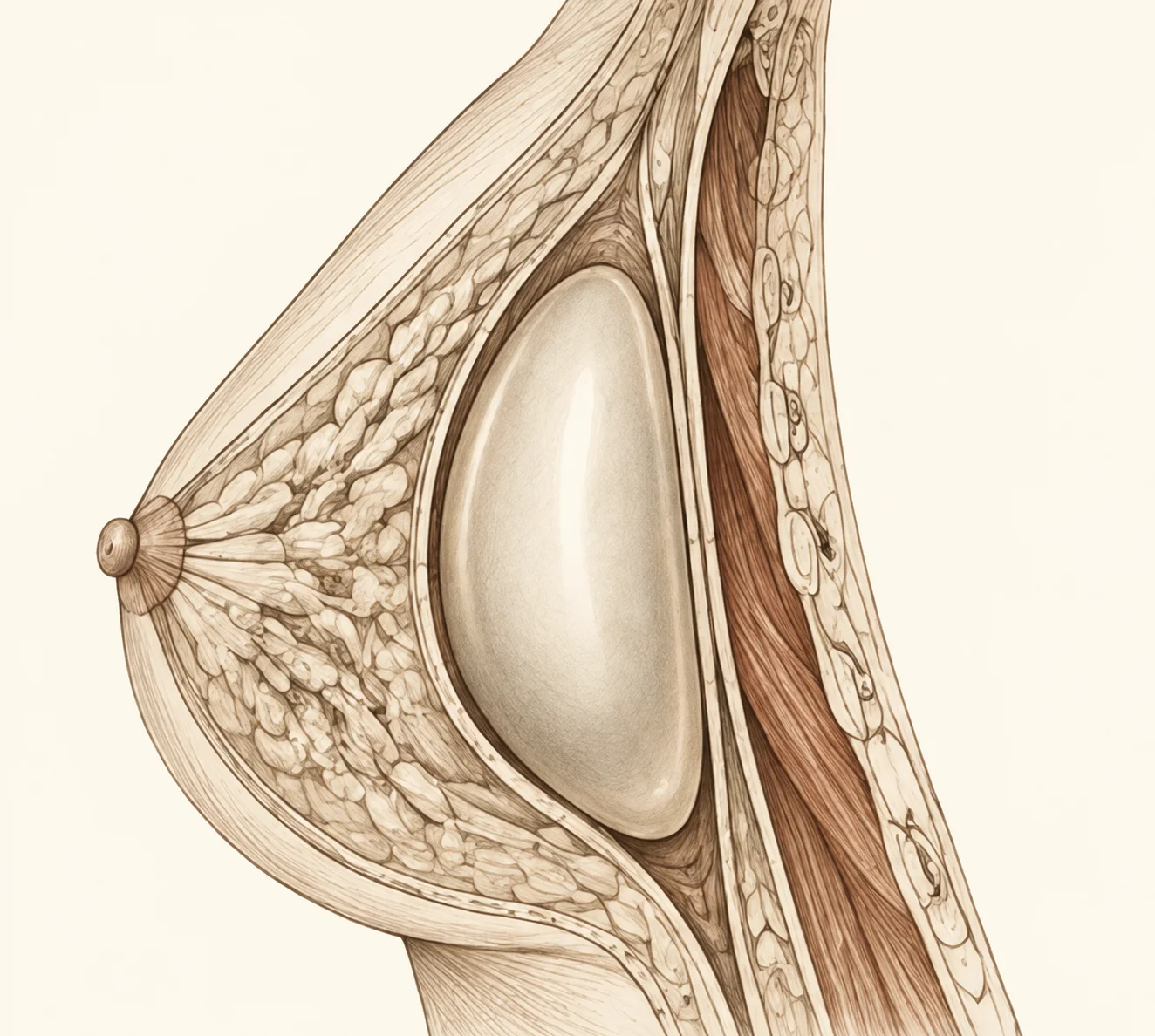
Cheek augmentation with implants increases midface projection using an implant placed on the zygomatic region. The objective is improved cheek definition, better midface support and a more balanced facial contour, in selected patients with structural underprojection.
Implant design and placement are chosen to match facial width, projection needs and soft-tissue thickness. Those three variables are why this is a planning operation rather than a sizing one.
The midface is read in transitions, not in one point of projection
The cheek must blend into the lower eyelid, the lateral midface and the nasolabial region, which is why transition planning is central rather than secondary. Over-augmentation can create a harsh highlight and an implant-defined contour, and thin tissue increases the risk of visible edges. Individual tissue behaviour influences swelling and long-term soft-tissue drape — but skeletal planning sets the foundation, and the placement has to respect the orbital rim and the natural malar highlight rather than override them.
Not every flat-looking cheek is an underprojected cheek
The anatomical complexity begins with the type of deficiency. Some faces are truly underprojected in the malar region and benefit from structural augmentation.
Others have adequate bone but appear flat because of soft-tissue descent, volume loss or skin thickness. In those faces an implant may not address the dominant problem, and it can sometimes create an unnatural “ledge” rather than a smooth contour — adding structure to a region whose problem was never structural.
Three midface presentations that can all look like “flat cheeks”
| Feature | True skeletal underprojection | Soft-tissue descent | Volume loss or skin thickness |
|---|---|---|---|
| What is actually creating the appearance | The malar region is genuinely underprojected | Adequate bone, but the soft tissue has descended | Adequate bone, but volume is reduced or skin thickness masks contour |
| What an implant can offer | Structural augmentation that improves projection and midface support | Little, because the dominant problem is position rather than projection | Little, because the dominant problem is volume rather than structure |
| What is more likely to be appropriate | Conservative implant selection matched to facial width and tissue thickness | A lifting strategy | A volumetric strategy |
| Risk of treating it as a skeletal problem | An implant placed where the deficiency is not skeletal can create an unnatural “ledge” instead of a smooth contour, and leave the original complaint unchanged | ||
This is one of the few operations where the result gets harder, not easier, with time
The safest changes here are moderate, and the reason is temporal rather than surgical. Larger projection increases the risk of an obvious result — and it can age poorly as the soft tissues change, because the implant stays the same while the tissue draped over it does not. An augmentation that reads as refined at forty can read as implant-defined later. That is why implant-based augmentation requires long-term thinking, including the possibility of revision if position shifts or if preferences change.
What cheek implants are not
They are not a substitute for a facelift when midface descent is dominant. They do not correct skin laxity. And they do not guarantee symmetry — facial asymmetry is common and healing is variable.
They are also not always the right answer when the desired result is trend-driven rather than anatomy-driven. Skeletal asymmetry, where it exists, sets a ceiling for correction: the goal is improved balance rather than perfect symmetry.
The complaint is usually about structure in profile and light
Patients describe a midface that lacks definition — a flatter malar contour that changes how the upper face is framed, particularly in photographs and in side lighting. The concern is usually about structure rather than a wish for a dramatic change. That framing is clinically useful, because a structural complaint in a face with genuine malar underprojection is exactly the indication for this operation, whereas the same complaint in a face with descent or volume loss is pointing at a different diagnosis.
I plan projection against the face, not against the request
I plan augmentation to match facial width and projection needs, and to maintain smooth transitions — and placement has to respect the orbital rim and the natural malar highlight. Over-projection looks artificial, and an implant-obvious highlight usually reflects over-augmentation or poor transition planning rather than the implant itself. In thin tissue I plan more conservatively again, because thin tissue is where visible edges appear. What I am aiming for is stronger midface support with smooth transitions, not a sharp, implant-obvious contour.
Recovery is a sequence, not a single date.
- Early phaseSwelling, tightness and sensitivity
Swelling varies between patients. Tightness and sensitivity can occur in this phase.
- Distorted-contour phaseEarly fullness is not the shape
Swelling can distort the early contour, which means the midface can look fuller and less defined than the plan before it looks like the plan.
- Settling phaseThe final shape becomes clearer
The final shape becomes clearer as the tissues settle. I avoid fixed timelines here because healing depends on individual tissue behaviour.
The middle phase deserves to be named in advance, because it is the opposite of what patients expect from a projection operation: early fullness reads as too much, not too little, and staged refinement of judgement matters more here than an early verdict.
Why the first design should prioritise proportion over projection
Revision logic is present in this operation. If implants are malpositioned, too prominent or not suited to the anatomy, revision or removal may be considered. But revision is more complex, because scar planes are altered.
Revision planning also begins with diagnosis rather than with technique: implant position, size relative to anatomy, soft-tissue condition, and the actual reason for the dissatisfaction. Removal or exchange can be considered, but revision surgery has narrower margins and should be conservative. All of which is the argument for making the initial design prioritise proportion and smooth transitions rather than maximum definition.
What should be weighed in the decision?
This is a permanent structural change to a region that is read in transitions and that continues to change with age.
- Trade-off: the safest changes are moderate, which means stronger midface support with smooth transitions rather than a sharp, implant-obvious contour.
- Trade-off: larger projection increases the risk of an obvious result, and it can age poorly as the soft tissues change.
- Trade-off: thin tissue can be augmented, but it requires more conservative planning because it is where visible edges appear.
- Trade-off: swelling can distort the early contour, so the result cannot be judged until the tissues settle.
- Trade-off: it can be combined with other facial procedures, but combinations need careful planning because multiple structural changes can shift facial balance.
- Limitation: it is not a substitute for a facelift when midface descent is dominant.
- Limitation: it does not correct skin laxity.
- Limitation: it does not guarantee symmetry; facial asymmetry is common and healing is variable.
- Limitation: skeletal asymmetry sets a ceiling for correction, so the goal is improved balance rather than perfect symmetry.
- Limitation: where the deficiency is not skeletal, an implant can create an unnatural “ledge” rather than a smooth contour.
- Limitation: over-augmentation or poor transition planning can produce a harsh highlight and an implant-defined contour.
- Limitation: risks include asymmetry, implant malposition, visible or palpable edges, infection, and dissatisfaction where expectations are unrealistic.
- Limitation: implants can provide durable structural support, but the face continues to age and soft-tissue changes influence how the result reads over time.
- Limitation: implant-based augmentation requires long-term thinking, including the possibility of revision if position shifts or preferences change.
- Limitation: revision is possible but more complex than primary placement, because scar planes are altered.
- Alternative: where soft-tissue descent is dominant, a lifting strategy may be more appropriate.
- Alternative: where generalised volume loss is dominant, a volumetric strategy may be more appropriate.
- Alternative: where the deficiency is mixed, augmentation may need to be structural, volumetric or both — which is a decision made on examination.
- Alternative: where the desired result is trend-driven rather than anatomy-driven, this is not the right operation.
How to think about the decision
The decision is sound when the type of deficiency has been identified rather than assumed, when soft-tissue thickness has been assessed alongside skeletal projection, when the plan has been described in terms of transitions rather than of projection alone, when the expectation is controlled refinement rather than a defined highlight, and when the long-term view — including how the result will read as the face ages — has been part of the conversation.
An in-person assessment is the safest way to define whether augmentation should be structural, volumetric or both — because that distinction depends on bone, soft-tissue thickness and midface position, which a photograph alone does not resolve.
When properly indicated, cheek implants provide controlled refinement by improving midface structure and support. The best outcomes come from careful facial analysis, conservative implant selection, and individualised planning that respects long-term facial balance.
Who is a good candidate for cheek implants?
Good candidates typically have true structural underprojection of the malar region and want a defined but natural midface contour. I assess facial proportions, soft-tissue thickness, and how the cheek relates to the lower eyelid and nasolabial region. Thin tissue requires conservative planning to avoid visible edges. A good candidate wants controlled refinement and accepts that individual tissue behaviour influences swelling and how the implant settles.
How do you decide implant size and position?
I plan augmentation to match facial width and projection needs, and to maintain smooth transitions. Over-projection can look artificial. Placement must respect the orbital rim and the natural malar highlight.
How do you tell whether my flat midface is skeletal or soft-tissue?
That distinction is the assessment. Some faces are genuinely underprojected in the malar region. Others have adequate bone and appear flat because of soft-tissue descent, volume loss or skin thickness. Only the first group is addressed by an implant, which is why the deficiency type is defined before implant design is discussed.
Will cheek implants make me look “done”?
They should not. An implant-obvious highlight usually reflects over-augmentation or poor transition planning. Conservative sizing and correct placement reduce that risk.
When are cheek implants not the right answer?
They are not always the right answer when the dominant issue is soft-tissue descent, skin laxity or generalised volume loss. In those cases a lifting or volumetric strategy may be more appropriate.
Why does thin tissue change the plan?
Because the implant is read through the tissue over it. Thin tissue increases the risk of visible edges, so projection is planned more conservatively in that anatomy. Individual tissue behaviour also influences long-term soft-tissue drape, while skeletal planning sets the foundation.
How variable is recovery?
Swelling varies and can distort early contour. Tightness and sensitivity can occur. I avoid fixed timelines because healing depends on individual tissue behaviour.
What are the main risks?
Risks include asymmetry, implant malposition, visible or palpable edges, infection, and dissatisfaction if expectations are unrealistic. Revision is possible but more complex than primary placement.
Can cheek implants be combined with other facial procedures?
Yes, but combinations should be planned carefully because multiple structural changes can shift facial balance. A coherent plan is essential.
What if I have facial asymmetry?
Most faces have asymmetry. The goal is improved balance, not perfect symmetry. Skeletal asymmetry sets a ceiling for correction.
How long-lasting are results?
Implants can provide durable structural support, but the face continues to age. Soft-tissue changes can influence how the result reads over time. Conservative augmentation tends to age more naturally.
What if I already have cheek implants and I am unhappy?
Revision planning begins with diagnosis: implant position, size relative to anatomy, soft-tissue condition, and the reason for dissatisfaction. Removal or exchange can be considered, but revision surgery has narrower margins and should be conservative.