Calf augmentation is usually described as “bigger calves.” Clinically, it is lower-leg proportion surgery, and that reframing changes what the operation is actually being asked to do.
The lower leg has tight soft tissue, visible borders and continuous motion with walking and training. Implant selection and pocket design have to respect anatomy, gait mechanics and soft-tissue coverage — which is why this is a conservative operation by nature rather than by preference.
What the operation actually does
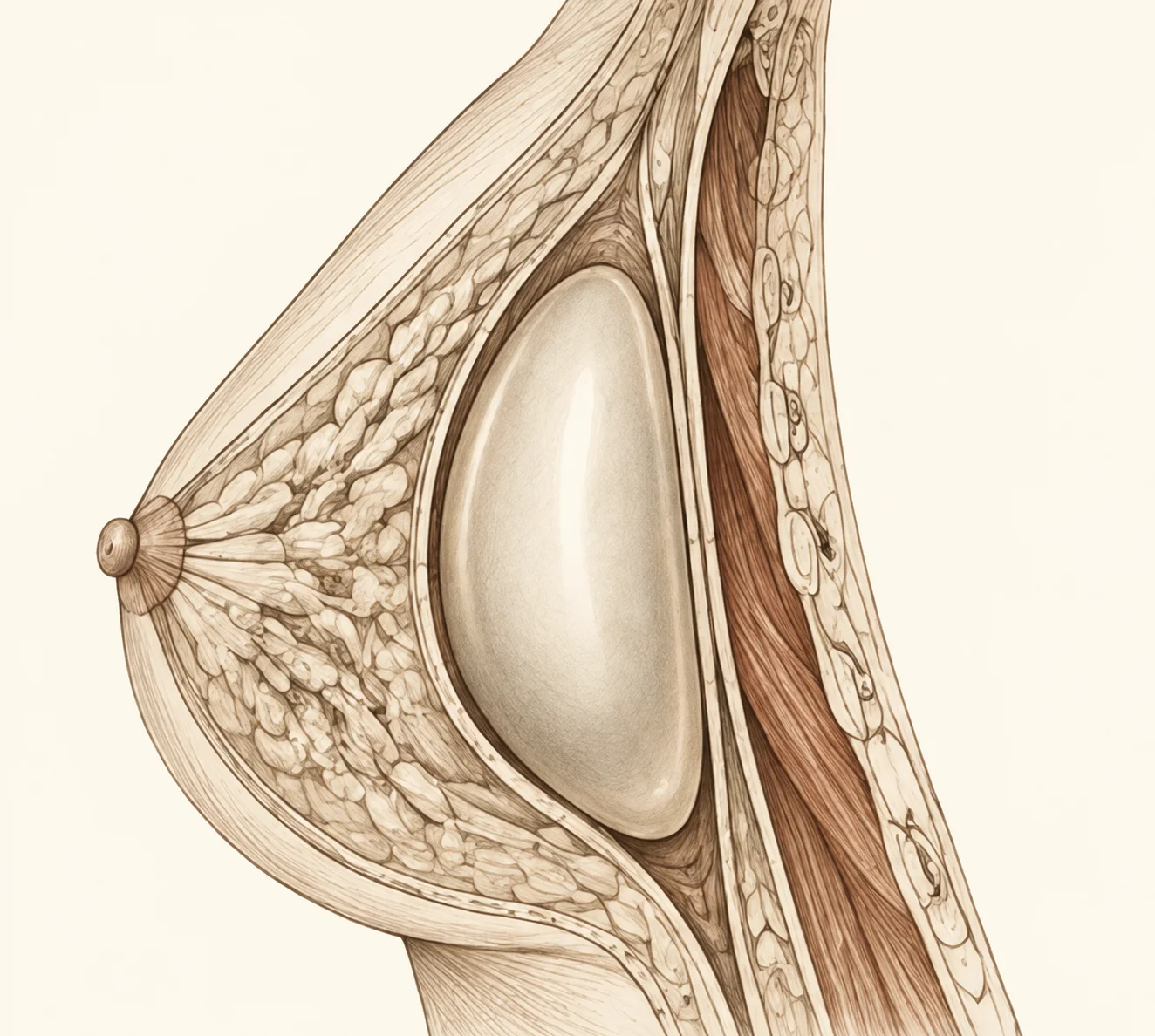
Calf augmentation with implants increases calf contour using specially shaped silicone implants. The implant is placed in a defined pocket, typically beneath the fascia of the gastrocnemius region, to improve volume and shape.
Indications include congenital thin calves, asymmetry, or contour deficiency after injury or neuromuscular conditions, as well as aesthetic proportion goals in selected patients. Those are not interchangeable starting points, and the distinction matters more here than the word “augmentation” suggests.
Why the reason for the deficiency changes the plan
Some calf deficiency is muscular underdevelopment. Some is congenital asymmetry. Some is post-traumatic or neuromuscular. These contexts change both the goals and the predictability of the result.
A patient with congenital deficiency and a patient with a post-neuromuscular contour problem may want a similar-looking outcome, but they are not operating on the same tissue, and the plan should not pretend otherwise. In selected post-neuromuscular or post-traumatic cases, planning must be cautious and individualised, because both the predictability and the risk profile can differ.
Coverage decides the ceiling before sizing does
The calf is a high-definition area. If tissue is thin, implant edges may be visible or palpable, regardless of how well the pocket is made. Tissue thickness and fascia characteristics set the main limits of the operation, and pocket placement and implant dimensions have to be conservative enough to avoid an implant-led contour — a shape that reads as a device rather than as a leg.
The calf is a working structure, not a display surface
Mechanics matter here in a way they do not in most augmentation surgery. The calf works continuously. Implant position must remain stable during movement, and the pocket has to be designed to minimise displacement.
Over-sizing increases pressure, increases discomfort, and increases the risk of visible contour issues. Those three consequences are related: a device that is too large for its pocket is under load every time the patient walks, and the tissue responds accordingly.
In the calf, size is a mechanical decision before it is an aesthetic one
The instinct in any augmentation is to ask how much can be added. In the lower leg, that question has to be answered by the coverage and the mechanics rather than by the goal. Thin tissue makes edges visible; a continuously working muscle makes an oversized pocket unstable. Conservative sizing is therefore not a compromise on the result — in this anatomy it is frequently the only version of the result that stays natural and stays put.
What calf implants are not
They are not a substitute for strength training in patients who have normal anatomy but want an extreme athletic look. They do not correct ankle width or knee shape. And they do not guarantee perfect symmetry, particularly when the baseline asymmetry is structural.
They can also improve contour and volume without replicating the dynamic definition of trained muscle in every anatomy. The realistic objective is proportional improvement, not a guaranteed athletic outline.
The limits should be stated directly
Some calf shapes cannot be converted into a completely different muscle outline safely. The safest changes are moderate and proportion-based. Patients with very thin tissue, or with unrealistic size goals, may simply not be good candidates — and identifying that before surgery is part of the assessment rather than a failure of it.
Three different starting points that all present as “my calves are too small”
| Feature | Congenital thin calves or asymmetry | Post-traumatic or neuromuscular deficiency | Normal anatomy, athletic goal |
|---|---|---|---|
| What is driving the deficiency | Structural volume deficiency or structural asymmetry | Contour deficiency following injury or a neuromuscular condition | No anatomical deficiency; the goal is a more developed outline |
| What surgery can offer | Improved lower-leg proportion in a restrained way | Contour improvement in selected cases | Implants are not a substitute for strength training |
| Principal consideration | Tissue thickness and fascia characteristics set the ceiling | Predictability and risk profile can differ; planning must be cautious | Extreme size goals reduce candidacy rather than increase the plan |
| Realistic expectation | Improved but not perfect symmetry | Individualised goals rather than a standard result | Implants cannot replicate dynamic trained definition in every anatomy |
The complaint is usually about proportion, not about size
Patients rarely describe wanting large calves. They describe a deficiency or asymmetry that stays visible in fitted clothing and in photographs despite consistent training, and the frustration is about the leg not reading as one continuous shape. That framing is clinically useful, because a proportion complaint is answerable with a moderate, well-covered implant — whereas a size complaint tends to push towards exactly the dimensions the tissue cannot support.
I size the implant to the coverage and the gait, not to the request
My sequence here is anatomical assessment first — muscle shape, skin thickness, fascia tightness, and the relationship between the calf, the ankle and the knee — then conservative implant selection, then a plan built around biomechanics and long-term stability. What I am aiming for is improved lower-leg contour that stays proportionate to the ankle, the knee and the overall frame, without an obvious implant outline. In a high-definition, continuously working area, that restraint is the technique.
Recovery is a sequence, not a single date.
- Early phaseSwelling, tightness and walking discomfort
Swelling and tightness are expected early, and temporary walking discomfort can occur. Early stiffness is part of the normal course rather than a sign that something is wrong.
- Staged activity returnLoad is reintroduced in steps
Activity return is staged rather than resumed at once, because the implant sits in a region that is loaded with every step.
- Gradual settlingContour and scar mature over time
Settling is gradual. Individual tissue behaviour influences both swelling and scar maturation, so the pace differs between patients even with the same plan.
I avoid fixed timelines in this region because healing depends on individual tissue behaviour and on postoperative care, and because the calf is being loaded continuously throughout the recovery rather than resting through it.
Why the first operation should be the conservative one
Revision logic is part of planning rather than an afterthought. If implant position is unsatisfactory, or if edges are visible, revision may be considered.
But revision is more complex here because the scar planes have been altered. Secondary enlargement in particular has to be approached carefully, because the pocket has limits — over-expansion increases risk and tends to look artificial. That is the practical argument for prioritising conservative sizing and stable pocket design at the first operation rather than treating it as a starting position to be built on later.
What should be weighed in the decision?
This is a device placed into a thin-cover, high-motion region. The trade-offs follow from those two facts.
- Trade-off: the calf is a high-definition area, so the same implant that gives a good result under adequate cover can read as a visible outline under thin tissue.
- Trade-off: conservative sizing protects the naturalness and stability of the result, but it delivers a moderate change rather than a dramatic one.
- Trade-off: the implant sits in a continuously working region, so activity return is staged rather than immediate.
- Trade-off: over-sizing increases pressure, discomfort and the risk of visible contour issues.
- Limitation: tissue thickness and fascia characteristics set the main limits, not the surgical plan.
- Limitation: if tissue is thin, implant edges may be visible or palpable, and no surgeon should promise an invisible implant in very thin tissues.
- Limitation: implants do not correct ankle width or knee shape.
- Limitation: they cannot replicate the dynamic definition of trained muscle in every anatomy.
- Limitation: perfect symmetry is not a realistic promise; structural differences and healing variability persist.
- Limitation: some calf shapes cannot be converted into a completely different muscle outline safely.
- Limitation: risks include infection, implant displacement, contour irregularity, visible or palpable edges, and prolonged discomfort.
- Limitation: individual tissue behaviour influences swelling and scar maturation.
- Limitation: long-term stability depends on pocket integrity, tissue behaviour and lifestyle.
- Limitation: revision is more complex because scar planes are altered.
- Limitation: secondary enlargement is constrained because the pocket has limits, and over-expansion increases risk.
- Alternative: in patients with normal anatomy who want a more developed outline, strength training addresses the goal that implants are not designed to address.
- Alternative: where tissue is too thin for the desired change, or where expectations require a dramatic transformation, declining surgery is the correct clinical answer.
- Alternative: where medical risk factors make surgery unsafe, no implant plan is appropriate.
How to think about the decision
The decision is sound when the reason for the deficiency has been identified rather than assumed, when the soft-tissue coverage has been assessed honestly, when the implant has been sized to the anatomy rather than to the ambition, and when the goal has been stated as proportion rather than size.
A detailed in-person assessment is the safest way to define candidacy, implant dimensions and realistic expectations, because coverage and fascia characteristics are difficult to judge from photographs alone.
When properly indicated, calf implants can improve lower-leg proportion in a restrained way, particularly in patients with congenital deficiency or asymmetry. The best outcomes come from anatomical assessment, conservative implant selection, and a plan that respects biomechanics and long-term stability — a calf that reads as proportionate to the ankle, the knee and the frame, without an obvious implant outline.
Who is a good candidate for calf implants?
Good candidates typically have calf volume deficiency or asymmetry that is stable and does not respond to training, or contour deficiency that is congenital or follows injury. I assess muscle shape, skin thickness, fascia tightness and overall leg proportions. Thin tissue and extreme size goals reduce candidacy. A good candidate wants controlled refinement and accepts that individual tissue behaviour influences healing and how natural the contour looks.
Where exactly is the implant placed?
The implant is placed in a defined pocket, typically beneath the fascia of the gastrocnemius region. Pocket design matters as much as implant choice here, because the calf is in continuous motion and the position has to remain stable during movement.
Can implants create an athletic calf shape?
They can improve contour and volume, but they cannot replicate the dynamic definition of trained muscle in every anatomy. The goal is proportional improvement rather than a guaranteed athletic outline.
Will the implants be visible?
Visibility depends on tissue thickness and implant sizing. Conservative selection and correct pocket placement reduce edge visibility, but no surgeon should promise an invisible implant in very thin tissues. The calf is a high-definition area, and that works against oversized choices.
Why does implant size matter more than I might expect?
Because the calf works continuously. Over-sizing can increase pressure, discomfort and the risk of visible contour issues, and it makes the pocket harder to keep stable during movement. Sizing in this region is a mechanical decision as much as an aesthetic one.
How variable is recovery?
Swelling and tightness are expected early, and walking can feel stiff for a period. Activity return is staged. I avoid fixed timelines because healing depends on individual tissue behaviour and postoperative care.
What are the main risks?
Risks include infection, implant displacement, contour irregularity, visible or palpable edges, and prolonged discomfort. Conservative planning reduces risk.
Can calf implants correct asymmetry?
They can improve asymmetry, but perfect symmetry is not a realistic promise. Structural differences and healing variability persist, and asymmetry is addressed rather than erased.
What if I have a neuromuscular condition?
Calf augmentation can be considered in selected post-neuromuscular or post-traumatic cases, but planning must be cautious and individualised. Both predictability and the risk profile can differ from a straightforward congenital deficiency.
When are calf implants not the right answer?
They are not the right answer when tissue is too thin for the desired change, when expectations require a dramatic transformation, or when medical risk factors make surgery unsafe. They are also not a substitute for strength training in patients with normal anatomy.
How long-lasting are the results?
Implants can provide durable contour, but long-term stability depends on pocket integrity, tissue behaviour and lifestyle. Conservative sizing tends to remain more natural over time.
What if I want more size later?
Secondary enlargement must be approached carefully because the pocket has limits, and over-expansion increases risk and can look artificial. Revision is also more complex because scar planes are altered. A conservative first plan is typically the safest approach.