Buttock implants are usually discussed as a volume solution, and often introduced as the “BBL alternative” for patients who do not have enough fat. That is partially true, and it is also the reason the operation is frequently underestimated.
Implant augmentation is not simply adding volume. It is placing a device into a high-motion, high-pressure region and creating a pocket stable enough to protect both the appearance and the comfort of that region for years. The clinical problem is not how much projection can be added. It is how much projection can be added and still remain stable, concealed and comfortable.
What the operation is actually designed to do
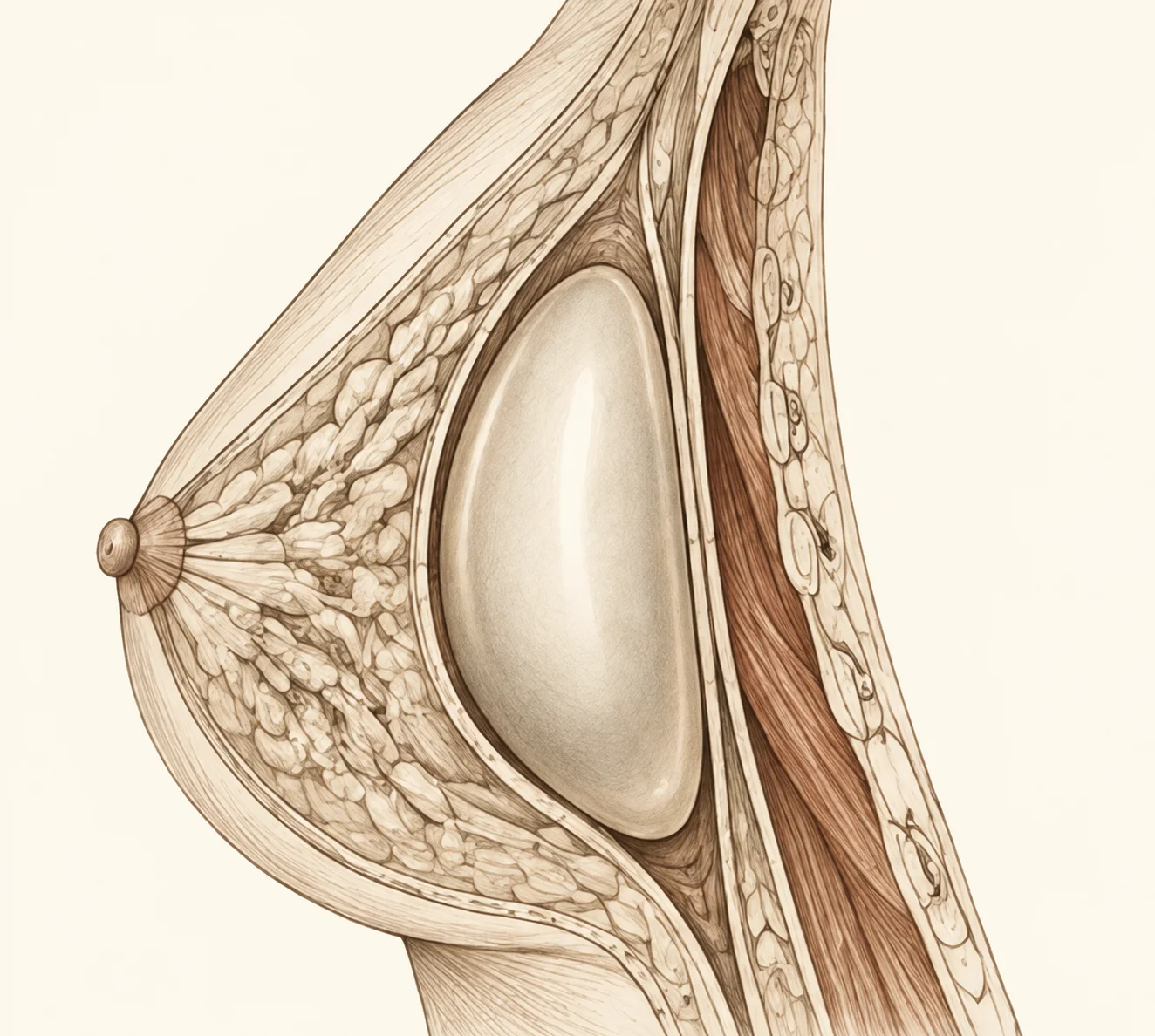
Buttock augmentation with implants is a surgical procedure that increases gluteal projection using specially designed silicone implants. The implants are placed through an incision, typically within the intergluteal cleft, and positioned in a defined pocket within or beneath the gluteal muscle depending on anatomy.
Its purpose is improved projection and contour in patients who want buttock enhancement and who may not be suitable candidates for fat transfer. The realistic aim is controlled refinement: projection that stays proportionate to the hips and thighs, without an exaggerated or implant-obvious result.
Coverage decides more than volume does
The anatomical complexity of this operation begins with tissue coverage, not with implant size. Thin soft tissue increases the risk of visible edges, palpability and an implant-led contour. Thick, resilient tissue conceals an implant better, but still requires careful pocket planning. Beneath that coverage sits the gluteal muscle, which is where the pocket is created — within or beneath it, depending on anatomy. And individual tissue behaviour governs how that pocket heals, how the scar matures, and how stable the implant position remains over time.
Why gluteal mechanics, not volume, drive the plan
The buttock is a high-motion, high-load area. It experiences repeated compression during sitting and continuous shear forces during movement. That is a genuinely different mechanical environment from most implant sites in the body.
Pocket design must therefore be stable enough to prevent displacement and to minimise unnatural movement. Implant selection must respect the patient’s frame — width, projection and the overall hip transition. A plan that ignores these mechanics tends to age poorly, regardless of how the result looks in the first weeks.
Over-sizing is not just an aesthetic risk; it is a mechanical one
Over-sizing can produce an obvious, implant-led result and it can increase complication risk at the same time. In a region under this much load, the larger implant is not simply the bolder choice — it places more demand on tissue coverage and on pocket stability, which are the two things the long-term result depends on.
How this differs from the operations it is compared to
Patients almost always arrive having already compared this operation to fat transfer, and sometimes having been told it is the same result by a different route. It is not.
Implants, fat transfer and lift-based planning address different problems
| Feature | Buttock implants | Fat transfer (BBL) | Lift-based plan |
|---|---|---|---|
| Problem it addresses | Insufficient gluteal projection, typically where donor fat is limited | Projection together with the shape of the surrounding silhouette | Dominant skin laxity rather than a volume deficit |
| What it delivers | Primarily added projection | Liposuction-based contouring plus transferred volume, improving the entire silhouette | Repositioning of lax tissue |
| Principal trade-off | A device in a high-load region: coverage, pocket stability and palpability must all be managed | Requires adequate donor fat to be a realistic option | Accepting the scars that laxity correction requires |
| When it is not the right choice | Coverage too thin, a very large change requested, or laxity dominant | Donor reserves too low, or previous liposuction has reduced available fat | Where the actual deficit is projection rather than laxity |
The important nuance is that implants do not provide the donor-area shaping that a fat-transfer plan produces. Two patients can both gain projection and read completely differently, because one of them also had the surrounding contour reshaped and the other did not.
Projection is not the same as proportion
Implants can provide projection, but the overall silhouette still depends on the hips, the lower back and the thigh transitions. If the waist is wide or the hip transition is weak, implants alone may not create the proportional read the patient is actually asking for.
In some cases a combined contour plan is appropriate — liposuction can improve framing. But combinations increase complexity and recovery, so they must stay conservative and prioritise safe, stable contour transitions rather than maximum change in one operation.
A patient can gain projection and still not get the shape they wanted
This is the most common source of disappointment in gluteal augmentation, and it is a planning problem rather than a surgical one. If the request is really about the waist-to-hip read, projection alone will not deliver it. Naming that at the consultation is more useful than adding a larger implant to compensate for it.
What buttock implants are not
They are not a weight-loss procedure. They are not a guarantee of a specific shape in every posture — this is a mobile, weight-bearing region, and it does not read identically standing, sitting and moving.
They do not replace the contour benefits of the liposuction-based framing that a fat-transfer plan often provides. And they are not the right answer when skin laxity is dominant and a lift-based plan is what the anatomy actually requires.
I size the implant to the coverage and the mechanics, not to the request
My assessment order here is deliberate: tissue thickness first, then gluteal anatomy and skin quality, then lifestyle factors such as sitting tolerance and training habits — and only then implant dimensions. A very thin patient asking for a large volume change is the clearest example of a request that anatomy cannot safely carry, because edges become visible and complication risk rises together. Conservative sizing and a stable pocket are not a compromise in this operation. They are what makes the result last.
The scar and the region it sits in
The incision is commonly placed within the intergluteal cleft, which keeps it discreet. That placement is an advantage aesthetically, but it is worth being honest about the environment: the region is prone to tension and to moisture, which is why wound-care discipline genuinely matters here rather than being routine advice.
Scar quality varies with individual biology and with aftercare. Discreet placement is a design decision; quiet healing is partly biology.
Recovery is a sequence, not a single date.
- Early phaseSitting is restricted
Sitting limitations are typical early on, which is the practical reality patients most underestimate about this operation. Activity return is staged rather than resumed at once.
- Tightness and firmnessSwelling and stiffness evolve
Swelling and tightness occur and the buttocks can feel firm. This early stiffness is expected and is not itself an indication of how the final result will feel.
- Contour settlingThe final shape emerges as tissues settle
The final contour becomes apparent as the tissues settle around the implant. Judging shape, symmetry or feel before this point produces conclusions that do not hold.
I avoid fixed timelines because healing depends on the surgical scope and on individual tissue behaviour. Realistic expectations about early stiffness and staged recovery are part of the plan, not an afterthought to it.
Why the first operation should be the conservative one
Revision logic exists here. Implant malposition, capsular issues, or dissatisfaction with size may all lead to a revision request.
But revision buttock implant surgery can be more complex than the first operation, because the scar planes are altered and tissue tolerance may be reduced. Revision planning starts with diagnosis rather than with a new implant: position, pocket stability, implant size relative to anatomy, and the condition of the soft tissue. This is precisely why the first operation should prioritise conservative sizing and a stable pocket — the margin for correction is narrower the second time.
What should be weighed in the decision?
This operation places a device into a region that is compressed every time you sit and loaded every time you move. The trade-offs follow directly from that.
- Trade-off: this is structural augmentation in a high-load area, and expectations about how it feels should be set accordingly.
- Trade-off: an incision is required. Placement within the intergluteal cleft keeps it discreet, but the region is prone to tension and moisture, so wound-care discipline matters.
- Trade-off: larger implants demand more of the tissue coverage and of the pocket, so the bolder choice is also the mechanically more demanding one.
- Trade-off: combining with liposuction can improve framing, but it increases complexity and recovery.
- Trade-off: sitting restrictions early on and a staged return to activity are part of the operation, not an optional protocol.
- Limitation: in thin tissue the implant may be more palpable, and edges may become visible.
- Limitation: it is not a weight-loss procedure.
- Limitation: it does not guarantee a specific shape in every posture.
- Limitation: it does not replace the contour benefits of liposuction-based framing that a fat-transfer plan often provides, and it does not shape the donor areas.
- Limitation: the silhouette still depends on the hips, lower back and thigh transitions. Where the waist is wide or the hip transition weak, implants alone may not create the desired proportional read.
- Limitation: risks include wound-healing problems, infection, implant displacement, capsular issues, discomfort and visible edges in thin tissue.
- Limitation: individual tissue behaviour influences pocket healing, scar maturation and how stable implant position remains.
- Limitation: durability requires long-term thinking. Tissue changes, capsule behaviour and lifestyle factors can all influence stability.
- Limitation: revision is possible but more complex, because scar planes are altered and tissue tolerance may be reduced.
- Alternative: where donor fat is adequate, a fat-transfer plan improves the whole silhouette rather than projection alone.
- Alternative: where skin laxity is dominant, a lift-based plan is the more coherent answer.
- Alternative: where coverage is too thin, expectations require a very large change, or medical risk factors make surgery unsafe, alternative strategies — or no surgery — may be the more responsible recommendation.
How to think about the decision
Buttock implants are well indicated when the goal is improved projection, when donor fat for transfer is limited, when there is enough soft-tissue coverage to conceal an implant, and when the patient wants controlled refinement rather than a maximal change.
They are the wrong choice when coverage is too thin for the volume requested, when laxity rather than projection is the dominant problem, or when the request is really about the waist-to-hip read that this operation does not address on its own.
When properly indicated, implants can provide a meaningful, proportionate enhancement for patients who are not candidates for fat transfer. The best outcomes come from careful anatomical assessment, conservative implant selection, and a plan built around gluteal mechanics and long-term stability — because a conservative plan tends to remain both more natural and more stable over time.
Who is a good candidate for buttock implants?
Good candidates typically want improved projection but have limited donor fat for transfer, and they have enough soft-tissue coverage to conceal an implant. I assess tissue thickness, gluteal anatomy, skin quality, and lifestyle factors such as sitting tolerance and training habits. Very thin patients seeking a large volume change can be poor candidates, because edges may be visible and complication risk increases. A good candidate wants controlled refinement and accepts that individual tissue behaviour affects healing and long-term implant stability.
How do implants compare to a BBL?
A BBL combines liposuction-based contouring with fat transfer and can improve the entire silhouette. Implants primarily add projection and do not provide the same donor-area shaping. In patients without adequate fat for transfer, implants may be the more realistic option. The best choice depends on anatomy and goals.
Where exactly is the implant placed?
The implant sits in a defined pocket within or beneath the gluteal muscle, and which of those is appropriate depends on your anatomy. The pocket matters as much as the implant, because it is what keeps the implant stable in a region that is compressed when you sit and subject to shear forces when you move.
Where is the scar?
The incision is commonly placed within the intergluteal cleft to keep it discreet. Scar quality varies with biology and aftercare. The region is prone to tension and moisture, so wound-care discipline matters.
Why does implant size matter more than I might expect?
Because size is not only an aesthetic decision here. Over-sizing can produce an obvious, implant-led result and can increase complication risk at the same time, since a larger implant places more demand on the tissue coverage concealing it and on the pocket holding it. Implant width, projection and your overall frame are assessed together rather than choosing a volume in isolation.
Will implants feel natural?
They can feel acceptable and stable when tissue coverage is adequate and pocket design is appropriate. In thin tissues, implants may be more palpable. Expectations should be realistic: this is structural augmentation in a high-load area.
When are buttock implants not the right answer?
They are not always the right answer when tissue coverage is too thin, when expectations require a very large change, when skin laxity is dominant, or when medical risk factors make surgery unsafe. In those cases, alternative strategies or no surgery may be more responsible.
How variable is recovery?
Recovery is variable. Sitting restrictions are common early. Tightness and swelling evolve over weeks, and activity return is staged. I avoid fixed timelines because healing depends on surgical scope and individual tissue behaviour.
What are the main risks?
Risks include wound-healing problems, infection, implant displacement, capsular issues, discomfort, and visible edges in thin tissue. Conservative sizing and stable pocket design reduce risk.
Can implants be combined with liposuction?
In selected cases, yes. Liposuction can improve framing, but combining procedures increases complexity and recovery. The plan should prioritise safety and stable contour transitions.
What if I already have implants and I am unhappy?
Revision planning starts with diagnosis: position, pocket stability, implant size relative to anatomy, and soft-tissue condition. Revision is possible but more complex because scar planes are altered. The plan must be conservative.
How long-lasting are results?
Implants can provide durable projection, but they require long-term thinking. Tissue changes, capsule behaviour and lifestyle factors can influence stability. A conservative plan tends to remain more natural and stable over time.