
Body feminization is a planning category rather than one operation, combining selected contour procedures when a patient seeks body proportions that feel more congruent with their goals.
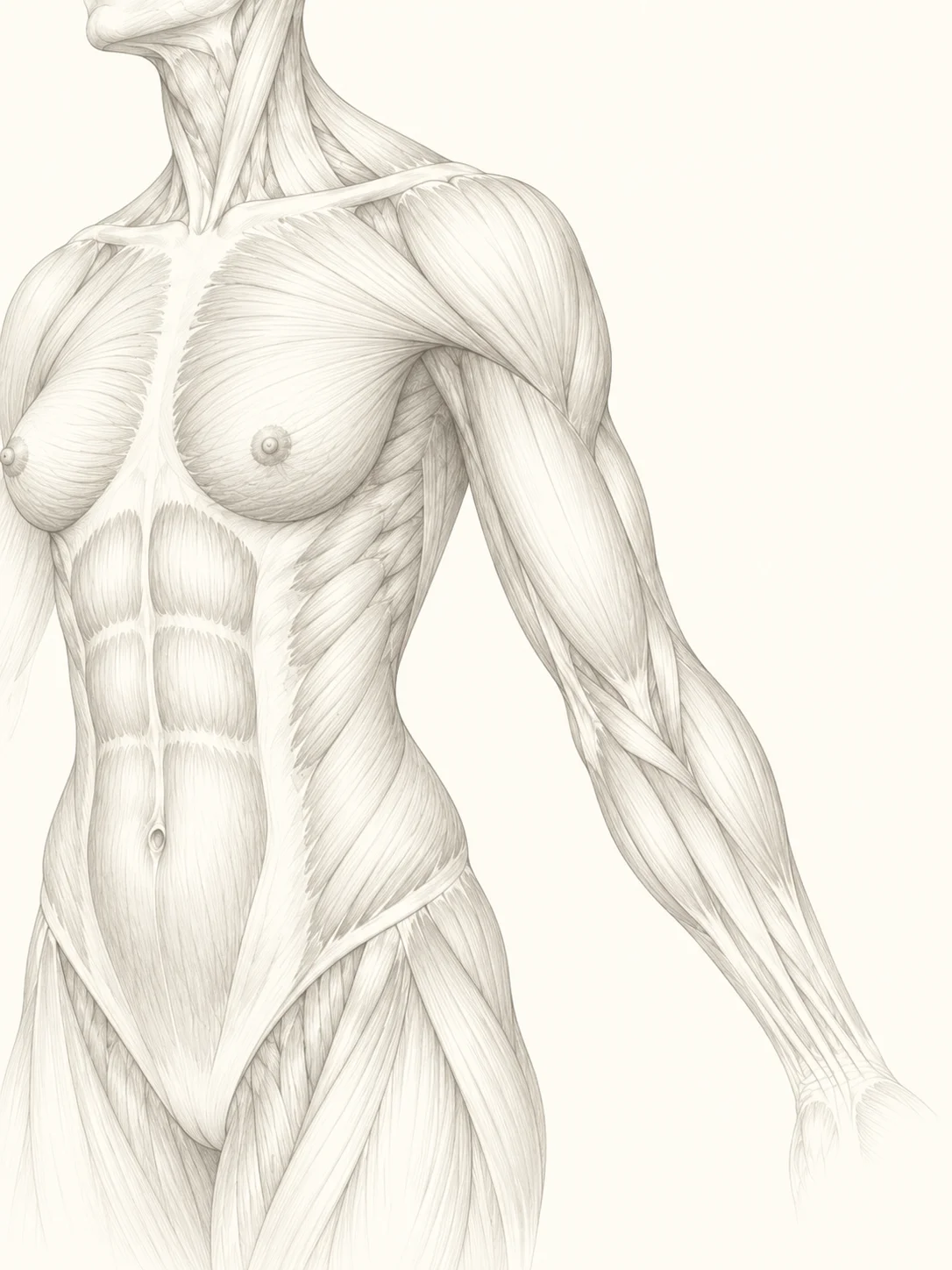
The visible label is only the starting point. Identify which perceived features come from fat distribution, skin, muscle, skeleton or breast anatomy and avoid reducing the plan to stereotyped measurements. The distinction matters because procedures that look adjacent on a menu can act on completely different tissue layers.
I would therefore not begin by asking how aggressively body feminization can be performed. I would begin by deciding whether the anatomy actually belongs to this procedure, what can be known before treatment and what still requires examination or staged reassessment.
The first distinction is the mechanism, not the label
Patient-defined body proportions associated with gender congruence can be influenced by more than one structure. A procedure becomes coherent only when the dominant driver sits in tissue that the planned treatment can actually change.
Identify which perceived features come from fat distribution, skin, muscle, skeleton or breast anatomy and avoid reducing the plan to stereotyped measurements.
This is also where no treatment remains a valid outcome. Normal anatomical variation, a concern that is too small for the trade-off, or a mechanism outside the procedure’s reach should not be converted into an indication simply because treatment is technically available.
Possible and appropriate are not synonyms.
Use region-specific augmentation, reduction or contouring only where each procedure has an independent anatomical indication, with staging when the total surgical burden becomes excessive. The point is to correct the structure responsible for the concern without expanding the operation into anatomy that does not need intervention.
Assessment determines the treatment ceiling
Examination is not a formality before a predetermined procedure. It is the step that separates what can be corrected predictably from what is being inferred from a photograph, a trend label or a comparison with somebody else’s anatomy.
For body feminization, the assessment centres on patient-defined body proportions associated with gender congruence. The surrounding structures are read at the same time because a successful local correction can still look incoherent if the adjacent anatomy is what actually established the visual problem.
When uncertainty remains, I prefer a smaller first intervention or a period of reassessment rather than making the largest irreversible correction at the first opportunity. Staging is not indecision; it is a way of allowing biology to supply information before the next decision.
How Body Feminization is planned
Use region-specific augmentation, reduction or contouring only where each procedure has an independent anatomical indication, with staging when the total surgical burden becomes excessive.
The operative or treatment plan follows that mechanism rather than a fixed recipe. The same procedure name can therefore involve different amounts, vectors, planes or combinations in two patients, while two visually similar complaints can lead to entirely different recommendations.
The endpoint is not the maximum technical correction. It is the smallest change that produces a stable improvement without sacrificing tissue, function or future options merely to intensify the immediate result.
Similar concerns can require different treatment families.
| Option | When the logic changes |
|---|---|
| Body Feminization | Used when the dominant mechanism matches the focus of this procedure. |
| Liposuction | A related option that addresses a different anatomical layer, treatment scope or durability trade-off. |
| Fat Grafting | A related option that addresses a different anatomical layer, treatment scope or durability trade-off. |
| Breast Implant | A related option that addresses a different anatomical layer, treatment scope or durability trade-off. |
Where Body Feminization stops being useful
Surgery cannot transform every skeletal proportion or guarantee a culturally fixed feminine body, and patient-defined goals should take precedence over trend or stereotype.
This boundary is clinically important because Liposuction, Fat Grafting, Breast Implant may address mechanisms that body feminization does not. Choosing another treatment is not a failure of the original procedure; it is the consequence of diagnosing the problem more precisely.
Likewise, a technically possible extension of treatment is not automatically justified. Once the procedure has reached the end of the layer it can change, doing more of the same usually increases intervention faster than it increases benefit.
Why restraint matters
Overcorrection is frequently more difficult to repair than modest residual anatomy. Tissue that has been removed, excessively tightened, overfilled or structurally destabilised cannot always be returned to its original state with equal predictability.
Risks are the sum of the selected procedures, including contour irregularity, scars, wound problems, asymmetry and cumulative surgical burden. These risks are not boilerplate appended after the aesthetic discussion; they help define how much correction is sensible in the first place.
I therefore prefer to leave a small amount of normal anatomy when the alternative is crossing into a reconstructive problem. A later refinement remains an option only if the first treatment has preserved enough tissue and structural stability to make that option worthwhile.
Treat the driver, then reassess the remainder.
The treatment map is built from anatomy and function rather than from the procedure name alone.
Residual concerns are reassessed after healing instead of being pre-emptively overtreated during the first intervention.
Recovery is part of the diagnosis
Recovery depends on the procedures selected; combined regions heal on different timelines and should be reassessed separately.
Early swelling, firmness, asymmetry or altered sensation can temporarily change how the treated region looks and feels. Unless a specific complication is suspected, those early findings should not be mistaken for the mature result or used as a reason for premature revision.
Follow-up therefore has a diagnostic role. As the tissues settle, we can distinguish expected healing from residual anatomy, undercorrection, overcorrection or a neighbouring mechanism that was intentionally left untreated.
The treatment happens first; the final decision develops over time.
- Stage 01Early healing
Swelling, bruising, tightness or local tissue response can temporarily exaggerate or obscure the intended change.
- Stage 02The main change becomes clearer
As early healing settles, the relationship between the treated region and neighbouring anatomy becomes easier to judge.
- Stage 03Tissue maturation
Scar behaviour, softness, position or retained volume continue evolving according to the procedure and tissue involved.
- Stage 04Reassessment
Only stable residual concerns are considered for additional treatment, and the mechanism is diagnosed again before any revision is proposed.
Risks and trade-offs belong in the indication
Risks are the sum of the selected procedures, including contour irregularity, scars, wound problems, asymmetry and cumulative surgical burden.
The probability and importance of individual complications vary with anatomy, treatment extent, medical history and technique. For that reason, risk cannot be reduced to a generic percentage copied across every patient.
The practical question is whether the expected improvement is large enough to justify those uncertainties for this particular anatomy. When the expected gain is marginal, the threshold for intervention should rise rather than fall.
Body Feminization should improve a defined problem without creating a larger one.
What treatment may improve
- Patient-defined body proportions associated with gender congruence
- A clearly identified mechanism that belongs to this treatment layer
- Selected asymmetry or contour disruption when it is part of the same diagnosis
What must remain explicit
- Surgery cannot transform every skeletal proportion or guarantee a culturally fixed feminine body, and patient-defined goals should take precedence over trend or stereotype.
- Perfect symmetry or a copied reference result cannot be guaranteed
- Further treatment is considered only after healing and re-diagnosis
Revision or additional treatment begins with a new diagnosis
A previously treated region is not simply the original anatomy with less of the original problem. Scar, changed support, altered tissue thickness or a different distribution of volume can make the second operation fundamentally different from the first.
Residual fullness, asymmetry or contour change can also be relative: one area may only look excessive because a neighbouring area was overcorrected. Repeating the same manoeuvre without recognising that distinction is how small imperfections become larger revision problems.
The revision threshold should therefore become higher as the remaining concern becomes smaller. Another procedure, a different procedure or no further treatment are all legitimate outcomes of reassessment.
Who is a reasonable candidate for Body Feminization?
A reasonable candidate has stable, personally defined contour goals and understands which parts of those goals are modifiable through soft-tissue surgery.
Candidacy also depends on general medical suitability, the ability to follow the required recovery pathway and an understanding of what the procedure cannot change. A procedure can be anatomically possible and still be a poor recommendation if the expected benefit is too small or the motivation is unstable.
The final plan is made after examination. In some consultations that plan becomes the procedure discussed here; in others it becomes a different treatment, a staged plan or a decision not to intervene.
What does Body Feminization actually treat?
It is intended for patient-defined body proportions associated with gender congruence. The operation or treatment is appropriate only when that mechanism is a meaningful part of the concern.
How do I know whether Body Feminization is the right procedure?
The decision follows examination and mechanism mapping. Identify which perceived features come from fat distribution, skin, muscle, skeleton or breast anatomy and avoid reducing the plan to stereotyped measurements.
Is more treatment likely to give a better result?
Not automatically. Once the dominant problem has been corrected, additional reduction, tightening, lifting or volume can move beyond benefit and create a new contour or functional problem.
Can the result be perfectly symmetrical?
No. Human anatomy is asymmetric before treatment and heals asymmetrically as well. The aim is meaningful improvement while preserving normal anatomy and function.
When is another treatment more appropriate?
Another pathway becomes more coherent when the dominant mechanism lies outside this procedure’s reach. Related options can include Liposuction, Fat Grafting, Breast Implant depending on the anatomy.
How should the early result be interpreted?
Recovery depends on the procedures selected; combined regions heal on different timelines and should be reassessed separately. Early swelling or firmness should not be confused with the mature result unless a specific complication is present.
Can revision be performed later?
Sometimes, but revision occurs in altered tissue and should address a specific stable problem. Repeating the original treatment automatically is not a revision strategy.
When would you recommend no Body Feminization?
I would avoid treatment when the mechanism does not match the procedure, when the expected improvement is too small for the trade-off, or when the patient’s goals require something the anatomy or evidence cannot reliably provide.