

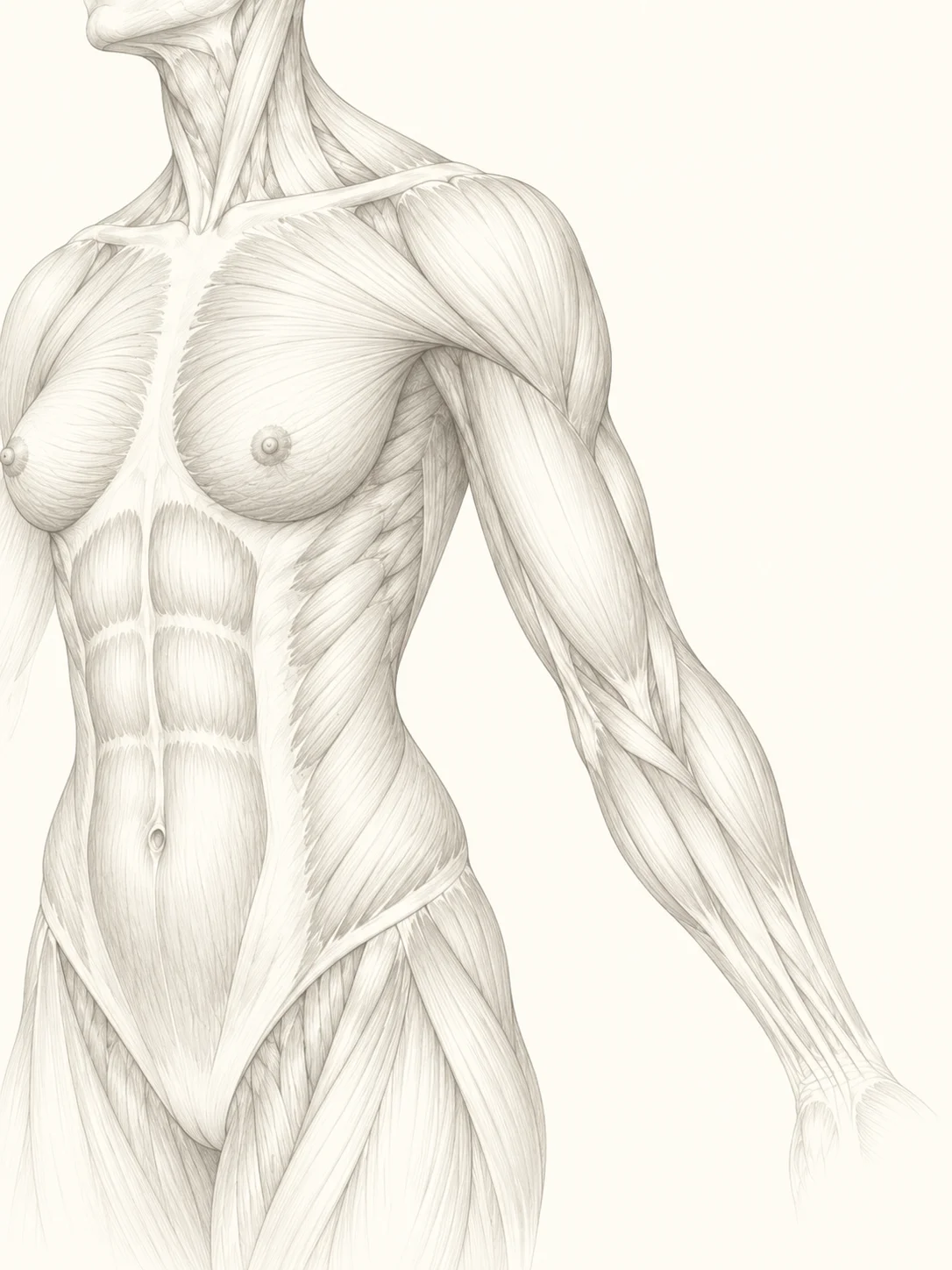
“360° tummy tuck” is one of the most frequently used and least clearly defined terms in body contouring. Most people who search for it assume it names a single standardised operation that tightens the waist from every angle. It does not. It describes an intention — to treat the torso as a continuous circumference rather than as separate zones — and that intention can be delivered in more than one way, depending on which tissue is actually limiting the shape.
What follows is an explanation of how that decision is made: what the term means, which anatomical layer is usually responsible, how the approach differs from the procedures it is confused with, and where the honest limits of the operation lie.
What “360°” actually describes
In clinical terms, “360°” describes the intent to plan the abdomen, flanks and lower back as one surface rather than as a list of treatment areas. The procedure itself may involve liposuction-based contouring, skin-envelope tightening, or both, depending on what the body is asking for.
This is where many plans fail: they begin with a technique name rather than with a diagnosis. If the dominant driver is fat, contouring can help. If the dominant driver is skin laxity, suction alone can disappoint. And if the dominant driver is abdominal wall mechanics, neither suction nor skin excision alone is a complete answer.
360° contour is not a trick. It is a planning logic.
The waistline is read as a continuous transition from front to side to back. Correct only the front and the profile can remain heavy from the side. Over-correct the flanks and the waist can look hollowed while the hip frame loses its natural support. The footprint of the operation should be decided after the limiting factor is identified, not before.
The problem the operation is built to address
Most patients describe the problem as a stomach that is not flat. But a flat anterior abdomen does not guarantee a defined waist, because much of what makes a waistline read as wide sits in the flank and in the transition into the lower back — areas the patient sees in photographs rather than in the mirror.
For that reason, “flat stomach” is better treated as a description of a symptom than as a diagnosis. It identifies what bothers the patient. It does not identify which tissue is responsible, and the correction has to match the mechanism. Otherwise the outcome can be a tightened envelope with a persistent contour problem, or a smaller measurement with broken transitions between zones.
Three layers that change shape in three different ways
Fat can be reduced. Skin can be re-draped or removed when properly indicated. The abdominal wall contributes to projection and to the stability of the shape. Because each layer behaves differently, the layer that dominates the problem determines which operation is reasonable.
In practice the three patterns present differently. Fat dominance usually looks like localised thickness that blurs the waistline, with skin that still has reasonable recoil. Skin dominance looks like looseness, creasing or redundancy that persists even when volume is not excessive — most often after weight change or pregnancy. Structural drivers include the way the ribcage and pelvis define waist width, and the way the abdominal wall affects the profile.
Many people have a mixed pattern, which is precisely why templates fail. The useful question during assessment is not which procedure the patient has read about, but what is limiting the silhouette when the torso is examined from several angles — and whether removing volume will genuinely improve the contour or simply reveal laxity that was already there.
The plan should follow the mechanism
If the plan does not match the dominant driver, satisfaction drops even when the surgery itself is technically successful. This is the single most useful thing to establish before any technique is discussed, and it is the reason two patients with the same complaint may be offered different operations.
Where a 360° approach and Lipo 360 diverge
These terms are used interchangeably, and they should not be. Both share the circumferential planning idea, but the tools differ, and the anatomy each is suited to differs with them.
Same circumferential logic, different tools
| Feature | Lipo 360 | Tummy tuck (abdominoplasty) | 360° planning approach |
|---|---|---|---|
| Primary focus | Contouring the abdomen, flanks and lower back to improve transitions | Skin-envelope correction and contour stability | Treating the torso as one continuous silhouette |
| Dominant driver it suits | Fat, where skin recoil is reasonable | Skin redundancy and laxity, often with abdominal wall considerations | Whichever driver assessment identifies — sometimes both |
| Scar implication | Contouring approach; no skin excision | Skin correction carries a scar footprint | Depends on whether envelope management is required |
| Main limitation | Can disappoint, and may expose looseness, when laxity dominates | Does not by itself address flank and lower back fullness | Not a template; only as good as the diagnosis behind it |
Some bodies need contouring, some need envelope tightening, some need both, and some need neither. The confusion arises from treating procedure names as promises. They are more accurately understood as categories of tools, and the correct procedure is the one that matches the dominant anatomical driver rather than the one with the most appealing label.
How the plan is decided
Two elements of history change planning as much as examination does. The first is weight stability: if weight is moving, the baseline contour is moving with it, which reduces predictability and can reduce long-term satisfaction. The second is expectation quality — someone seeking a fixed hourglass template regardless of their own skeletal proportions does not have a good foundation for surgery, however suitable the tissue may be.
The design question that follows is one of dose and of transitions. If the back-to-flank transition is left untreated, the waistline can remain visually wide. If the flank is treated too aggressively, the silhouette can look scooped. The objective is a coherent taper that still reads as normal anatomy.
Controlled refinement rather than aggressive transformation
My approach is to define the dominant anatomical driver, choose the smallest footprint that honestly addresses it, protect the transitions, and keep expectations anchored to how that individual’s tissue actually behaves. Tightness is not a clinical endpoint; stability is. A result that looks good in a single posed photograph but creases or looks harsh in movement is not a refined result.
Who may be considered — and when doing less is the better answer
A reasonable candidate is usually someone whose contour concern is not limited to the front of the abdomen: the waistline reads wide from the side or the back, and the flanks and lower back contribute to the overall silhouette. Beyond that, candidacy is defined by skin behaviour, weight stability and expectations. Where skin redundancy is meaningful, a tightening strategy may be necessary — and at that point the scar becomes part of the contract rather than a footnote to it.
Caution is warranted when the requested change is large relative to tissue quality. Where skin recoil is limited, aggressive suction can create looseness and irregularity. Where the dominant driver is structural waist width, chasing a narrower waist through maximal removal can produce a scooped appearance and an unbalanced hip frame. The same applies when weight is not stable, or when expectations include guarantees, fixed measurements or matching a photograph.
There is also the situation where the concern is mild and the surgical footprint would be disproportionate to it. Not every contour variation needs surgery. A mature plan includes the option of doing less, delaying, or doing nothing when the trade-off is not fair.
Why recovery does not settle evenly
Recovery in circumferential work is uneven by nature. Swelling settles in stages, and different zones can look and feel different at the same time. Compression changes how the contour reads during the early phase, which is why early photographs are a poor judge of the outcome.
Recovery is a sequence, not a single date.
-
Early phase
Firmness and swelling
Circumferential areas can feel firm and look uneven. The back and flanks often feel firm while the abdomen settles at a different pace.
-
Settling phase
Staged resolution of swelling
Swelling resolves in stages rather than linearly, and comfort with normal movement returns at different rates between individuals.
-
Maturation phase
Tissue settling and scar maturation
Tissues continue to settle and, where skin has been corrected, the scar continues to mature. Timelines are not identical between individuals.
Early is not final. Healing is biological rather than linear, and it is not perfectly symmetrical. A plan should therefore assume variability instead of promising a timeline. If someone needs a guaranteed appearance by a guaranteed date, that expectation is a reason to slow the decision down, because biology does not cooperate with rigid calendars.
What should be weighed in the decision?
These are the trade-offs worth understanding before a decision rather than after one.
- Trade-off: where the mechanism is skin redundancy, correction requires envelope management, and a scar footprint comes with it. Scar behaviour is individual and cannot be guaranteed.
- Limitation: tightness cannot be promised. Fat can be removed; skin recoil depends on tissue quality, thickness, stretch history and biology.
- Limitation: symmetry cannot be promised either. Bodies are not perfectly symmetrical before surgery, and healing is not symmetrical.
- Limitation: this is not weight-loss surgery, and it does not deliver a fixed waist measurement.
- Risk of over-correction: in circumferential work, more can look worse. Over-resection, unblended transitions, or a mismatch between tool and skin behaviour are the usual causes of visible step-offs and irregularity.
- Alternative: doing less, staging the decision, or doing nothing is a legitimate outcome where the trade-off is not favourable.
Why previous surgery narrows the safe range
A torso that has been suctioned or operated on before behaves differently. Scar planes beneath the skin make the tissue less predictable, transitions become harder to smooth, and the safe range of correction is narrower. In practical terms, the torso can behave as though it has tissue memory, tending to heal toward patterns it has already learned.
Revision therefore calls for more conservative planning: define whether the residual issue is remaining volume, a transition problem or skin behaviour, set clearer ceilings, and consider staged decision-making rather than escalation. Revision can be worthwhile when the problem is specific and stable. It is not a guaranteed finishing step, and sometimes escalation is not the intelligent choice.
How long the result holds
Results can be long-lasting under stable conditions, but they are not immune to life. Weight change can alter fat distribution, ageing changes skin elasticity and drape, and pregnancy and hormonal shifts can change the abdomen and waistline. The most durable outcomes come from stable inputs and realistic goals.
For that reason “permanent” is the wrong word, since it implies immunity to biology. The more accurate statement is that the contour can remain stable for as long as the body remains stable.
Preparing for an assessment
The purpose of a consultation is mechanism definition, not a quick recommendation. Photographs matter, but so does context: what bothers you most, stated in one sentence; how stable your weight has been; whether there is a history of pregnancy or previous abdominal surgery; and whether you have had liposuction before.
Photographs should include front, oblique, side and back views in neutral posture, with consistent lighting, so that true anatomy can be separated from the effect of the angle. It also helps to be precise about expectations — what refinement means to you, which trade-offs you accept, and which outcomes you would consider unacceptable. The more disciplined the input, the more disciplined the plan.
How do I know whether my waist problem is fat, skin laxity or something structural?
Fat dominance usually looks like localised thickness that blurs the waistline, with skin that still has reasonable recoil. Skin dominance looks like looseness, creasing or redundancy that persists even when volume is not excessive, often after weight change or pregnancy. Structural drivers include the way the ribcage and pelvis define waist width and the way the abdominal wall affects the profile. Many people have a mixed pattern, which is why this question is answered by assessment from several angles rather than by a procedure name.
Is a 360° tummy tuck the same as Lipo 360?
Not necessarily. Both share the idea of treating the torso as a continuous circumference, but the tools differ. Lipo 360 is primarily a contouring approach using liposuction around the abdomen, flanks and lower back to improve transitions. A tummy tuck is a skin-envelope and contour stability operation for cases where redundancy and laxity dominate, often with abdominal wall considerations. Some bodies need contouring, some need envelope tightening, some need both and some need neither.
Will my skin be tight all the way around my waist afterwards?
Contour may improve, but tightness is not guaranteed, because skin behaviour is individual. Fat can be removed. Skin recoil depends on tissue quality, thickness, stretch history and biology. Where there is true redundancy, tightening may require envelope management rather than relying on retraction. A responsible consultation separates what can be designed surgically from what has to be accepted biologically, and if a guaranteed tight result is the requirement, the decision should slow down rather than proceed.
Why do some people end up with step-offs or irregularities?
Most irregularities come from one of three causes: removing too much, failing to blend the transition between a treated and an untreated zone, or using a tool that does not match how the skin behaves. Where skin is thin or has limited recoil, removing too much volume can make waviness more visible. And where the real limitation was skin redundancy, suction alone can reveal looseness and create uneven drape. A refined result is usually the product of restraint and transition control rather than intensity.
I have had liposuction before. Can I still have a circumferential correction?
Sometimes, but the planning has to be more conservative. Previously treated tissue can develop scar planes beneath the skin, which makes the surface less predictable and reduces the safe range of correction. The torso can behave as though it has tissue memory. The first step is defining whether the residual problem is remaining volume, a transition issue or skin behaviour, and then setting clearer ceilings. Revision can be worthwhile when the problem is specific and stable, but it is not a guaranteed finishing step.
When is this not the right answer?
Caution is appropriate when the requested change is large relative to tissue quality, when skin recoil is limited, when the dominant driver is structural waist width, or when weight is not stable. The same applies when expectations involve guarantees, fixed measurements or matching a photograph. There is also the case where the concern is mild and the surgical footprint would be disproportionate. Doing less, delaying, or doing nothing are all legitimate conclusions when the trade-off is not fair.
How long do the results last?
Results can be long-lasting under stable conditions, but they are not immune to life. Weight change can alter fat distribution, ageing changes skin elasticity and drape, and pregnancy and hormonal shifts can change the abdomen and waistline. The most durable outcomes follow from stable inputs and realistic goals, which is why “permanent” is an inaccurate word here. The contour can remain stable for as long as the body remains stable.