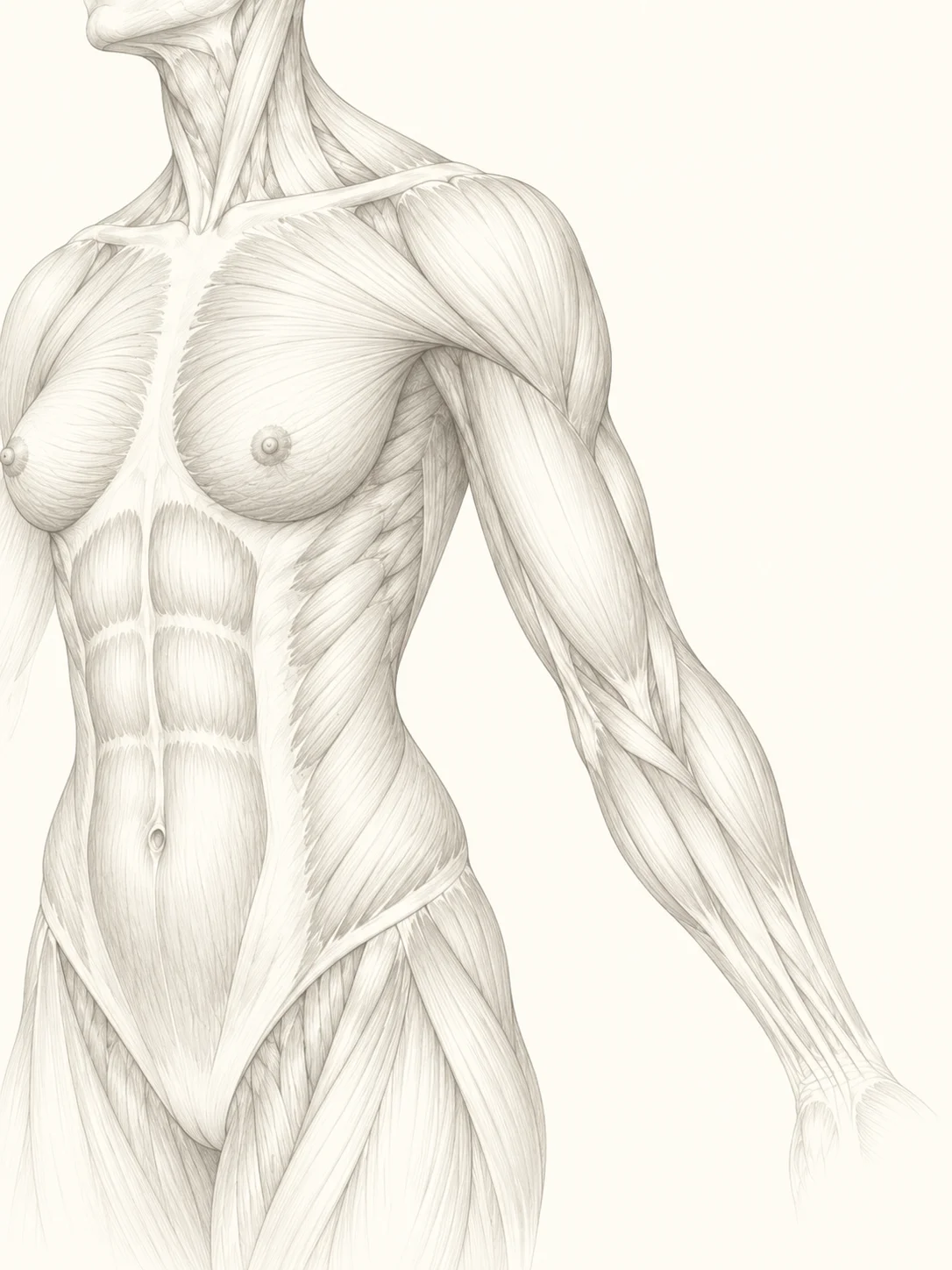
A thick waist can come from several structures that a mirror compresses into one outline: subcutaneous flank fat, deeper abdominal fullness, rib-cage and pelvic width, abdominal-wall shape, muscle, posture and the relative size of the hips and shoulders. This is why “make my waist smaller” is not yet a liposuction diagnosis. The visible circumference has to be decomposed before treatment.
The waist is a relationship, not one measurement
A waist appears narrow when the transition from ribs to pelvis is clearly defined. That transition depends partly on fat, but also on the width of the rib cage and pelvis. A patient with a naturally broad torso can be lean and still have a relatively straight silhouette.
Surgery can change soft tissue. It cannot narrow the skeleton. If skeletal width establishes most of the shape, removing more fat eventually reaches a point where the intervention increases irregularity without creating the hourglass proportion the patient has in mind.
Two patients with the same waist circumference can need different advice
One patient has a narrow rib cage but thick flank deposits that blur the waist. Another has little pinchable fat but a broad skeletal frame and deeper abdominal projection. Their tape measurements may be similar.
The first may have a meaningful subcutaneous contour target. The second does not become a good liposuction candidate simply because the number is the same. Circumference tells me how large the region is; examination tells me which layer creates it.
Flank fat is often the most surgically accessible part of the waist
Liposuction can reduce selected subcutaneous fat at the flanks and waist when the deposit is genuinely disproportionate and the skin can adapt. The useful effect is often not a dramatic reduction in body weight but a cleaner transition between the waist, back and hips.
I plan this transition in three dimensions. Treating only the front or only the visible “love handle” can leave a step into the posterior waist. The waist is read circumferentially, even if the patient notices it most from one view.
Visceral fat can keep the waist broad after superficial fat is reduced
Deeper abdominal fat lies inside the abdominal cavity and contributes to projection and circumference in a way liposuction cannot directly remove. A patient can therefore have a relatively thin subcutaneous layer and still feel thick through the middle.
This is one of the most important treatment limits to explain. More aggressive suction does not reach deeper visceral fullness. Once the superficial contour has been optimised, the remaining width may belong to a layer that plastic surgery should not pretend to change.
The abdominal wall can also change the silhouette
Pregnancy, major weight change and individual anatomy can alter how the abdominal wall behaves. Muscle separation or laxity can increase central projection even when fat is not excessive.
If the wall and skin are meaningful parts of the concern, a procedure such as tummy tuck may belong to a different discussion. That operation changes the abdominal envelope and, in selected anatomy, addresses the wall; it is not simply “stronger liposuction”.
Hip proportion changes how wide the waist appears
The same waist can look narrower when the hips are relatively broad and straighter when the hips are narrow. The eye reads ratios rather than isolated centimetres.
This does not mean every waist concern should become a hip-augmentation plan. It means I step back far enough to understand whether the waist itself is dominant or whether the complaint is mainly relational. Sometimes a modest waist correction is enough because it restores the transition without changing another region.
Loose skin can imitate thickness
After major weight loss, folds of redundant skin can accumulate around the waist and lower back. The region can look bulky even when the remaining fat layer is limited.
Removing more fat from beneath a hanging envelope may make the fold thinner but not remove it. In circumferential laxity, body lift may be a more coherent treatment family because the dominant problem has moved from volume to skin.
Posture can change the photograph without changing the anatomy
Pelvic tilt, rib flare and the way a patient stands for photographs can change how the waist reads from the front and side. This is especially relevant when comparing highly posed social-media images.
I assess the patient in a relaxed stance because an operation should improve the body that exists during normal movement, not only the posture used to create one reference photograph.
The narrowest possible waist is not automatically the best result
Over-suctioning can create depressions, visible rib or pelvic transitions, skin adherence and an operated appearance. The waist needs enough subcutaneous softness to connect naturally to the back, abdomen and hips.
I want definition without skeletonisation. A strong waist result usually comes from reducing the dominant excess while preserving the tissue that makes the torso move and age naturally.
What I assess before deciding the waist is a fat problem
I examine rib-cage and pelvic width, pinchable flank and abdominal fat, deeper abdominal projection, skin quality, abdominal-wall behaviour, back contour, hip relationship, asymmetry, scars and weight stability.
The answer may be local liposuction, abdominal-envelope surgery, post-weight-loss skin surgery or no surgical route to the degree of narrowing imagined. A useful consultation should tell the patient which part of the waist is actually modifiable before discussing how aggressively to modify it.