

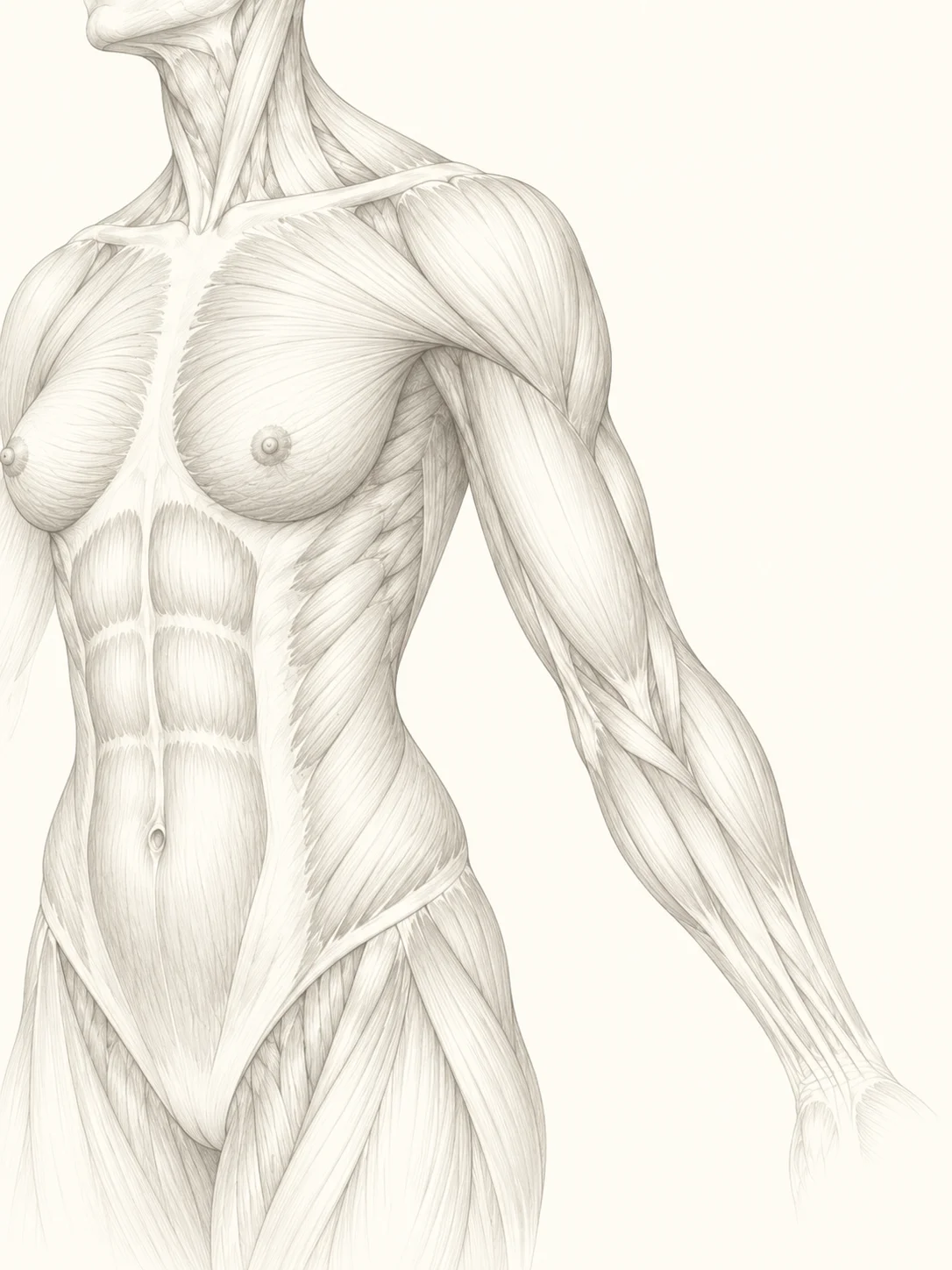
A hanging abdomen can be created by a heavy fat-and-skin apron, mostly loose skin after weight loss, a descended lower abdominal envelope after pregnancy, or a combination with abdominal-wall laxity. Patients often call all of these “belly fat”, but the mechanism matters because liposuction, tummy tuck and post-weight-loss body lifting act on different layers.
The part that hangs is not always the part that projects
A patient can have a lower skin apron that hangs over the pubic region while the upper abdomen is relatively flat. Another can have limited hanging skin but substantial deeper abdominal projection. A third has both.
This distinction tells me whether the main problem is envelope, subcutaneous volume, deeper abdominal fullness or wall shape. One operation rarely changes every layer equally.
A pannus is an envelope problem as much as a fat problem
When skin and subcutaneous tissue hang as an apron, removing fat alone can make that apron lighter without actually removing the excess skin. In some patients, the practical issues include moisture, irritation, hygiene or difficulty with clothing in addition to appearance.
The surgical plan then needs to respect the envelope. The question is not simply how much fat can be suctioned from it.
Tummy tuck changes the lower abdominal architecture
Tummy tuck can remove selected excess skin and fat from the lower abdomen, reposition the remaining envelope and, in suitable anatomy, address abdominal-wall laxity. It is therefore structurally different from liposuction.
The operation is most coherent when loose skin and lower abdominal architecture are meaningful components of the concern. It should not be sold as a substitute for whole-body weight loss or as a treatment for deeper visceral fat.
Mini tummy tuck only makes sense when the problem is genuinely limited
Mini tummy tuck addresses a smaller lower-abdominal envelope problem in selected patients. The word “mini” describes scope, not a preferable or easier version of every tummy tuck.
If excess skin extends broadly above and below the navel or the wall problem is more extensive, forcing the anatomy into a smaller operation can leave the central concern untreated. A limited procedure is conservative only when the problem is also limited.
Two hanging abdomens can require completely different operations
One patient has a modest postpartum lower-skin fold with otherwise stable weight. Another has circumferential skin redundancy after major weight loss extending into the flanks and back. Their lower abdomen may look similar from the front.
The first may fit an abdominal operation. The second may need broader body lift logic because the envelope problem does not stop at the abdomen. Treating one panel of a circumferential problem can leave abrupt transitions at the sides.
Liposuction can complement envelope surgery, but it cannot replace it
Selected fat reduction can refine the waist or abdominal thickness when subcutaneous volume is also present. But the more the skin is hanging, the less leverage suction has over the visible problem.
I avoid the idea that sufficiently aggressive liposuction will somehow make a large apron retract. Skin quality and the amount of redundancy determine whether that is biologically plausible.
Abdominal-wall laxity changes the side view
Pregnancy and major weight change can alter the relationship of the abdominal muscles and fascia. A patient may remain projected even after weight loss because the wall itself is part of the contour.
That is why I examine the abdomen standing and lying down and assess how the wall behaves with tension. The plan should distinguish what belongs to the wall from what belongs to skin and fat.
Weight stability matters more as the operation becomes larger
A broad skin-removal procedure creates a result around the body the patient has at that moment. Substantial future weight loss can create new laxity; substantial gain can stretch the repaired envelope.
I prefer large abdominal contouring when the patient’s weight has reached a reasonably stable direction and nutritional status supports healing. The operation should consolidate weight change, not compete with it.
The scar is part of the exchange
Removing a hanging abdominal envelope requires an incision long enough to control that envelope. The exact scar depends on the distribution of excess tissue and the chosen operation.
I would rather discuss this honestly than promise a nearly invisible solution to a large skin problem. The patient is exchanging a hanging fold for a flatter contour and a permanent scar. That trade should be worth making before surgery is scheduled.
New pain, a focal bulge or other abdominal symptoms deserve separate assessment
Not every lower abdominal prominence is cosmetic. A focal bulge, significant pain or symptoms suggesting an abdominal-wall problem may require medical or surgical evaluation beyond aesthetic contour planning.
Plastic surgery should not use the label “hanging abdomen” to absorb symptoms that belong to a different diagnosis. The cosmetic plan begins after those boundaries are clear.
What I consider a successful abdominal-envelope result
I want the lower abdomen to sit more smoothly, the skin envelope to match the body beneath it and the transition into the flanks to look continuous. I do not want the abdomen over-tightened or the waist treated so aggressively that the result looks disconnected from the torso.
A good result is not the flattest abdomen technically possible. It is the most coherent correction the skin, wall and body proportions can support safely.
What I assess before choosing the operation
I map skin redundancy above and below the navel, subcutaneous fat, deeper abdominal projection, wall behaviour, scars, stretch marks, weight history, flank and back extension, symptoms and the scale of the patient’s desired change.
From there the pathways separate: limited lower-envelope correction, full tummy tuck, broader body lift, local fat contouring or no aesthetic operation until weight or another medical issue is clarified. “Hanging abdomen” is useful only after the hanging layer has been identified.