
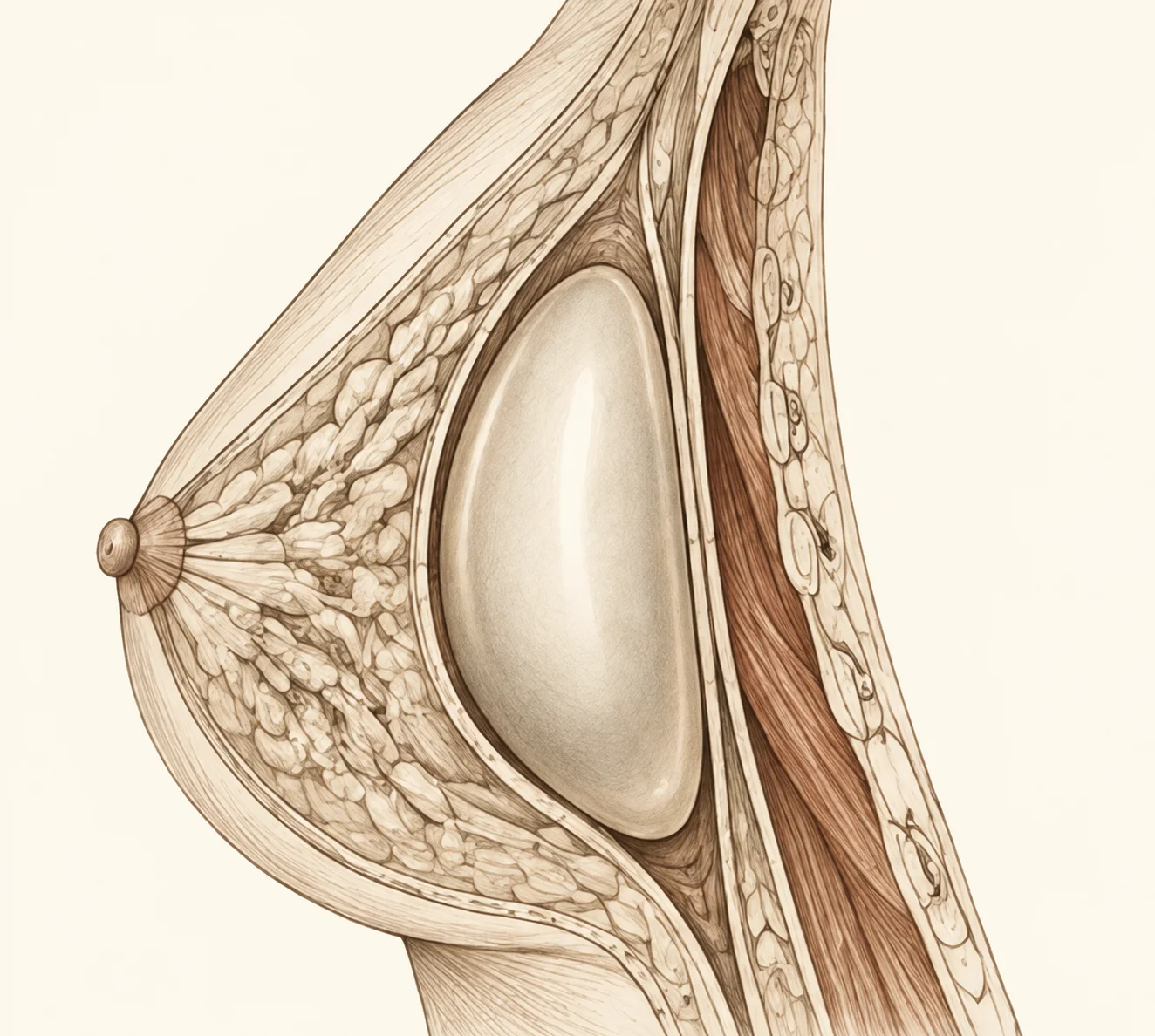
Patients often recognise breast sagging correctly but describe very different anatomies with the same word. In true ptosis, the nipple and breast mound have descended relative to the inframammary fold. In pseudoptosis, the nipple may remain reasonably positioned while more tissue hangs below it. Another patient has mainly an empty upper pole after pregnancy but little true descent. Those differences determine whether the problem is position, volume, skin envelope — or a combination.
The nipple is an important landmark, but it is not the entire diagnosis
Nipple height relative to the inframammary fold helps classify breast position. But the lower pole, breast footprint, tissue distribution and skin quality also matter. A nipple can appear acceptable while the lower breast has elongated substantially.
This is why I do not diagnose sagging from one measurement or from whether the nipple points downward. The breast has to be assessed as a three-dimensional mound sitting inside a skin envelope.
Three patients who say “my breasts have dropped” may need three different conversations
The first has true ptosis with a low nipple and redundant skin. The second has mostly upper-pole deflation after pregnancy. The third has a heavy breast whose weight has stretched the envelope over time.
The first is fundamentally a position problem. The second may be primarily a volume-distribution problem. The third may require reduction as well as lifting. Calling all three “sagging” is accurate at the level of the complaint but incomplete at the level of planning.
A breast lift reshapes the envelope; it does not create unlimited upper-pole volume
Breast lift (mastopexy) removes and redistributes skin, reshapes the breast mound and repositions the nipple–areola complex when descent is significant enough to justify surgery.
A lift can create a more elevated, compact breast, but it does not manufacture large amounts of new tissue. If the patient wants substantially more upper-pole fullness in addition to lifting, volume augmentation may become a separate decision.
An implant can fill a breast without truly lifting a low nipple
Adding an implant to a mildly deflated breast can improve upper-pole fullness and projection. This can make the breast look less empty. But a significantly low nipple remains a positional problem.
Using a larger implant to avoid a necessary lift asks added volume to compensate for skin redundancy. The breast may look fuller initially while becoming heavier over time. If the patient’s dominant concern is position, the treatment needs a mechanism that actually changes position.
The scar pattern is the route by which excess envelope is corrected
Lift scars are determined by how much skin needs to be removed and how far the breast must be reshaped. A small degree of descent may require a different pattern from a long, heavy lower pole.
I do not present scars as an unrelated downside that can always be minimised independently of the operation. A meaningful lift requires control of the skin envelope. Trying to produce a large shape change through an unrealistically limited scar can transfer the compromise into tension, contour or recurrence.
Skin quality decides how the result will age
Thin skin, stretch marks, repeated pregnancy, large weight changes and naturally low elasticity can all reduce long-term support. Surgery can reorganise tissue and remove redundant skin, but it cannot permanently change the biology of the remaining envelope.
This means some breasts will settle more than others after an initially similar lift. I would rather design a proportion that can age reasonably than create an artificially high early result whose long-term behaviour is less believable.
Large and sagging is a different problem from small and sagging
A patient with significant volume and ptosis may benefit from reducing weight while reshaping the breast. Another patient may have very little native volume and considerable skin excess after pregnancy. Their desired final volumes may be completely different.
This is why reduction, lift and augmentation should be thought of as different tools rather than as a hierarchy. Each changes a different variable: volume down, position/envelope, or volume up.
Future pregnancy can create a new envelope after surgery
Pregnancy and breastfeeding may enlarge and later deflate the breast, stretch skin and alter nipple position. Weight change can do something similar. A breast lift does not prevent those biological changes.
For patients planning pregnancy soon, timing may influence the decision. For others, waiting years for a hypothetical future event may not be reasonable. The useful discussion is how much future change the patient expects and how they feel about the possibility of later revision.
Asymmetry becomes more visible when the breast is lifted
Most breasts begin at different heights, volumes or fold positions. Once the envelope is tightened and the nipple repositioned, some baseline differences may become easier to see because the breast has a more defined structure.
I document those differences before surgery. The goal is to reduce meaningful asymmetry, not to promise that two biologically different breasts will become mirror images after lifting.
A new change in breast position or shape should not be assumed to be ageing
Gradual bilateral change after pregnancy, weight variation or ageing is different from a new unilateral shape change, lump, skin tethering or nipple change. The latter deserves appropriate breast assessment before elective aesthetic planning.
This boundary matters because the same visible word — “change” — can belong either to normal tissue evolution or to a new medical finding. Cosmetic treatment starts only after that distinction is respected.
What I call a successful breast lift
I want the breast mound to sit in a more coherent position on the chest, the nipple–areola complex to belong naturally within that mound, and the lower pole to look supported without creating excessive tightness or an artificially high breast.
A good lift does not try to defeat gravity permanently. It restores proportion, accepts the scar required for that restoration and leaves the breast capable of ageing in a way that still looks like the patient’s own tissue.