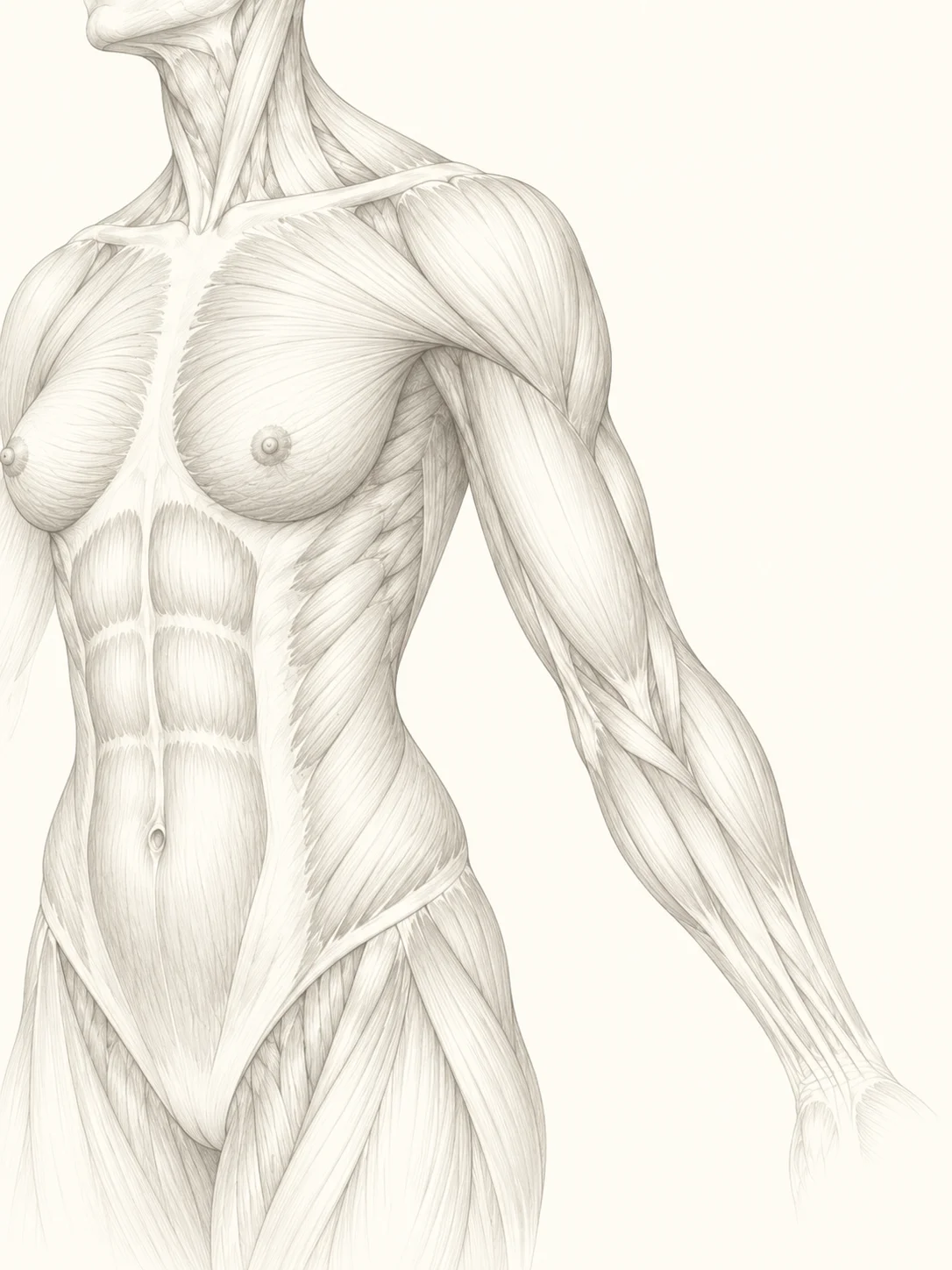
“My whole body is sagging” usually means the patient is seeing a pattern across several regions rather than one isolated problem. After major weight loss, pregnancy, ageing or repeated volume change, the abdomen, arms, thighs, breasts, buttocks and back can all lose the relationship they once had between volume and skin envelope. The challenge is not to find one operation that tightens everything. It is to identify which regions carry the largest meaningful excess and how they connect.
Body sagging is usually an envelope problem before it is a fat problem
A patient may still have some residual fat, but the defining complaint is often that the skin no longer follows the body beneath it. Folds hang, transitions become less defined and movement creates more independent tissue motion.
Removing more fat from that anatomy can make the body smaller while leaving the envelope looser. Volume reduction and skin removal are different tools.
Several regions can be affected without needing one maximal operation
The abdomen may be the dominant concern in one patient, while the arms and thighs matter more in another. A full list of lax areas does not automatically become a single surgical session.
I prioritise the regions that create the largest functional or proportional burden. Staging can be a deliberate strategy rather than a compromise, especially when the total body-contouring plan is large.
After major weight loss, lower-torso laxity can become circumferential
Loose skin can continue from the abdomen around the flanks into the lower back and buttocks. Treating only the front may leave an abrupt transition at the sides.
Body lift is relevant when lower-torso skin redundancy is broad and connected enough to justify circumferential correction. The larger scar reflects the larger anatomical envelope being treated.
The arms and thighs belong to their own envelope systems
Upper-arm laxity can be addressed with arm lift when redundant skin is dominant. Thigh laxity may lead to a separate thigh lift discussion.
These are not add-ons simply because the patient also has abdominal laxity. Each region needs its own scar-to-benefit calculation.
The abdomen may need a regional operation rather than a body lift
If redundancy is concentrated mainly in the abdominal envelope, a tummy tuck may be more coherent than a circumferential operation.
The treatment should match the geography of the laxity. Bigger surgery is not automatically better surgery.
Skin quality places a ceiling on how “tight” the body can safely become
Thin, stretched or extensively weight-expanded skin does not regain youthful elasticity simply because excess is removed. The operation can reduce redundant envelope, but the remaining skin continues to have the biological character it had before surgery.
I want the tissues to fit better, not to be placed under excessive tension in pursuit of an unnaturally tight result.
Scars are the mechanism of large-scale skin removal
Every region that requires excision requires an incision long enough to control the excess. The relevant question is therefore not whether scars can be avoided, but whether the contour and functional improvement justify them.
I prefer to make that trade explicit early. A patient should never discover after surgery that the real price of removing broad laxity was a scar she was not prepared to accept.
Weight stability determines whether the target is mature
Further major weight loss can create additional laxity, while significant regain can stretch repaired tissues. Large body-contouring procedures are strongest when they consolidate a stable change.
This does not require a perfect number on the scale. It requires a body whose current shape is likely to remain recognisable after the operation has healed.
Nutrition and healing capacity matter more as the operation becomes broader
The larger the excision and the more regions involved, the more important overall medical suitability and wound-healing capacity become.
I do not treat body sagging as an aesthetic map alone. The plan has to be physiologically reasonable as well as visually coherent.
Normal softness should survive the operation
The human body creases when it sits, bends or raises the arms. Some tissue movement is normal even after successful contouring.
I do not define success as eliminating every fold. I define it as removing the stable redundant envelope that dominates the silhouette while leaving the body able to move naturally.
What I assess before building a multi-region plan
I map the abdomen, flanks, back, arms, thighs, breasts and buttocks; separate skin from residual fat; review weight history and stability, scars, symptoms, previous surgery and the patient’s priorities.
The result may be one regional procedure, staged arm/thigh/abdominal surgery, a body lift, or no surgery in areas where the scar trade-off is not fair. “Body sagging” becomes manageable when the whole-body complaint is broken back into separate envelopes.