
Small breasts do not automatically represent a deficiency. Some patients have always had a naturally small breast volume that fits their frame. Others feel that the breasts became smaller after pregnancy, breastfeeding or weight loss. Another patient has adequate total tissue but little upper-pole fullness, so the breast looks “empty” rather than globally small. These are different starting points, and they should not all lead to the same augmentation plan.
The word “small” needs a reference point
Small compared with what? The patient’s previous breast? The shoulders and rib cage? A desired clothing silhouette? A photograph of another body? The answer changes the goal.
I prefer to establish whether the concern is total volume, upper-pole fullness, projection, cleavage, asymmetry or loss of volume from a previous baseline. Once that is clear, the patient can make a decision about proportion rather than simply choosing “bigger”.
A naturally small breast and a deflated breast are not the same anatomy
A young patient with limited native volume and a tight skin envelope often has a different breast shape from a patient who lost volume after pregnancy. The second patient may have more skin relative to the remaining tissue, a lower nipple position or an elongated lower pole.
Adding the same implant to both can therefore produce very different results. In the deflated breast, volume may improve fullness while skin excess or ptosis remains. Sometimes augmentation is enough. Sometimes position and envelope need a separate solution.
Implant volume is only one part of breast augmentation
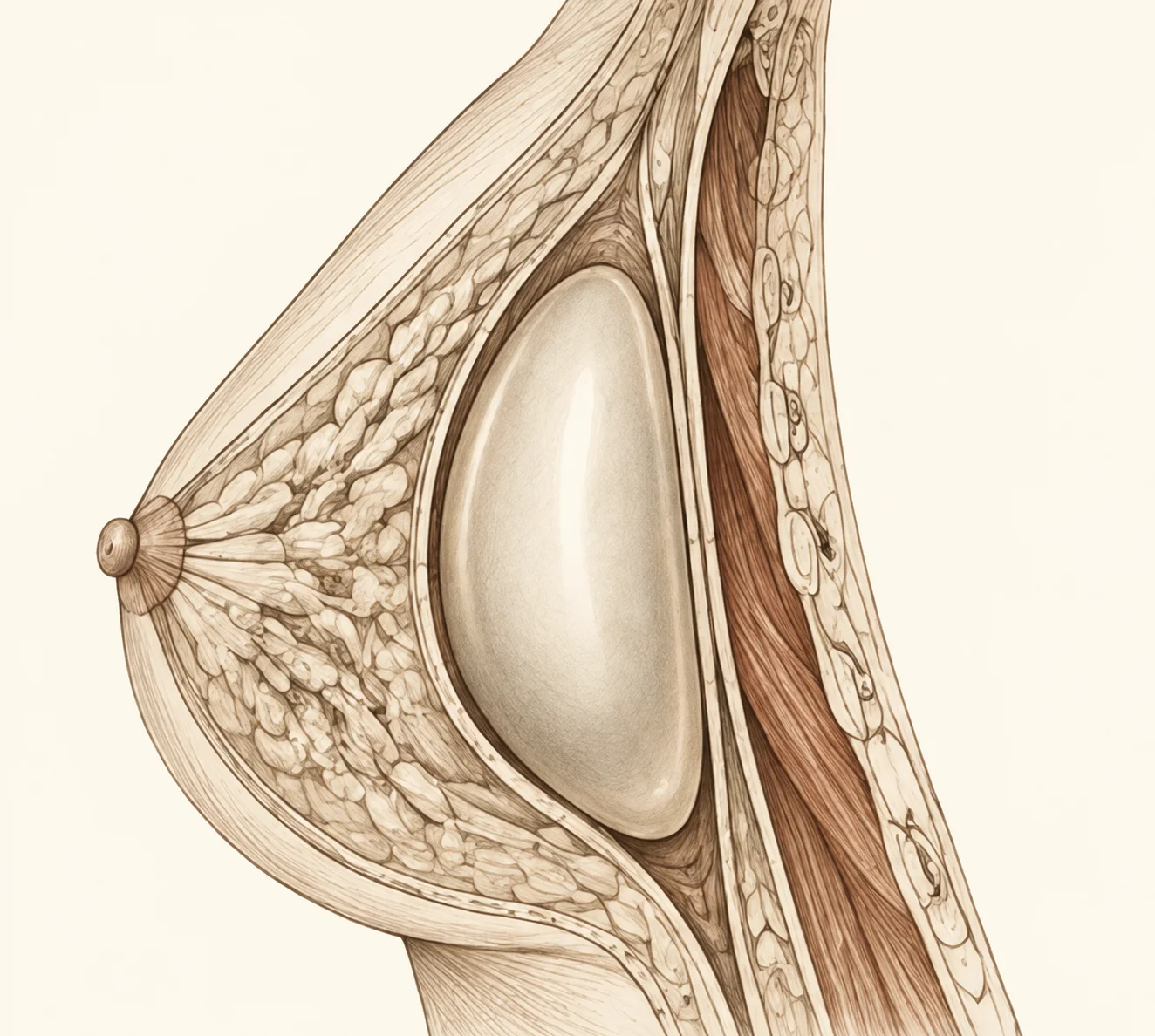
Breast augmentation changes breast volume, but implant width, projection, shape and the patient’s existing tissue are what determine how that volume appears on the chest. Two implants with similar volume can create different silhouettes.
I do not begin with a cubic-centimetre target. I begin with chest width, breast base, skin envelope, nipple position and how much native tissue will cover the implant. A volume that looks attractive on another patient may be too wide, too projected or too heavy for a different frame.
A larger implant cannot be asked to perform a breast lift indefinitely
When a breast is deflated and slightly low, increasing volume can sometimes improve shape. But an implant works by adding volume and weight; it does not remove redundant skin or reliably reposition a significantly low nipple.
Using progressively larger implants to avoid a lift can create a short-term impression of fullness while placing more load inside an already stretched envelope. If position is the dominant problem, more volume can eventually make the breast heavier rather than more youthful.
The chest wall establishes limits that photographs hide
Rib-cage width, sternum shape and natural breast spacing influence cleavage and breast direction. Some patients have breasts that naturally sit farther apart because of the chest wall. An implant cannot safely erase every anatomical distance between them.
I think this is particularly important when patients bring front-facing photographs with very close cleavage. The appearance may depend on anatomy, garment support, camera position or temporary posing. Surgery should improve the patient’s breast, not force the chest wall to imitate somebody else’s.
Asymmetry should be measured before volume is added
One breast may contain less tissue, sit higher, have a different base width or rest on a different rib-cage contour. If the smaller side is also shaped differently, simply using different implant volumes may improve one dimension while leaving another unchanged.
The purpose of asymmetry planning is to reduce the differences that matter most, not to promise mirror-image breasts. A technically identical operation on both sides is not always the most symmetrical plan.
“Natural” does not mean one implant size or one breast shape
Naturalness depends on the relationship between implant, native tissue and body frame. A fuller upper pole can look appropriate in one patient and obviously augmented in another. The amount of projection the skin can carry also differs.
My preference is for the smallest increase that reaches the patient’s meaningful goal without asking the soft tissues to support more weight than the long-term result requires. Under-treatment can be revised; overstretching the envelope is harder to undo.
Future pregnancy and weight change may alter both native tissue and implant relationship
Implants do not prevent the surrounding breast from changing. Pregnancy, breastfeeding, weight change and ageing can alter skin, glandular tissue and nipple position around an implant that initially fit very well.
This does not mean breast augmentation has a short lifespan. It means the patient should understand that the body continues to change around any implant, and future reassessment may be needed because of the breast, the implant or both.
A new reduction in one breast deserves medical assessment before cosmetic correction
If one breast has recently changed size, developed a new contour change, lump, skin alteration or nipple discharge, the first task is not simply restoring symmetry with an implant. New unilateral breast changes deserve appropriate evaluation.
Long-standing developmental asymmetry and a new acquired change are different histories. A cosmetic plan should only begin once that distinction is clear.
What I want the patient to decide — not just choose
The useful decision is not “which implant do I like?” It is how much volume the patient actually wants, which part of the breast should change, how visible an augmented look is acceptable, and what trade-offs they are comfortable carrying long term.
Once those questions are answered against the actual breast anatomy, implant selection becomes a technical consequence rather than the starting point. A small breast can be augmented. It does not need to be converted into somebody else’s breast to become proportionate.