
What the operation is actually designed to do
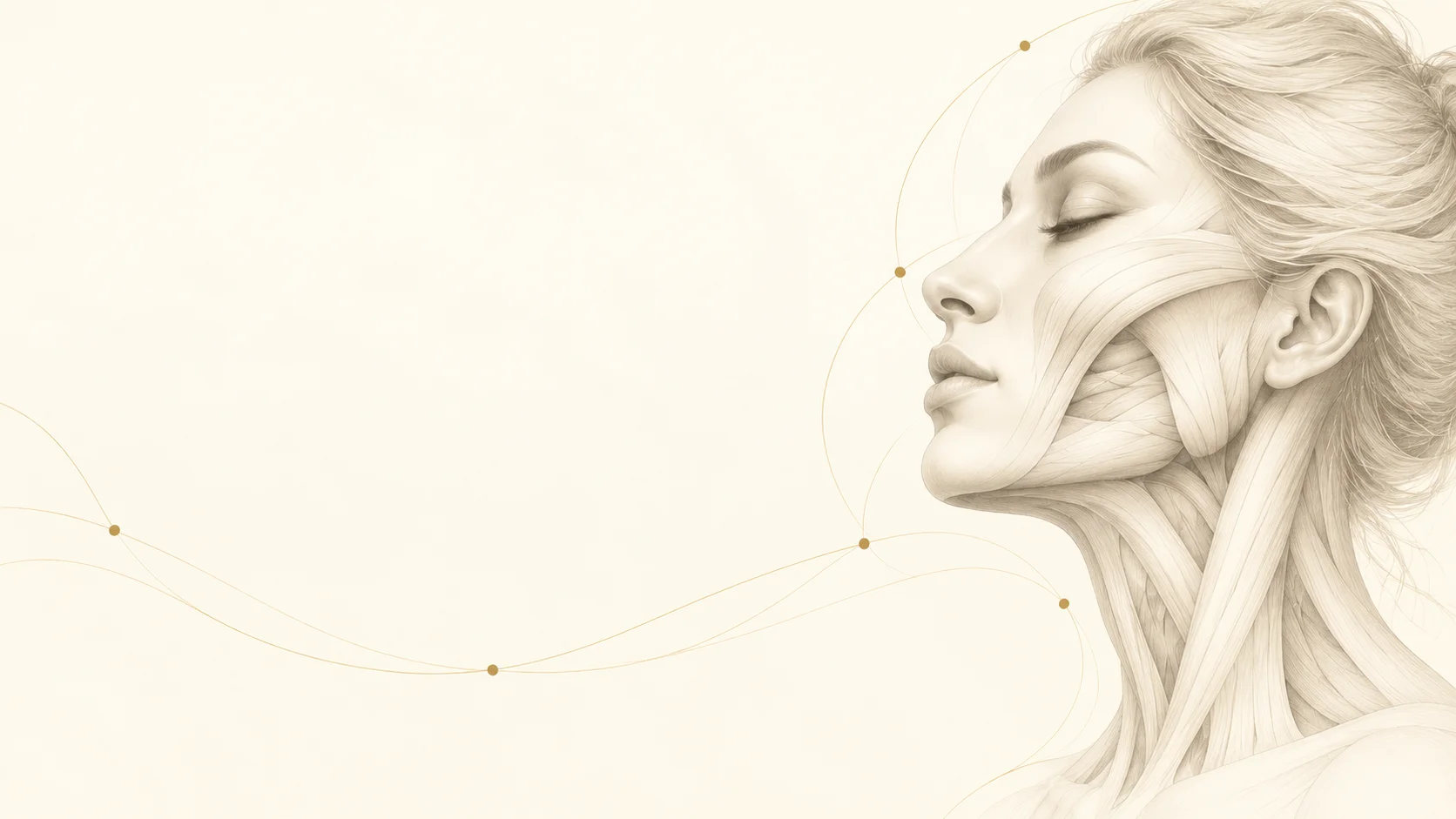
A brow lift, also called a forehead lift, is a surgical procedure designed to elevate and reposition the brow in order to improve the relationship between the brow, the upper eyelid and the forehead. Depending on anatomy and goals, it may also soften forehead and glabellar expression lines by altering the balance between the muscles that elevate the brow and those that depress it. Techniques vary — endoscopic and limited-incision approaches among them — and the choice should follow brow anatomy, hairline considerations, skin quality and the pattern of descent. The realistic aim is controlled refinement: a calmer upper face, an improved lid–brow relationship, and a result that still looks like you.ANATOMY ILLUSTRATIONUpper-third diagram: the brow soft-tissue unit sitting on the orbital rim, with medial and lateral brow segments labelled separately, the elevating and depressing muscle groups indicated, and the upper eyelid shown beneath to demonstrate how brow position changes how much lid is displayed
The brow has segments, and they age differently
The brow rests on the orbital rim and has medial and lateral segments that do not descend at the same rate. Many patients have a lateral brow descent pattern, which produces hooding at the outer upper eyelid. Others have a global descent across the whole brow. Sitting above this, the forehead muscles work in two opposing directions — some elevate the brow, others depress it — which is why brow position is a balance rather than a fixed height. And because the brow sits directly above the upper lid, its position governs how much eyelid is visible.Diagnosis: which component is actually creating the heaviness?
This is a diagnostic step and it decides everything downstream. I evaluate brow position at rest, the effect of gently elevating the brow on eyelid hooding, and how much true eyelid skin redundancy exists. Some patients have both components. If brow descent is dominant, removing eyelid skin alone can under-deliver — and can sometimes increase tension and scar visibility. If eyelid skin is dominant, a brow lift alone may be insufficient. And if the real problem is eyelid ptosis, neither of those operations is the correct answer. The plan should match the anatomy rather than the request.Three different causes of a heavy upper lid
| Feature | Brow descent dominant | Eyelid skin excess dominant | Eyelid ptosis |
|---|---|---|---|
| What is actually happening | The brow has descended on the orbital rim, displaying more upper lid than before | There is genuine redundancy of upper eyelid skin | The eyelid itself sits low, independently of the brow and of skin excess |
| How it reads | Hooding at the outer upper lid; a tired or tense upper face, often most obvious in photographs | Fullness and folding of the eyelid skin itself | A low lid margin and a smaller-looking eye |
| What the correct plan addresses | Brow elevation and repositioning to restore the lid–brow relationship | Upper blepharoplasty, with or without a brow lift | A different problem requiring a different procedure |
| If the wrong operation is chosen | Removing eyelid skin alone under-delivers, and can increase tension and scar visibility | A brow lift alone may be insufficient | Neither brow elevation nor skin removal resolves it |
Asymmetry is the starting point, not a complication
Many patients have a natural asymmetry in brow height or arch that becomes more noticeable with time. A responsible plan treats that asymmetry as the baseline it is working from rather than as something the operation will erase. Symmetry is a goal, not a promise. That distinction is worth stating at the consultation, because a patient who requires guaranteed symmetry as a condition of satisfaction is not well served by this operation.Vector planning is the operation
Elevation that is too vertical creates an unnatural, surprised look. Elevation that is too lateral distorts the brow tail and the transition into the temple. A refined result depends on the correct direction and degree of repositioning, and on respecting the patient’s baseline expression. This is where conservative planning matters most. The goal is not maximal elevation. It is a more balanced lid–brow relationship — which is frequently achieved with less movement than patients expect.Expression changes are a planning failure, not a side effect of surgery
A well-planned brow lift should not create a surprised or artificial appearance. When it does, the cause is over-elevation or an incorrect vector — not the operation itself. The objective is restoring balance, not changing identity, and conservative repositioning is typically the safer route to it.How the brow decision interacts with the eyelid
If upper lid skin is truly excessive, an upper blepharoplasty may be indicated with or without a brow lift. In some anatomies both components contribute and the correct plan is combined. But combination has to be designed with restraint. Two operations addressing the same region can easily overshoot together in a way that neither would alone, and the eye can end up over-opened. Combining is a decision about total dose, not simply about addressing two findings.A quiet result looks rested; it does not look operated
The measure of this operation is not how much the brow moved. It is whether the upper face reads as calmer and less heavy while still looking like the same face. If a patient’s expression has changed, the technical elevation succeeded and the operation failed — and that is a considerably harder problem to correct than the original heaviness was.I decide the vector before I decide the technique
My planning order in the upper third does not change: establish whether the heaviness is brow descent, eyelid skin, eyelid ptosis or a combination; identify the pattern of descent as medial, lateral or global; record the baseline asymmetry; then choose the direction and degree of repositioning. Technique selection comes last, because the specific method is less important than correct diagnosis and vector planning. The best outcomes come from anatomical diagnosis and conservative planning, not from maximal elevation.EDITORIAL IMAGEConsultation-room photograph: upper-face assessment in progress — the brow being gently elevated by hand to demonstrate how much of the eyelid hooding is brow-driven, with the patient’s resting expression observed side to side
What a brow lift is not
It is not a guarantee of eliminating all forehead lines. Lines can be static as well as dynamic, and changing muscle balance softens the dynamic component rather than erasing the surface. A realistic expectation is improvement, not erasure. It is not a procedure that should create a different personality or expression. And it is not always the right answer — not when the heaviness is mostly eyelid skin, not when brow position is already high, and not when the primary issue is eyelid ptosis.The limits are anatomical
Hairline position, scalp laxity and skin quality all influence what can be achieved, and they differ from patient to patient. Scars exist even when they are hidden. Temporary numbness can occur. Individual tissue behaviour governs swelling, scar maturation, and how quickly the forehead feels normal again.Recovery is a sequence, not a single date.
- Early phaseSwelling and bruising in the upper faceSwelling can be more visible in the upper face than patients expect, and bruising can track down around the eyes. This is the least informative period for judging brow position.
- Settling phaseThe brow relaxes downward from its early positionEarly brow position can look higher than intended and then settle as the tissues relax. This descent is part of the expected sequence rather than a loss of the result.
- Sensation and scar maturationForehead feel and incision lines normaliseForehead tightness and temporary numbness resolve on their own timeline, and scars mature independently of how the brow position is settling. The result becomes clear in phases, not immediately.
Why the first operation should be the conservative one
Revision logic in the upper third is relevant but should be applied cautiously. If the brow settles more than desired, or if asymmetry persists, a secondary adjustment may be considered — but only after adequate healing, because the tissues are still moving before that point. Each revision increases scar planes and reduces predictability. That is the strongest argument for planning the first operation conservatively: an under-corrected brow can be revisited, whereas an over-elevated one is a considerably less forgiving problem.What should be weighed in the decision?
This operation changes a region that is directly involved in expression, which is why the trade-offs are worth reading carefully before a technique is even discussed.- Trade-off: scars exist even when they are placed discreetly. Their visibility depends on skin type, tension and healing biology.
- Trade-off: the amount of elevation that most reliably looks natural is usually less than the amount that most reliably looks changed.
- Trade-off: combining with upper eyelid surgery can address both components, but the combined plan must stay conservative to avoid over-opening the eye.
- Trade-off: softening dynamic forehead lines involves altering the balance of the muscles that move the brow — which is precisely why vector and dose matter.
- Limitation: over-elevation or an incorrect vector can produce a surprised look, a distorted brow tail, or an altered temple transition.
- Limitation: static forehead lines are not eliminated. Improvement rather than erasure is the honest expectation.
- Limitation: baseline brow asymmetry may persist. Symmetry is a goal, not a promise.
- Limitation: hairline position, scalp laxity and skin quality set a ceiling on what is achievable, and that ceiling differs between patients.
- Limitation: temporary numbness of the forehead can occur.
- Limitation: swelling in the upper face and bruising tracking around the eyes should be expected.
- Limitation: early brow position settles downward as tissues relax, so the initial appearance is not the final one.
- Limitation: individual tissue behaviour governs swelling, scar maturation and how quickly the forehead feels normal again.
- Limitation: results can be durable but the face continues to age, and tissue relaxation continues over time.
- Limitation: each revision increases scar planes and reduces predictability, and any secondary adjustment must wait for adequate healing.
- Alternative: where the dominant problem is true upper eyelid skin excess, upper blepharoplasty — with or without a brow lift — is the more coherent plan.
- Alternative: where the primary issue is eyelid ptosis, a different procedure is required and brow elevation will not resolve it.
- Alternative: where brow position is already high, or where expectations require a dramatic change or guaranteed symmetry, this is not the right operation.