
Nostril base surgery is usually described in four words: make the nostrils smaller. The difficulty is that the base cannot be treated as an isolated detail. It sits near the centre of the face, it is read instantly by anyone looking at you, and it is simultaneously part of the airway. Both of those facts limit how much can responsibly be changed.
There is also a diagnostic problem underneath the request. Nostrils that look wide are not always wide. What follows is an explanation of how the true source of width is identified, why the base and the tip have to be planned as one story, and where the honest limits of this operation lie.
What alar base reduction actually is
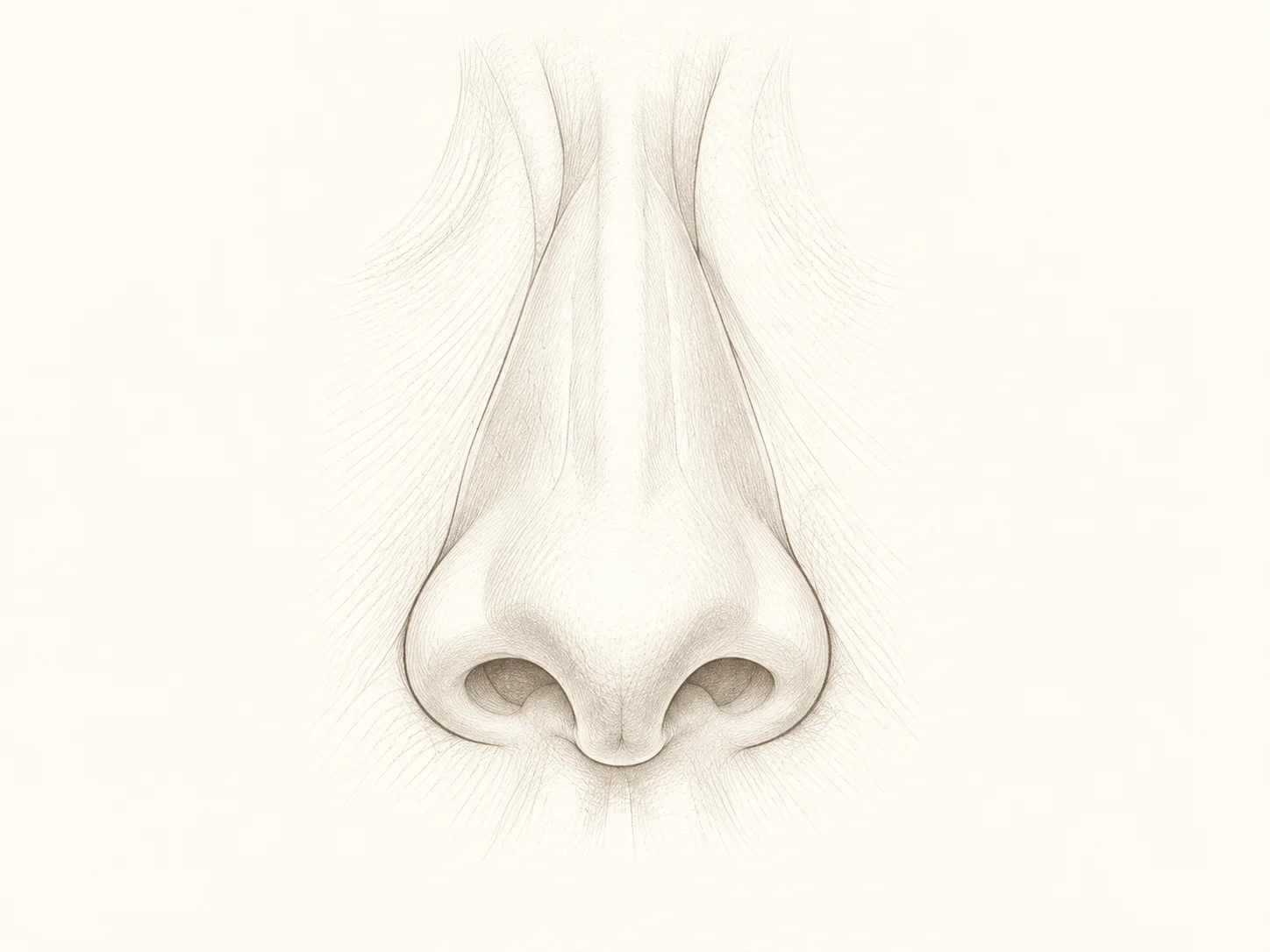
Alar base reduction is a targeted refinement procedure that adjusts the width of the nostril base and reduces alar flare — when that feature is genuinely the limiting factor in the lower third of the nose. It is most often a small component within a broader rhinoplasty plan, though it can be performed as a focused procedure in selected patients whose nose is otherwise already harmonious.
The important framing is that this is not a main-event operation. It is a precision adjustment in a highly visible zone, and it behaves accordingly: the margin between an improvement and an over-treatment is small.
Wide-looking nostrils are not always a base problem
Nostril width can be a downstream effect of tip position, inadequate tip support, or how the nose rotates during expression. In those situations the base is not too wide; it is simply more visually dominant because the rest of the nose is not carrying its share of structure. Narrowing the base to solve a problem that does not originate there produces a nose that looks constrained at the bottom and unfinished elsewhere.
Defining what “wide” means in a particular face
Wide at rest is not the same as wide while smiling. A nostril that flares mainly with expression raises a different discussion from a base that is consistently broad in a neutral face. Front view, three-quarter view, smiling and normal breathing are effectively four different noses, and a decision built on one posed photograph is a common route to an over-treated result.
The base is a frame and an airway entrance at the same time
The nostril base defines the proportion of the lower third of the nose, and it is also where air enters. Any change made for proportion is therefore constrained by function — which is why dosage, rather than technique choice, is the decisive variable in this region.
For that reason the assessment is deliberately repeated under several conditions rather than performed once. I look at width on the front view at rest, on the three-quarter view, during smiling, and during normal breathing, and I watch how the nostrils behave with expression. Flare that appears only with animation is a different clinical problem from a base that is broad in a still face.
Base reduction is a decision, not a default step
If the nose needs structural change at the tip, those changes can alter how the base reads — sometimes reducing the perceived width without any base excision at all. Establishing where the width actually originates is therefore the first task, and it frequently changes what the operation should be.
Where the apparent width is actually coming from
Four patterns account for most of what patients describe as wide nostrils, and each points to a different answer.
Same complaint, four different sources
| Pattern | How it presents | What it usually calls for | What happens if the base is reduced instead |
|---|---|---|---|
| True base width | Consistently broad base at rest, dominant on front and three-quarter views | Measured base reduction, alone or within a wider plan | Appropriately indicated |
| Expression-driven flare | Width appears mainly with smiling and animation | A separate discussion; the resting base may not be the problem | Risk of a nose that looks tight at rest |
| Insufficient tip support or projection | Base looks dominant because the structure above is not carrying its share | Structural work at the tip, which can change how the base reads | A pinched lower third with the mid-nose unchanged |
| Angle-dependent appearance | Prominent in one photograph, not consistent in normal viewing | Often no surgery | More regret than benefit |
The second discipline follows from this: the base and the tip must remain one story. The nose is an integrated structure, and tip projection and rotation change how the base reads. Reduce the base too early in a plan and the result can be a lower nose that looks pinched while the upper and mid-nose remain relatively unchanged. That imbalance is subtle on paper and obvious on a face — it is one of the more common ways a nose comes to look operated.
Function is not optional
The nostril is not decoration. It is the entrance to the airway, and any plan that narrows the base has to respect breathing. Over-reduction can produce a nostril shape that feels tight, looks unnatural, or performs poorly during deep breathing and exercise.
This is why dramatic narrowing is not something I pursue through base excision. When a patient asks for very small nostrils, the task is to translate that wish into an anatomically safe plan that still looks natural and functions properly — and to say clearly when the degree of narrowing being requested would risk function or produce an unnatural lower nose.
Controlled refinement, not aggressive change
My approach here is consistent: define the true source of width, keep the tip and base coherent, protect breathing, and choose the smallest measured change that delivers a natural, stable result. In rhinoplasty-related work the most natural outcome is usually the one that respects the face, not the one that pursues the smallest possible feature.
Why a millimetre reads so loudly
The nostril base sits near the centre of the face and the brain reads it quickly. A millimetre of change here can alter facial impression more than a considerably larger change elsewhere. That is precisely why restraint matters: this is one of those procedures where a little more becomes too much very quickly, both visually and functionally.
It is also why the plan has to consider the whole nose and the whole face. A base narrowed without regard to tip projection and rotation can look tight; a base narrowed without respecting natural nostril shape can look artificial. The better results tend to look unremarkable in the best sense — the nose reads as more proportionate without announcing what was done.
What the procedure involves — and why dosage matters more than technique
The procedure typically involves a small, carefully designed excision at the nostril base, usually placed along natural creases where the nostril meets the cheek and along the alar sill. The aim is to reduce width and flare while preserving a natural nostril shape.
The detail that matters most is not the name of the incision. It is dosage. With alar base work you do not try a lot and then assess; you choose a measured target and respect what the tissue will tolerate. Attempting dramatic narrowing by simply excising more at the base is how nostrils come to look unnatural.
Who may reasonably be considered
A reasonable candidate typically has a base that is genuinely wide at rest, or alar flare that consistently dominates the nasal silhouette on front and three-quarter views. The rest of the nose still has to be assessed for balance, because base refinement works best when it supports an already coherent structure.
Base-only surgery can make sense, but the word “selected” carries weight: it is appropriate when the rest of the nose is already harmonious, breathing is stable, and the base is consistently wide at rest in a way that clearly limits lower-nose proportion. Where there is a structural issue elsewhere — inadequate tip support, a dorsal imbalance, or a rotation and projection mismatch — base-only work risks a tight lower third against an unchanged remainder. The objective is not to do less surgery. It is to do the correct surgery.
Expectations and scar acceptance are part of candidacy rather than footnotes to it, and breathing status matters. Where functional concerns already exist, the plan must be more conservative still, and additional functional assessment may be appropriate. Candidacy is not a question of who wants the procedure; it is a question of who can benefit in a measured way without acquiring a new problem.
Caution is warranted when the base is not truly the limiting factor and the request is driven mainly by a single front-view photograph or a trend reference; when the desired change is dramatic, since large narrowing requests tend to conflict with function and natural nostril shape; when the nose needs structural support elsewhere; when scar intolerance is high, because a scar is part of the reality of excision; and when a fixed outcome is needed by a fixed date. In those situations the most responsible plan may be a different procedure category, a smaller change, or no surgery.
Recovery, and why it varies
Recovery is usually more a matter of swelling, incision care and gradual tissue settling than of severe pain, though variability is normal. The early appearance can be misleading: swelling can make the nostril base look uneven, or tighter than it will ultimately look.
Recovery is a sequence of checkpoints, not a single date.
-
Early phase
Swelling and incision care
The base can look uneven or tighter than it will later. The area moves with expression and breathing, which can make it feel tight at this stage.
-
Settling phase
Oedema resolves gradually
The direction of improvement is often visible early, but the appearance continues to change as swelling resolves.
-
Maturation phase
Scar maturation and final refinement
Scar maturation is a slow process and the nose continues to refine over time. Timelines are not identical between individuals.
Early is not final, and even small procedures at the nasal base can look different across weeks and months. I avoid timeline guarantees, because healing does not follow a strict calendar. If a patient has a hard deadline, that constraint belongs in the decision-making rather than in the recovery.
What should be weighed in the decision?
The trade-offs here are small in size and large in visibility, which is exactly why they deserve to be understood in advance.
- Trade-off: this is not a scar-free procedure. Any excision creates a scar. The correct expectation is not the absence of a scar but scar discipline — placement in natural creases, tension control, and an understanding that behaviour varies.
- Limitation: scar behaviour differs between individuals. Some heal quietly; others may develop thicker, more visible scars or pigmentation differences, particularly in a high-movement facial area. Discreet is not the same as invisible.
- Limitation: symmetry is a goal, not a promise. Faces are not mirrored and healing is variable.
- Limitation: matching a reference photograph exactly is not achievable.
- Functional risk: over-reduction can create a nostril shape that feels tight or performs poorly during deep breathing and exercise.
- Balance risk: reducing the base when the limitation lies at the tip or mid-nose can produce a pinched lower third against an unchanged remainder.
- Alternative: where the base is not truly wide at rest, where the concern is angle-dependent, or where scar tolerance is low, a smaller change or no surgery may be the more honest option.
After a previous rhinoplasty
This can sometimes be done, but the planning has to be more disciplined. After prior surgery the tissue planes are altered and scar tissue reduces predictability. The base can also be more sensitive to further excision, and the safe range for change is often smaller.
It is equally important to establish why the base looks wide after rhinoplasty. In some cases the perceived width relates to tip support, rotation or scar behaviour rather than to a base that is genuinely too broad — and in those cases narrowing the base creates a tight lower third without resolving the underlying imbalance. Revision planning is a matter of precise problem definition, conservative dosing and realistic ceilings. Sometimes improvement is possible. Sometimes the better decision is to avoid escalation.
How stable the result is over time
Alar base reduction can be long-lasting, but absolute language is not appropriate. Tissue changes with time, scars mature and soften although scar quality varies, nasal tissues evolve with ageing, and facial proportions shift subtly.
Patients who are properly indicated and conservatively treated generally experience a stable improvement in base width and flare. The expectation should nevertheless remain adult: symmetry is not guaranteed, and the nose does not become immune to biology. The aim is a proportionate lower nose that stays natural in expression, in motion and in ordinary light — and long-term satisfaction tends to correlate with measured goals rather than with the pursuit of the smallest possible nostrils.
How do I know whether my nostrils are truly wide, or whether the tip is making them look wide?
This distinction prevents the wrong operation. A nostril base can appear wider when the tip lacks support, when projection is low, or when rotation is unbalanced — in which case the base is not too wide, only more visually dominant. I assess width on the front view at rest, on the three-quarter view, while smiling and during normal breathing, and I watch how the nostrils behave with expression, since flare on smiling is a different problem from a consistently broad base. If the tip needs structural change, that can reduce perceived width without any base excision.
Can it be performed on its own, without a full rhinoplasty?
In selected cases, yes — and “selected” matters. Base-only surgery makes sense when the rest of the nose is already harmonious, breathing is stable, and the base is consistently wide at rest in a way that clearly limits lower-nose proportion. If there is a structural issue elsewhere, such as inadequate tip support or a rotation and projection mismatch, base-only work can leave a lower third that looks tight while the rest of the nose is unchanged. That imbalance is one of the common ways noses come to look operated.
Will it leave scars, and where are they?
There can be scars, because any excision creates one. The aim is to place incisions in natural creases at the nostril base, control tension, and allow the scars to mature with appropriate care. Behaviour varies between individuals: some heal quietly, while others may develop thicker or more visible scars, or pigmentation differences, particularly in a high-movement facial area. I do not build plans on “scarless” language. In appropriate cases scars can be designed to be discreet, but discreet is not invisible, and that trade-off belongs early in the conversation.
Can it affect breathing?
If done aggressively, it can. The nostril is not only an aesthetic frame; it is the entrance to the airway, so narrowing must respect function. A correct plan maintains a stable nostril shape and avoids a pinched appearance that could restrict airflow or feel limiting during deep breathing and exercise. This is why I do not chase dramatic narrowing through base excision, and why I am comfortable saying that it is not always the right answer when a request would require a degree of narrowing that risks function or produces an unnatural lower nose.
Why can such a small change look so significant?
Because the nostril base sits near the centre of the face and is read quickly. A millimetre of change at the base can alter facial impression more than a larger change elsewhere, which is exactly why restraint matters — here, “a little more” becomes “too much” rapidly, both visually and functionally. It is also why planning must account for the whole nose and the whole face. The best results tend to look unremarkable in the best sense: more proportionate, without announcing what was done.
When is it not the right answer?
When the base is not truly the limiting factor and the request comes mainly from a single front-view photograph or a trend reference. When the desired change is dramatic, since large narrowing requests often conflict with function and natural nostril shape. When the nose needs structural support elsewhere, because base-only reduction can create imbalance. When scar intolerance is high, since a scar is part of the reality of excision. And when a fixed outcome is needed by a fixed date. In these situations the most responsible plan may be a different procedure, a smaller change, or none.
Can this be done after a previous rhinoplasty?
Sometimes, but the planning has to be more disciplined. Tissue planes are altered after prior surgery and scar tissue reduces predictability, the base can be more sensitive to further excision, and the safe range is often smaller. It also matters why the base looks wide: if the perceived width relates to tip support, rotation or scar behaviour rather than a genuinely broad base, narrowing it creates a tight lower third without solving the imbalance. Revision work is about precise definition, conservative dosing and realistic ceilings.
How stable are the results over time?
They can be long-lasting, though absolute language is not appropriate. Tissue changes with time, scars mature and soften but scar quality varies, nasal tissues evolve with ageing, and facial proportions shift subtly. Properly indicated and conservatively treated patients generally see a stable improvement in base width and flare. Symmetry is still not guaranteed and the nose does not become immune to biology. Long-term satisfaction usually correlates with measured goals rather than with pursuing the smallest possible nostrils.