

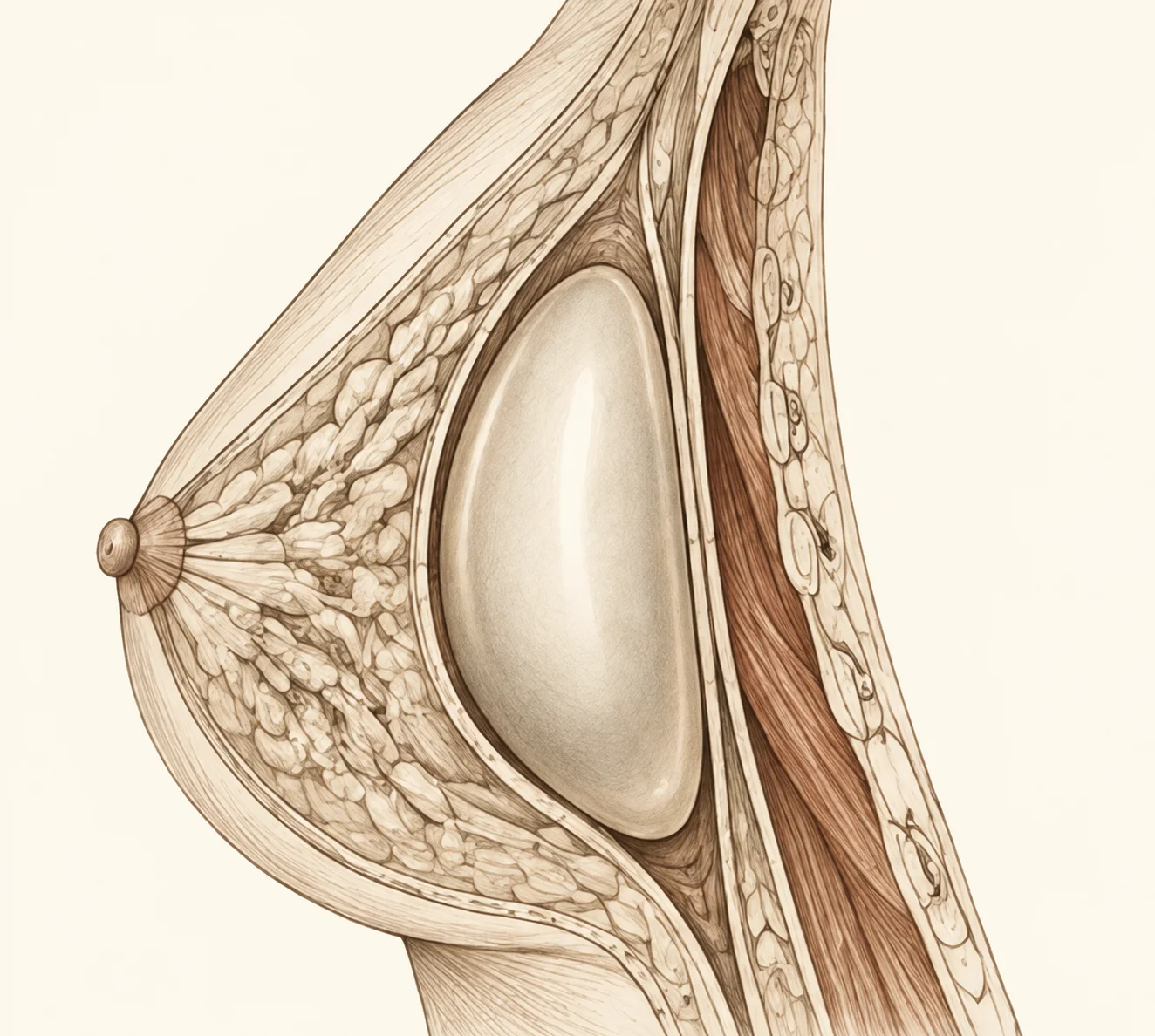
Breast symmetrization is often understood as doing the same operation on both sides. That is the single most common reason a symmetrization plan goes wrong, because the anatomy is not the same on both sides.
Most breasts are naturally asymmetric. The rib cage is asymmetric. The inframammary folds are rarely at the same height. The breast footprint on the chest wall differs side to side. Even posture and shoulder position change how the breasts sit. Surgery can improve harmony. It cannot erase the baseline architecture.
What symmetrization actually means
Bilateral breast symmetrization is not a named operation. It is surgical planning that uses one or more procedures to reduce visible differences between the two breasts — aiming at improved balance in volume, shape, projection, nipple–areola position, and how the breasts sit in clothing.
It can involve different operations on each side. In some patients, one breast requires a lift while the other requires a smaller lift. In others, one side needs reduction and the other needs augmentation, or both need subtle reshaping.
“Bilateral” does not mean identical technique. It means the plan is designed as a paired system.
The goal is a matched outcome, not matched steps. Each breast is treated according to its own structure, while the two are planned against each other. That is a different discipline from performing one operation twice — and it is why the analysis has to come before the technique name.
Asymmetry is not one measurement
The anatomical complexity begins with defining which type of asymmetry is dominant. It can be driven by volume difference, but it can equally be driven by base width, fold position, nipple height, upper pole fullness, or differences in skin stretch.
Two breasts can have the same volume and still look different, because one has a wider base or a lower fold. If a plan is built only around bigger versus smaller, the result may still look imbalanced.
The footprint, not just the volume
I assess base width, the footprint on the chest wall, fold height, nipple–areola position, upper pole fullness, and how volume is distributed between the medial, central and lateral breast. Posture and rib cage shape are part of the assessment, because they influence how the breasts sit. Photographs can exaggerate some asymmetries and hide others. The point of the consultation is to separate the differences that are structural from those that can be meaningfully changed — and that anatomic map is what guides a conservative plan.
Which driver is dominant changes the tool
Three different dominant patterns, three different plans
| Feature | Volume-dominant asymmetry | Envelope and position-dominant asymmetry | Chest wall-dominant asymmetry |
|---|---|---|---|
| What creates the visible difference | A genuine difference in breast volume and projection | Skin envelope, nipple position, fold height, base width, upper pole fullness | The underlying rib cage and chest wall the breasts sit on top of |
| Tools that fit the mechanism | Reduction on one side, augmentation on the other, or differing amounts of each; implants where a substantial and stable increase in projection is needed | Lift techniques, often with different degrees of adjustment per side, and modest reduction where indicated | The breasts can be improved, but the asymmetry itself is not being corrected |
| Where fat transfer fits | Not reliable for a guaranteed size increase | Useful for contour refinement, upper pole softness, subtle hollows and smoothing transitions in mild to moderate cases | Limited relevance to a structural difference |
| Realistic ceiling | Set by tissue thickness, pocket behaviour and what the tissues can support | Set by skin quality, blood supply considerations and scar tension | Structural — improvement is possible, correction is not |
Every breast procedure changes more than one dimension
A lift changes nipple position, skin envelope and upper pole shape at the same time. A reduction changes volume and often shifts the breast footprint. An implant changes projection and can change how the skin drapes. Fat transfer changes contour but has a biologic ceiling.
When these tools are combined across two sides, each change has to be anticipated in terms of how it will interact with the other breast. This is the mechanical reason conservative planning matters here more than in single-breast work.
Overcorrecting one side to match the other can create a new imbalance
Chasing a match by pushing one side further does not converge on symmetry — it introduces a second problem alongside the first, and produces a result that reads as engineered rather than natural. The safer logic runs in the opposite direction. When one nipple sits higher than the other, for instance, it may be safer to lift the lower side than to try to lower the higher one. The first operation should prioritise balanced design and tissue-respecting changes rather than aggressive matching.
What symmetrization is not
It is not a guarantee of perfect symmetry in every posture, in every bra, and under every lighting condition. It is not a single-number target. It is not a promise of a specific cup size.
And it is not always the right answer. Where chest wall asymmetry is the dominant problem, the breasts simply sit on top of that structure. Improvement is possible, but the ceiling is structural. Where expectations are built around perfect symmetry or a fixed bra size outcome, the plan is being measured against something surgery does not deliver.
When symmetrization planning is particularly relevant
Some patients have congenital asymmetry, including tuberous or constricted breast features on one side. Others have asymmetry following pregnancy and breastfeeding. Others have changes after prior surgery, where scar planes and implant pockets differ side to side.
Revision symmetrization
In revision contexts, predictability is lower. Prior surgery changes scar planes and can alter pocket behaviour and blood supply. The tissues have memory, and the plan must be more restrained.
I evaluate existing scars, implant position where present, capsular tightness, tissue thickness and nipple–areola viability. The plan may involve pocket adjustment, implant exchange, lift, reduction or fat transfer. A staged approach can be more honest than forcing a single-session result. The goal is a stable improvement with realistic boundaries, not a perfect reset.
Skin quality sets the ceiling
Skin quality is one of the main limitations in this work. If one breast has thinner tissue, more stretch marks or greater laxity, it may relax differently after surgery — which influences scar width, shape retention and long-term symmetry.
This is why conservative tightening matters. A plan that is too aggressive can lead to widened scars or recurrent laxity. Individual tissue behaviour is not a minor detail here; it largely determines how stable the result remains.
A coherent pair, not two identical breasts
The goal is controlled refinement: improved harmony in shape and fit, without forcing identical breasts or overcorrecting one side. I plan each breast according to its own structure while aiming for a coherent pair. Perfect alignment is not a realistic promise — nipple position alone can appear different in different bras and postures. When properly indicated, symmetrization improves proportion, garment fit and visual harmony in a way that looks natural rather than manufactured. In some situations, doing less is the more responsible approach.
Recovery is not symmetric either
It is common for the two sides to heal differently. Swelling can differ. One side can feel tighter. One side can settle earlier. This does not automatically indicate a problem, but it does mean early impressions are misleading, particularly in the first weeks.
Recovery is a sequence, not a single date.
-
Early phase
Swelling is asymmetric, and so is the appearance
One breast can be more swollen or feel tighter than the other. Judging symmetry at this stage means judging swelling, not shape.
-
Settling phase
The breasts evolve over weeks to months
Tissues relax, scars mature, and where implants are used the pockets settle. The two sides may reach each stage at different times.
-
Assessment phase
Symmetry is assessed once swelling and settling are stable
I avoid fixed timelines because healing varies. Judgment is reserved rather than formed early.
What should be weighed in the decision?
The central trade-off is that the more closely you pursue a match, the more you spend in scars, tissue disruption and predictability — and the less stable the result tends to be.
- Trade-off: a lift or reduction usually requires scars, and those scars mature according to individual tissue behaviour. Scar placement is part of the decision, not a detail after it.
- Trade-off: overcorrecting one side to match the other can create new imbalance and a result that feels engineered.
- Limitation: small residual asymmetries can remain even with good planning. Perfect symmetry in every posture, garment and lighting condition is not available.
- Limitation: skin quality sets a ceiling. A side with thinner tissue, more stretch marks or greater laxity may relax differently, affecting scar width, shape retention and long-term symmetry.
- Limitation: implant-based symmetry can be limited by pocket behaviour and tissue thickness. Implants also introduce long-horizon considerations such as capsule behaviour and positional change over time.
- Limitation: fat transfer is limited by donor availability and graft take variability, and is not a reliable method for a guaranteed size increase.
- Limitation: where chest wall asymmetry is dominant, the ceiling is structural regardless of what is done to the breasts.
- Limitation: each revision increases scar burden and can reduce predictability. Any decision to revise should be conservative and based on stable findings after adequate healing.
- Alternative: where the differences are skin envelope, nipple position or mild volume, a lift and/or small reduction can often improve balance without implants.
- Alternative: staging can be safer than forcing a single-session result, particularly after prior surgery.
- Alternative: if weight is changing, pregnancy is planned soon, or medical risk factors compromise healing, delaying is the appropriate plan rather than a compromise.
How long-lasting the result is
Results can be durable, but they are not immune to ageing, weight change, pregnancy and tissue relaxation. Long-term stability is improved by conservative planning that respects base width, skin quality and scar tension.
The honest framing is a proportional reset that improves harmony — not a permanent freeze of anatomy. The best outcomes come from precise anatomic analysis, realistic expectations, and individualised planning that treats each breast according to its own structure while aiming for a coherent pair.
How do you evaluate breast asymmetry in a consultation?
I evaluate asymmetry in multiple dimensions, not just size. This includes breast base width, breast footprint on the chest wall, inframammary fold height, nipple–areola position, upper pole fullness, and the distribution of volume between the medial, central and lateral breast. I also assess posture and rib cage shape because they influence how the breasts sit. Photographs can exaggerate some asymmetries and hide others. The purpose of consultation is to define which differences are structural and which can be meaningfully changed. That anatomic map is what guides a conservative plan.
Do you perform the same procedure on both breasts?
Not necessarily. In symmetrization, doing the same procedure on both sides can be the wrong approach because the anatomy is not the same on both sides. One breast may need a lift while the other needs a smaller lift. One may need reduction and the other a modest augmentation. In other cases, both sides need the same category of procedure but with different amounts of adjustment. The goal is a matched outcome, not matched steps.
Am I a candidate for symmetrization without implants?
Sometimes, yes, depending on the type of asymmetry. If the main differences are skin envelope, nipple position, or mild volume difference, a lift and/or small reduction can often improve balance without implants. Fat transfer can be considered in selected cases, but it has a biologic ceiling and cannot always replace implant-level volume correction. If the smaller breast needs a substantial, stable increase in projection, implants may be the more predictable tool. The safest answer comes from measuring your baseline anatomy and matching the method to what the tissues can support.
When is fat transfer useful for symmetrization?
Fat transfer can be useful when the asymmetry is mild to moderate and the goal is contour refinement rather than a large change in size. It can improve upper pole softness, fill subtle hollows, and smooth transitions. The limitation is variability of graft take and the need for adequate donor fat. It is not a reliable method for a guaranteed size increase. In asymmetry work, I use fat transfer when it fits the anatomic scale of the problem and when the patient accepts that results can be incremental.
When is symmetrization not the right answer?
It is not always the right answer when expectations are based on perfect symmetry or a fixed bra size outcome. It can also be limited when chest wall asymmetry is dominant, because the breasts sit on that structure. Surgery can improve how the breasts look, but the ceiling is structural. If weight is changing, pregnancy is planned soon, or medical risk factors compromise healing, the plan may need to be delayed or staged. In some situations, doing less is the more responsible approach.
How do you manage nipple height differences?
Nipple–areola position is managed primarily through lift techniques, which reshape the skin envelope and reposition the nipple on the breast mound. The degree of elevation must match tissue quality and blood supply considerations. When one nipple is higher than the other, it may be safer to lift the lower side rather than lower the higher side. However, each case is individualised. I also emphasise that nipple position can appear different in different bras and postures, and perfect alignment is not a realistic promise.
How does skin quality affect the result?
Skin quality is one of the main limitations in symmetrization. If one breast has thinner tissue, more stretch marks, or more laxity, it can relax differently after surgery. That can influence scar width, shape retention, and long-term symmetry. This is why conservative tightening is important. A plan that is too aggressive can lead to widened scars or recurrent laxity. Individual tissue behaviour is not a minor detail here; it largely determines how stable the result remains.
How variable is recovery between the two sides?
It is common for recovery to be asymmetric. Swelling can be different. One side can feel tighter. One side can settle earlier. This does not automatically mean a problem. The breasts evolve over weeks to months as tissues relax, scars mature, and, if implants are used, the pockets settle. I avoid fixed timelines because healing varies. The correct approach is to assess symmetry in phases and reserve judgment until swelling and settling are stable.
What if I have had breast surgery before and now need symmetrization?
Revision symmetrization requires more restraint. Prior surgery changes scar planes and can alter pocket behaviour and blood supply. I evaluate existing scars, implant position if present, capsular tightness, tissue thickness, and nipple–areola viability. The plan may involve pocket adjustment, implant exchange, lift, reduction, or fat transfer, but predictability is lower than in primary surgery. Sometimes staging is the safer approach. The goal is a stable improvement with realistic boundaries, not a perfect reset.
How long-lasting are symmetrization results?
Results can be durable, but they are not immune to ageing, weight change, pregnancy, and tissue relaxation. Long-term stability is improved by conservative planning that respects base width, skin quality, and scar tension. Implants, if used, introduce their own long-horizon considerations such as capsule behaviour and positional change over time. I encourage patients to view symmetrization as a proportional reset that improves harmony, not as a permanent freeze of anatomy.