Some patients want a higher, fuller breast but do not want an implant. That is a coherent goal, and it runs into one honest limitation: a lift can reposition tissue, but it cannot create volume from nothing.
Auto-augmentation is the response to that limitation. It treats your own breast tissue as a shaping resource — redistributing what already exists, supporting it internally, and placing the nipple–areola complex into a more balanced position. The result is not implant-like projection. It is a tissue-based refinement.
Why a lift alone does not produce fullness
A lift changes shape by tightening and re-draping the skin envelope and repositioning the nipple–areola complex. That improves position, but it does not add substance to the upper pole — which is why a well-executed lift can still leave a breast that sits higher and looks flatter than the patient expected.
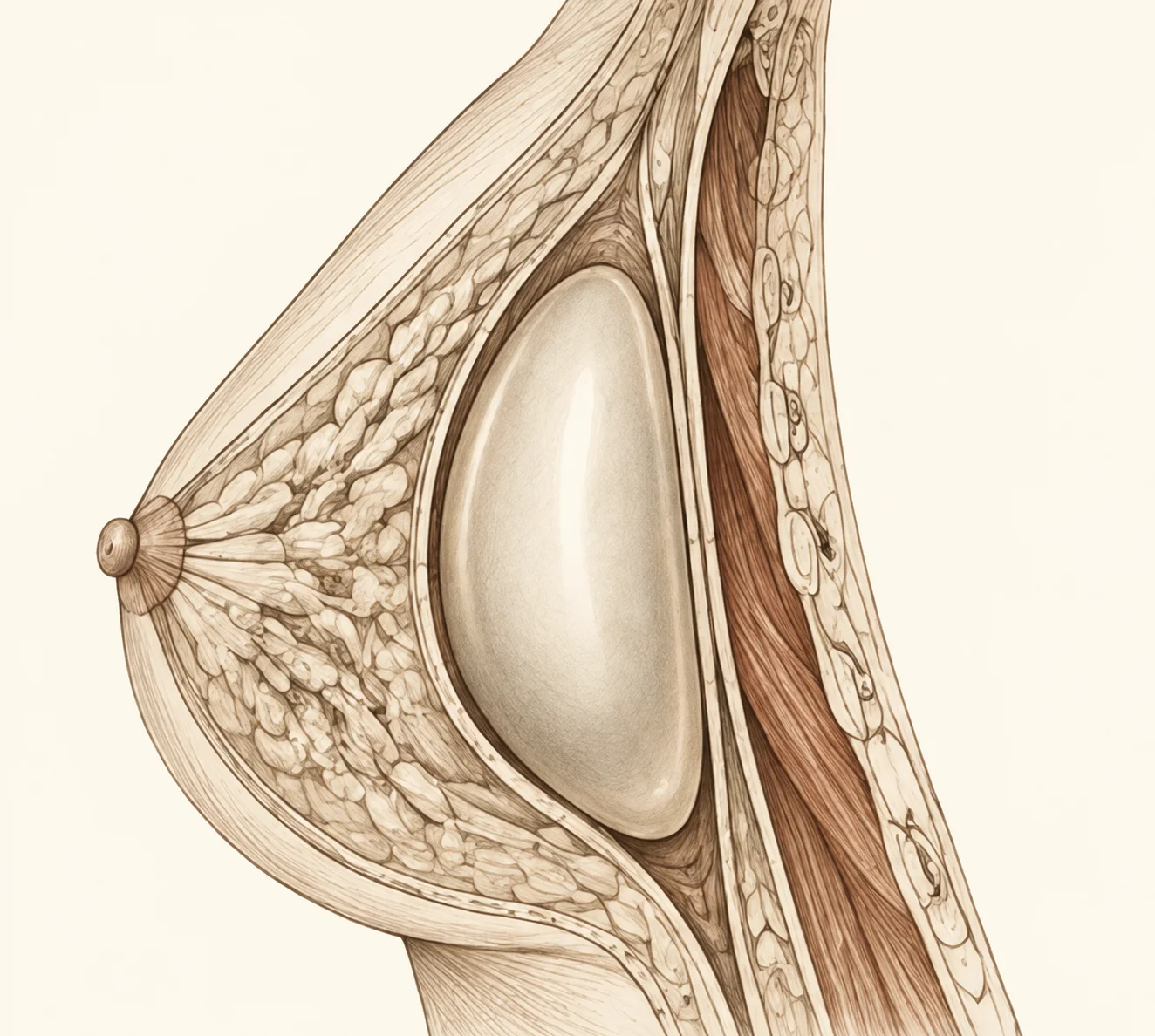
Auto-augmentation adds an internal reshaping step. The breast mound is reshaped, the nipple–areola complex is elevated where needed, and the patient’s own glandular tissue is used to build a more supported upper pole and central projection. It is typically performed in the context of a mastopexy. Different technical designs exist, but the principle is consistent: redistribute tissue and reinforce support, rather than adding a foreign device.
The distinction that decides everything is parenchyma versus envelope
Some breasts have enough parenchymal volume to redistribute. Others are primarily skin and stretched envelope with limited tissue substance — particularly after major weight loss or breastfeeding-related involution. The two can look similar in clothing and behave completely differently on the operating table, which is why the assessment has to separate how much breast there is from how much breast there appears to be.
Tissue availability is a ceiling, not a variable to work around
Where there is limited tissue substance, auto-augmentation has a clear ceiling. Repositioning a small amount of tissue can improve shape, but it cannot produce a strong, implant-like upper pole — and no refinement of technique changes that arithmetic. This is the single most important thing to establish before surgery rather than after it, because a patient who was told the ceiling exists experiences a modest improvement as success, and a patient who was not experiences the same result as a failure.
Three different operations that all get described as “a lift”
Where the fullness actually comes from
| Feature | Standard breast lift | Auto-augmentation | Implant-based augmentation |
|---|---|---|---|
| What changes the shape | Tightening and re-draping the skin envelope, and elevating the nipple–areola complex | The same, plus an internal step that repositions existing glandular tissue | A device that adds volume the tissue did not contain |
| Where upper pole fullness comes from | Nowhere — position improves, substance does not | Tissue borrowed from elsewhere in the same breast | The implant itself |
| What the upper pole looks like | Higher, but often flatter than expected | Improved continuity and central projection, tissue-led rather than round | The round, implant-driven upper pole some patients specifically want |
| The principal limitation | Cannot create volume | Limited by how much tissue there is to redistribute | Introduces long-horizon implant considerations |
| Scars | Required for meaningful lift | Required — the same scar commitment as a lift | Depends on whether a lift is also needed |
Skin quality is the second ceiling
If the envelope is lax, it will continue to relax over time. A lift improves position and shape, but long-term stability depends on tissue behaviour and internal support rather than on how tightly the skin was closed.
Individual tissue behaviour also affects scar maturation and the degree of settling, which means two patients with a similar starting shape can finish in different places for reasons neither the plan nor the technique controls.
Over-tightening buys scar tension, not durability
The instinct when skin is lax is to close it tighter, on the reasoning that a tighter result will hold longer. It does not work that way. Over-tightening increases scar tension without guaranteeing long-term shape, because the shape is being held by tissue behaviour and internal support, not by skin under load. So I plan conservatively — and when a result settles slightly more than a maximally tightened one would have, that is usually the trade I intended to make.
What auto-augmentation is not
It is not a replacement for implants when a patient wants a large volume increase or strong projection. It is not a guarantee against future settling — ageing, pregnancy and weight change still affect the breast envelope.
It is also not an operation that creates perfect symmetry. Baseline asymmetry persists, healing is variable, and where one breast has different tissue volume or skin quality it may settle differently. The plan aims for improved harmony, not identical breasts.
The honest shape of the trade
The advantage is real: shape can be improved using existing tissue while avoiding implant-related long-horizon issues. The trade-off is equally real: the achievable change is limited by anatomy, and scars are part of the procedure.
A mature plan acknowledges both halves. Presenting the first without the second is how a technically successful operation becomes a disappointing one.
I do not promise invisible scars
Scars depend on the lift pattern the anatomy requires, and a meaningful lift usually requires scars. The goal is well-placed scars that mature favourably — but scar quality is influenced by biology and aftercare, not only by technique, and I would rather a patient hear that from me than discover it during healing. This is also why I do not choose a smaller scar pattern than the anatomy calls for. Choosing the incision first and the correction second reverses the order in which those decisions should be made.
Recovery and settling
Recovery is similar to a lift, with variability in swelling, tightness and scar maturation. The breast continues to settle as tissues relax and internal support integrates.
Recovery is a sequence, not a single date.
-
Early phase
Swelling and tightness are expected
The shape at this stage reflects inflammation and tissue tension rather than the design. Early shape is not final shape.
-
Settling phase
The breast settles as the internal support integrates
Shape continues to refine as tissues relax and the repositioned tissue takes up its supported position. This is gradual, and it is the phase in which the upper pole becomes readable.
-
Assessment phase
Scars mature over months
Scar appearance changes well after the shape has stabilised, so the two should be judged separately. I avoid fixed timelines because healing varies with activity level and individual tissue behaviour.
If the shape settles more than intended
Revision options exist. They may include further lift-based refinement or, in some patients, adding an implant later. Each revision increases scar burden and can reduce predictability.
That is the argument for designing the first operation to be stable rather than extreme. It is also why some patients reasonably choose auto-augmentation as a first step, with an implant considered later if more projection turns out to be wanted — though if an implant is added, the pocket and scar plan have to be reassessed carefully rather than layered onto the previous design.
If you have had prior breast surgery
Secondary planning requires more restraint, because scar planes and blood supply can be altered. The assessment has to cover existing scars, tissue thickness and nipple–areola viability. Options depend on the prior procedure and the current anatomy, and staging is sometimes safer.
What should be weighed in the decision?
The central question is whether the amount of change your own tissue can deliver is worth the scars the lift requires — and whether that is genuinely the change you want.
- Trade-off: the procedure avoids implant-related long-horizon issues, and accepts a smaller achievable change in return. Those two are the same decision viewed from opposite sides.
- Trade-off: scars are part of the procedure. A meaningful lift usually requires them, and the pattern is dictated by the anatomy rather than by preference.
- Trade-off: conservative closure settles slightly more but protects scar quality; tighter closure raises scar tension without guaranteeing long-term shape.
- Limitation: tissue availability sets a ceiling. Where tissue substance is minimal, repositioning can improve shape but cannot produce a strong upper pole.
- Limitation: it does not produce the round, implant-driven upper pole some patients specifically want.
- Limitation: it is not a replacement for implants where a large volume increase or strong projection is the goal.
- Limitation: a lax envelope will continue to relax over time, and long-term stability depends on tissue behaviour and support rather than on tightness.
- Limitation: it is not a guarantee against future settling. Ageing, pregnancy and weight change still affect the breast envelope.
- Limitation: perfect symmetry is not a realistic promise. Baseline asymmetry persists, and a side with different tissue volume or skin quality may settle differently.
- Limitation: scar quality is influenced by biology and aftercare, and invisible scars cannot be promised.
- Limitation: individual tissue behaviour affects both scar maturation and the degree of settling, and neither is fully controllable by planning.
- Limitation: in secondary cases, altered scar planes and blood supply reduce predictability, and nipple–areola viability has to be assessed directly.
- Limitation: each revision increases scar burden and can reduce predictability.
- Alternative: where strong projection is the objective, an implant-based plan is the more appropriate tool rather than a harder-worked auto-augmentation.
- Alternative: auto-augmentation first, with an implant considered later, is a legitimate staged path in selected patients.
- Alternative: where tissue volume is minimal and scar tolerance is low, no surgery may be the more appropriate answer.
How long the result holds
Results can be durable, but the breast continues to age. Skin relaxation, pregnancy, weight change and gravity can all alter contour over time. A conservative plan tends to age better, because it avoids excessive tension and respects tissue limits from the start.
How to think about the decision
The question worth asking is not whether auto-augmentation can avoid an implant — it can. It is whether the change your own tissue can provide is the change you actually want, once the scars are counted honestly on the same page.
When properly indicated, the operation produces a natural, uplifted breast with improved upper pole continuity and a more supported silhouette. The best outcomes come from careful anatomical assessment, conservative reshaping, and individualised planning that respects what the tissue can realistically provide.
Who is a good candidate for breast auto-augmentation?
Good candidates typically have enough breast tissue to redistribute, mild to moderate ptosis, and a desire for shape improvement without implants. I assess tissue volume, skin elasticity, nipple position, and scar tolerance. If the breast has very little tissue substance, the achievable change is limited. The best candidates want a natural lift and modest fullness, and they accept that individual tissue behaviour influences settling and long-term stability.
Why can a breast lift not create fullness on its own?
A lift works on position, not on substance. It tightens and re-drapes the skin envelope and elevates the nipple–areola complex, which raises the breast but does not add anything to the upper pole. That is why a technically good lift can still leave a breast that sits higher and looks flatter than expected, and it is the specific gap auto-augmentation is designed to address by redistributing tissue that is already there.
How is auto-augmentation different from a standard breast lift?
A standard lift primarily repositions and tightens the skin envelope and elevates the nipple–areola complex. Auto-augmentation adds internal reshaping: tissue is repositioned to improve upper pole contour and support. The intent is a more stable shape, not simply a higher nipple.
Will the result look like implants?
No, and it should not be promised that way. Auto-augmentation can improve upper pole continuity and central projection, but it does not create the round, implant-driven upper pole that some patients desire. If that is the goal, implants may be the more appropriate tool.
Is auto-augmentation safer than an implant-based plan?
It avoids implant-related long-horizon issues, which is a genuine advantage for some patients. But it is not a shortcut: it still requires the scars of a lift, and the achievable change is limited by how much tissue is available to redistribute. The honest comparison is not safer versus riskier. It is a smaller, tissue-limited change without implant maintenance, against a larger, more predictable change with it.
What scars should I expect?
Scars depend on the lift pattern required by your anatomy. A meaningful lift usually requires scars. The goal is well-placed scars that mature favourably, but scar quality is influenced by biology and aftercare. I do not promise invisible scars.
When is auto-augmentation not the right answer?
It is not always the right answer when a significant volume increase is the goal, when tissue volume is minimal, or when scar tolerance is low. In those cases, either an implant-based plan or no surgery may be more appropriate.
How variable is recovery?
Swelling and tightness are expected early. Shape continues to refine as tissues settle and scars mature over months. I avoid fixed timelines because healing varies with activity level and individual tissue behaviour.
Can auto-augmentation correct asymmetry?
It can improve asymmetry, but perfect symmetry is not a realistic promise. If one breast has different tissue volume or skin quality, it may settle differently. The plan aims for improved harmony, not identical breasts.
What if I have had prior breast surgery?
Secondary planning requires more restraint because scar planes and blood supply can be altered. I evaluate existing scars, tissue thickness, and nipple–areola viability. Options depend on the prior procedure and the current anatomy, and staging is sometimes safer.
Could I add implants later if I want more fullness?
Yes, in selected cases. Some patients choose auto-augmentation as a first step and consider implants later if more projection is desired. If implants are added, the pocket and scar plan must be reassessed carefully.
How long do results last?
Results can be durable, but the breast continues to age. Skin relaxation, pregnancy, weight change, and gravity can alter contour over time. A conservative plan tends to age better because it avoids excessive tension and respects tissue limits.