
Explant surgery is usually described as taking the implants out. That is accurate as a description of the act, and it is misleading as a description of the operation.
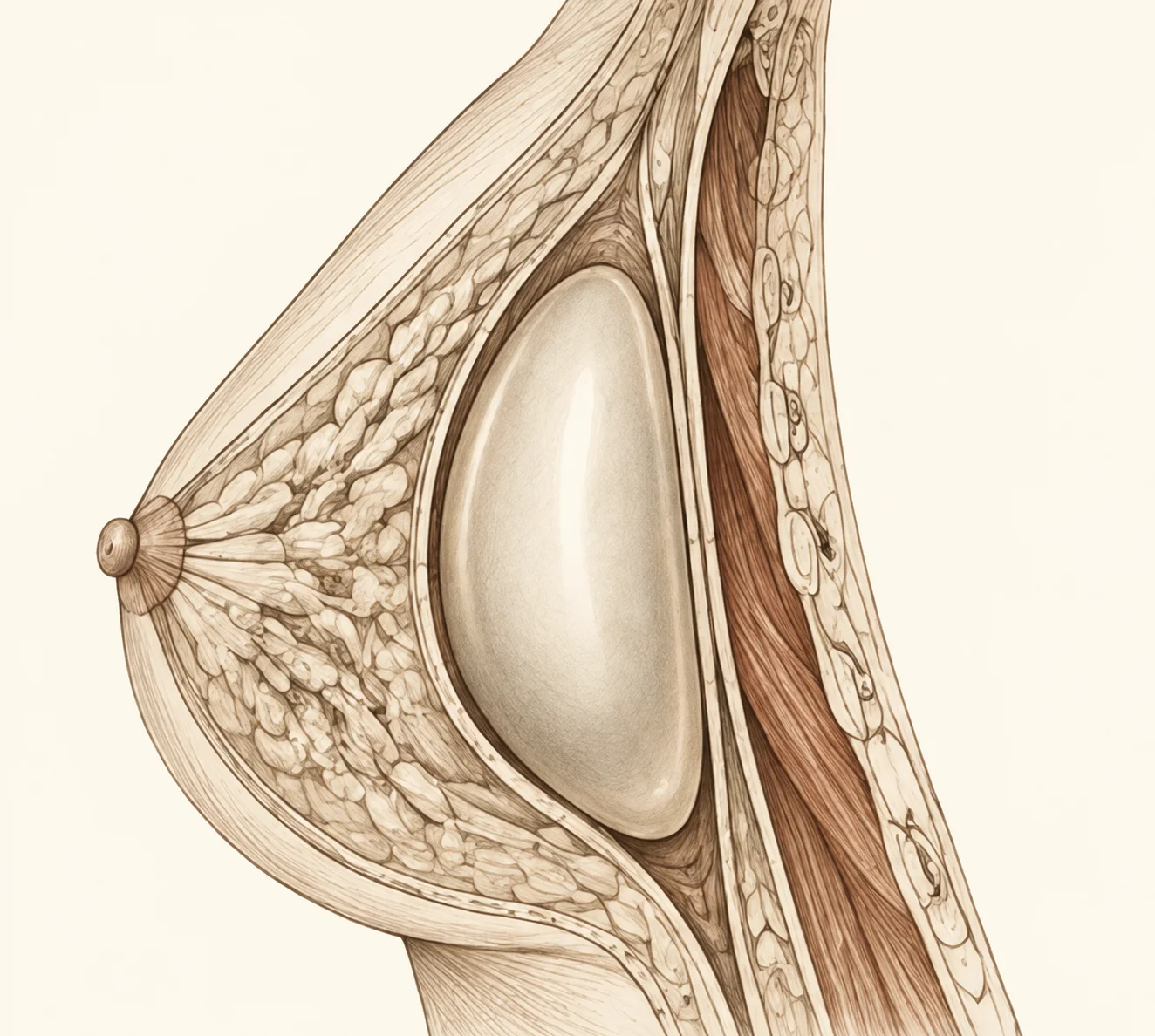
Removal changes volume. It also exposes the condition of three structures that were previously hidden by the implant: the skin envelope, the pocket, and the scar capsule that formed around the device. The quality of the result depends far less on the act of removal than on how those structures are assessed and managed. Some patients need removal only. Others need pocket stabilisation, capsular work, or a lift to restore a natural breast position. Treating every explant as the same operation is how expectations break.
Why this is not a reversal
Many patients approach explant as an undo: remove the implants and return to the original breast. The difficulty is that the original breast no longer exists as a starting point. After years with an implant, the skin and supporting tissues may be stretched, and what is uncovered is the current state of that tissue rather than its previous state.
Breast implant removal is a surgical procedure that removes breast implants. It may be performed alone, or combined with additional steps such as capsular work and a breast lift, depending on anatomy and goals. Some patients want to downsize and remain implant-free. Others want removal as part of a wider revision strategy. In every case the plan should be driven by tissue quality, implant history, and the mechanics of the pocket rather than by the removal itself.
The envelope decides how removal looks
When the implant comes out, the breast can appear deflated, with lower pole laxity or a lower nipple position. That is not a surgical error. It is tissue behaviour, and it is largely determined before the operation begins. In some anatomies the envelope re-drapes well and the breast looks natural after removal. In others a lift is needed to restore a coherent shape. Predicting which of those applies is the substance of the consultation.
Three structures, three separate decisions
The reason explants differ so much from one another is that the operation is really three assessments carried out in the same sitting, and each can point in a different direction.
What the operation is actually deciding
| Structure | The skin envelope | The scar capsule | The pocket |
|---|---|---|---|
| What it is | The skin and supporting tissues that held the implant’s volume | Scar tissue that forms around any implant | The space the implant occupied, with its boundaries |
| How much it varies | From good recoil to significant stretch, depending on baseline volume, elasticity and years in place | From thin and quiet to thickened, contracted or symptomatic | From stable to overly large, unstable or distorted |
| What the decision is | Whether removal alone gives a coherent shape, or a lift is needed | Conservative management, or partial or total capsulectomy based on findings | Whether pocket tightening and internal reinforcement are required |
| If it is misread | The breast looks deflated or bottom-heavy and the patient feels misled | Either symptoms persist, or more tissue is removed than safety required | The breast settles into a deformity rather than a shape |
Removing more tissue is not automatically better
Capsule management is the part of explant surgery most often discussed as though one answer were universally correct. It is not. A capsule can be thin and quiet, or thickened and contracted, and the appropriate response depends on what is found rather than on a rule agreed in advance. Some cases can be managed conservatively; others require partial or total capsulectomy. When capsulectomy is extensive, the risk profile increases — which means a maximal approach applied without indication is not a safer choice, it is a different set of risks accepted for no anatomical reason.
Why the pocket still matters once the implant is gone
If the pocket is unstable, overly large, or distorted, removal on its own can leave the breast settling into a shape the tissue was not organised to hold. Additional steps may be needed to avoid deformity, including pocket tightening and internal reinforcement.
Where a patient has had multiple implant surgeries, the pocket and scar planes are often altered and predictability falls. That does not exclude explant, but it makes the planning more conservative and the outcome less certain, and a careful evaluation of tissue thickness, capsule behaviour and pocket stability becomes essential rather than routine.
The same request can mean four different operations
Two patients can arrive with an identical sentence — I want these out — and leave with genuinely different plans: removal alone, removal with capsular work, removal with pocket reinforcement, or removal with a lift. Nothing about that reflects inconsistency. It reflects the fact that the sentence describes an intention while the operation is determined by findings. This is also why a plan quoted before the envelope, capsule and pocket have been assessed in person is a plan for an operation that has not yet been diagnosed.
What explant surgery is not
It is not a guaranteed return to a pre-implant breast. Ageing, pregnancy, weight change and prior stretching continue to influence shape. It is not a guarantee of perfect symmetry, because baseline asymmetry persists and healing is variable.
It is also not a scar-free operation. Existing scars remain, and additional scars may be necessary if a lift is included — which is the trade a patient accepts in exchange for a shape the envelope could not produce on its own.
Where removal alone will under-deliver
If the nipple position is low and the goal is a higher, tighter breast, removal alone will not achieve it. If the tissue is extremely thin or lax, the breast may look more deflated than expected. And if expectations are built around a fixed cup size or a tight outcome without a lift, the honest response is to slow the plan down and reframe it rather than to proceed and manage the disappointment afterwards.
I do not promise that removal alone will create a lifted, firm breast
Some envelopes re-drape well and produce a natural result with nothing more than removal. Others do not, and no amount of careful surgery converts a stretched envelope into a firm one by taking something out of it. Saying this clearly at the planning stage is not pessimism — it is the difference between a patient who experiences a softer, smaller, coherent breast as the intended outcome and one who experiences the same breast as a failure. Where a lift is the anatomically correct answer, I would rather present it as a choice with scars attached than let removal be judged against a result it was never able to deliver.
Recovery and re-draping
Recovery is typically manageable but variable. Swelling and tightness occur, and the shape evolves as the envelope re-drapes. Where a lift or significant capsular work is performed, recovery can be longer.
Recovery is a sequence, not a single date.
-
Early phase
Swelling and tightness are expected
The breast at this stage is not showing the shape the operation was designed around. Early appearance is not final appearance.
-
Re-draping phase
The envelope settles onto the remaining tissue
As swelling resolves and the pocket heals, the skin re-drapes and the breast finds its tissue-based shape. This is the phase that answers the question the consultation could only estimate.
-
Assessment phase
The shape becomes stable enough to judge
Only once settling has completed can it be decided whether further refinement is worthwhile. I avoid fixed timelines because settling depends on individual tissue behaviour and on the surgical scope that was required.
Staging is often the more honest plan
Some patients remove implants and later choose a lift or fat transfer for contour refinement once the breast has stabilised. Others remove and then decide on a smaller implant or a different pocket strategy.
Both paths are legitimate, and both work better staged than combined by default. Each additional surgery adds scar planes and reduces predictability, so the argument for staging is not caution for its own sake — it is that decisions made on a settled breast are made with better information than decisions made on a projected one.
What should be weighed in the decision?
The central question is not whether the implants can come out. It is what the envelope, the capsule and the pocket will require once they do, and whether that scope is acceptable.
- Trade-off: removal alone avoids new scars and accepts whatever shape the envelope produces. A lift produces a coherent shape and adds scars. These are the two halves of one decision.
- Trade-off: extensive capsulectomy addresses more capsule and carries an increased risk profile. The correct extent is set by findings, not by preference for thoroughness.
- Trade-off: combining removal, capsular work and a lift addresses everything in one operation and lengthens recovery; staging shortens each step but means more than one procedure.
- Limitation: it is not a guaranteed return to a pre-implant breast. Ageing, pregnancy, weight change and prior stretching continue to influence shape.
- Limitation: some deflation is expected. Whether the breast looks empty depends on baseline tissue volume, skin elasticity and how long the implant was in place.
- Limitation: removal alone does not raise a low nipple position or tighten a stretched envelope.
- Limitation: perfect symmetry cannot be guaranteed. Baseline asymmetry persists and healing is variable.
- Limitation: it is not a scar-free operation. Existing scars remain, and a lift adds more.
- Limitation: individual tissue behaviour strongly influences how the breast settles, and it is not fully predictable in advance.
- Limitation: where there have been multiple implant surgeries, altered scar planes and pocket mechanics reduce predictability.
- Limitation: risks include bleeding, infection, contour irregularity, persistent asymmetry, scarring, and dissatisfaction where expectations were unrealistic.
- Limitation: symptom improvement cannot be promised. Where discomfort is implant- or capsule-related it may improve after removal and appropriate capsule management, but pain has many causes and requires structured assessment first.
- Limitation: results are not a freeze. They continue to change with ageing, weight fluctuation and hormonal factors.
- Alternative: where a coherent lifted shape is the goal, a lift alongside or after removal is the anatomically correct discussion rather than removal alone.
- Alternative: fat transfer can improve contour and modest volume after explant, with limits and variable retention. It is not a substitute for implant-level projection.
- Alternative: where the objective is larger volume or strong projection without implants, explant is not the operation that delivers it.
- Alternative: where expectations centre on a pre-implant breast that anatomy cannot deliver, deferring surgery until the plan has been reframed is the more responsible step.
How long the result holds
Results can be durable, but they continue to change with ageing, weight fluctuation and hormonal factors. Explant is not a freeze. It is a structural reset toward an implant-free breast, and the breast that results remains a living structure with the same variability as any other.
How to think about the decision
The useful question is not whether the implants can be removed — they can. It is what your envelope is likely to do once they are, whether your capsule findings will require conservative or more extensive management, and whether you would accept a lift if that is what a coherent shape requires.
When properly indicated, explant surgery is a clear and responsible choice: it reduces implant-related concerns, restores comfort, and allows the breast to settle into a natural, tissue-based shape. The best outcomes come from individualised planning that respects envelope behaviour, capsule findings, and long-term stability.
Is explant surgery a reversal of my augmentation?
Not in the way the word suggests. Removal takes the volume away, but it does not return the tissue to its previous condition — it reveals the current condition of the envelope, the pocket and the capsule that formed around the implant. Some breasts re-drape well and look natural afterwards. Others need a lift or pocket work to produce a coherent shape. The operation is better understood as a structural reset toward an implant-free breast than as an undo.
Am I a candidate for explant surgery without a breast lift?
Sometimes, yes. The key variable is the condition of the skin envelope and nipple position. If tissue recoil is reasonable and the nipple sits in a balanced position on the breast mound, removal alone can produce a natural-looking result. If the nipple is low, the envelope is stretched, or there is significant laxity, explant alone may look deflated or bottom-heavy. In those cases, a lift may be the more anatomically correct plan. The decision is individualised and depends on individual tissue behaviour, implant history, and realistic expectations.
What is the capsule, and do you always remove it?
The capsule is scar tissue that forms around an implant. It can be thin and quiet, or thickened and contracted. Capsule management is not one-size-fits-all. Some cases may require partial or total capsulectomy. Others can be managed more conservatively. The choice depends on anatomy, symptoms, implant history, and safety. More removal is not automatically better.
Will my breasts look empty after implant removal?
They can look smaller and softer, and some deflation is expected. Whether the breast looks empty depends on your baseline tissue volume, skin elasticity, and how long the implant has been in place. Some breasts re-drape well. Others benefit from a lift or contour refinement. The goal is a coherent breast shape, not a promise of fullness without volume.
Do I have to decide about a lift at the same time as removal?
Not always. Combining them in one operation is appropriate for some patients, but staging is often the more informative path: remove first, allow the breast to settle, and then decide on a lift or contour refinement with the actual result in front of you rather than a projection of it. The counterweight is that each additional surgery adds scar planes and reduces predictability, so staging should be a considered choice rather than an indefinite deferral.
Can fat transfer be used after explant?
In selected cases, yes. Fat transfer can improve contour and modest volume, but it has limits and variable retention. It is not a substitute for implant-level projection. Some patients benefit from staging: removal first, then fat transfer once tissues stabilise.
When is explant not the right answer?
It is not always the right answer when the primary goal is larger volume or strong projection without implants. It may also be the wrong timing if expectations are centred on a pre-implant breast that anatomy cannot realistically deliver. However, for patients seeking implant-free shape and comfort, explant can be appropriate when properly indicated.
How variable is recovery and settling?
The breast changes in phases. Swelling resolves, the envelope re-drapes, and the pocket heals. If capsular work or a lift is performed, healing can take longer. I avoid fixed timelines because settling depends on individual tissue behaviour and surgical scope.
What if I have had multiple implant surgeries?
Multiple surgeries alter scar planes and pocket mechanics. That does not exclude explant, but it makes planning more conservative and outcomes less predictable. A careful evaluation of tissue thickness, capsule behaviour, and pocket stability is essential.
Will explant correct pain or discomfort?
If discomfort is implant- or capsule-related, symptoms may improve after removal and appropriate capsule management. However, pain has many causes. A structured assessment is necessary before promising symptom resolution.
What are the main risks?
Risks include bleeding, infection, contour irregularity, persistent asymmetry, scarring, and dissatisfaction if expectations are unrealistic. When capsulectomy is extensive, the risk profile can increase. Conservative planning reduces risk.
How long-lasting are results?
Results can be durable, but they will continue to change with aging, weight fluctuation, and hormonal factors. Explant is not a freeze. It is a structural reset toward an implant-free breast.