Breast augmentation is usually discussed as choosing an implant size. That is an understandable question, but it is not how the operation is planned.
An implant changes more than volume. It changes projection, upper pole shape, cleavage dynamics, and the way the breast sits on the chest wall. If those variables are not planned together, the result can look heavy, artificial, or unstable — regardless of whether the size chosen was modest or large.
Why the first question is dimensions, not size
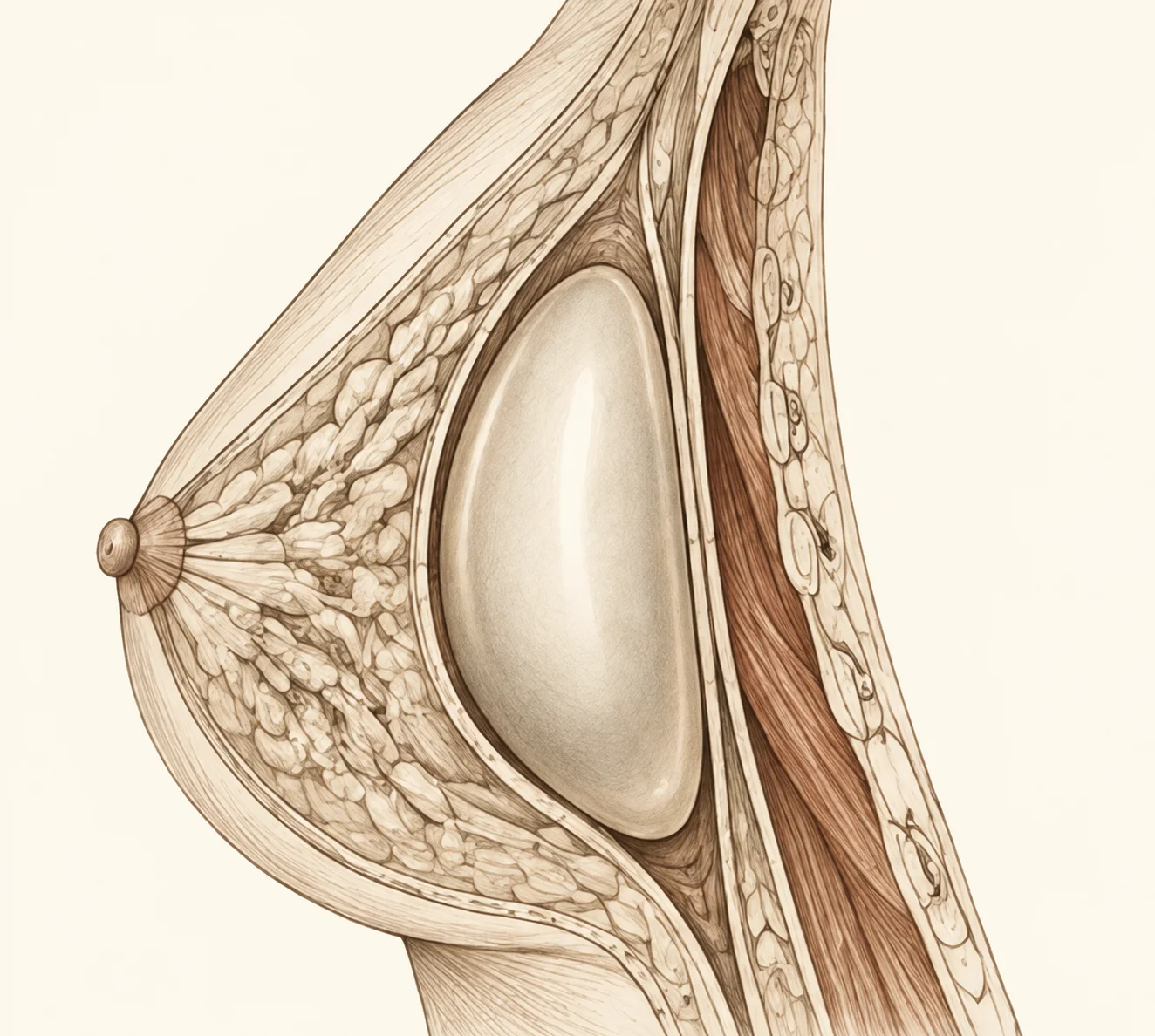
The breast is a three-dimensional structure defined by base width, projection, tissue thickness, nipple position, and the relationship between the breast footprint and the chest wall. When size is chosen without those variables, the result may look disproportionate, feel unnatural, or age poorly.
Augmentation mammoplasty increases breast volume and reshapes the breast contour, most commonly using implants. In selected cases fat transfer can be used for modest volume changes or contour refinement, but implants remain the most predictable tool for meaningful projection and upper pole support. The operation is not only about adding volume — it is about placing that volume in a position and dimension that fits the anatomy it is going into.
The base width sets the boundary
A breast has a base width, and that measurement should guide implant width. Projection then has to be matched to skin envelope tolerance, tissue thickness and the desired profile — which means projection is a separate decision from width, not a consequence of it. These are measurable anatomic boundaries, and they are what the plan is built on.
What happens when the dimensions do not fit the base
Three ways an implant can be mismatched to the anatomy
| Feature | Too narrow for the base | Too wide for the base | Projection beyond envelope tolerance |
|---|---|---|---|
| What has been chosen | An implant narrower than the breast footprint it sits in | An implant wider than the natural footprint, often to force cleavage | A profile the skin envelope and tissue thickness cannot support |
| How the breast reads | A central mound with poor side support | Lateral fullness and distortion of the natural breast footprint | An implant-led contour rather than an anatomy-led one |
| What tends to happen over time | The shape stays disconnected from the chest wall it sits on | Pocket problems, because the implant is occupying space the anatomy did not offer | Progressive stretching, and a result that becomes heavier and less refined |
| The honest expectation | Width has to follow the base, not the desired volume | Cleavage is partly skeletal and cannot be created by widening an implant | A conservative, well-matched implant usually produces the more natural silhouette |
The same implant behaves differently in different tissue
Thin tissue can reveal implant edges and rippling, and can produce an implant-led contour. Lax tissue can settle and change shape over time, particularly with larger implants. Strong, elastic tissue holds shape well, but it can also create a tighter upper pole if the plan is too aggressive.
Soft-tissue quality is not a secondary variable
It is a primary determinant of long-term stability. Two patients can receive the same implant and end up with results that look and behave nothing alike, because the covering tissue is doing different work in each case. This is why implant selection cannot be transferred from one patient to another, and why a size that produced an excellent outcome in someone else’s anatomy is not evidence that it will work in yours. The tissue is not a passive envelope. It is part of the mechanism.
Placement is a judgement, not a default
Implant position relative to the pectoralis muscle and the existing breast gland affects upper pole slope, cleavage behaviour and implant visibility. Placement under the muscle, or a dual-plane approach, can improve upper pole smoothness in selected patients.
But there is no universally correct plane. The correct choice depends on tissue thickness, breast footprint, activity level and the specific contour goal. The safest plan is the one that respects the anatomy in front of it rather than reproducing a standardised look.
I plan with measurable anatomic boundaries rather than trends
Trends describe an appearance. Anatomy describes what is possible without borrowing from long-term stability. When those two disagree, I plan to the anatomy — which sometimes means recommending less projection than a patient arrived expecting. That conversation is easier at the planning stage than it is years later, when the tissue has been asked to hold something it was never dimensioned for. A good augmentation should look coherent in normal light and in motion, and it should still make sense as the tissue ages.
What augmentation is not
It is not a guarantee of perfect symmetry. Natural breasts are asymmetric, and healing is variable. It is not a promise of a fixed cup size, because bra sizing is not standardised and depends on many variables.
It is also not a reliable method of correcting significant ptosis when the nipple sits low on the breast mound. In that situation a lift may be properly indicated, with or without an implant — and adding volume alone can sometimes make the droop more apparent rather than less.
On cleavage specifically
Cleavage is partly anatomy: chest width, breast footprint and natural spacing. Implants can improve fullness, but they cannot change bone structure. Forcing cleavage with an overly wide implant creates unnatural lateral fullness and pocket problems. A refined plan aims for proportionate medial fullness within safe anatomic boundaries.
An oversized implant borrows from the future
An overly large implant may look impressive early, and then become heavy and less refined as the tissues stretch. That is the part of the decision that is hardest to feel at the consultation, because the cost is not paid on the day — it is paid gradually, in envelope quality and in the likelihood of further surgery. So when I recommend restraint in sizing, it is not aesthetic conservatism. It is an attempt to keep the result and the tissue on the same side of the equation.
Recovery and settling
Recovery is usually manageable, but variability is real, and much of what patients worry about in the early phase is the settling process rather than the result.
Recovery is a sequence, not a single date.
-
Early phase
The implants sit higher and the breast feels firm
Swelling and tightness are expected, and the shape at this stage is not the shape the operation was designed to produce. Early appearance is not final appearance.
-
Settling phase
The implant settles as the tissues relax
As the soft tissues adapt, the implant position lowers into the pocket and the contour becomes smoother and more natural. This is a gradual process rather than an event.
-
Assessment phase
The shape becomes readable
Once swelling has resolved and the pocket is stable, the proportions can be judged properly. I avoid fixed timelines, because healing depends on activity level, aftercare and individual tissue behaviour.
The long horizon that comes with implants
Implants require long-term thinking. They are not lifetime devices in the practical sense, and future surgery may be needed for reasons including ageing, pregnancy, weight change, capsule behaviour, or a change in preference.
This does not mean augmentation is unstable. It means it should be approached with mature expectations and conservative planning. Conservative sizing and a stable pocket design are what reduce long-term problems.
If you already have implants and want a change
Secondary augmentation requires careful assessment of pocket stability, capsule tightness, tissue thickness and the reason for the change. Sometimes the answer is a size adjustment; sometimes it is a pocket revision or a lift. Revision planning is more constrained than primary surgery, so the plan has to be measured rather than ambitious.
What should be weighed in the decision?
The central question is not how much volume is wanted, but how much volume the tissue can carry without spending its long-term stability.
- Trade-off: greater projection increases visual impact and increases the load on the skin envelope. The two move together, and the second is what determines how the result ages.
- Trade-off: a wider implant can add medial fullness but distorts the natural footprint and creates pocket problems if it exceeds the base.
- Trade-off: where ptosis is significant, a lift produces the lifted appearance an implant cannot — but it is accepted with its scars. Choosing fewer scars over the correct operation is choosing a different result.
- Limitation: perfect symmetry cannot be guaranteed. Natural breasts are asymmetric and healing is variable.
- Limitation: a fixed cup size cannot be promised, because bra sizing is not standardised.
- Limitation: implants cannot change bone structure, so chest width and natural breast spacing set the ceiling on cleavage.
- Limitation: augmentation alone does not reliably correct significant ptosis, and can sometimes make droop more apparent.
- Limitation: thin tissue can reveal implant edges and rippling, and produces a more implant-led contour.
- Limitation: lax tissue can settle and change shape over time, particularly with larger implants.
- Limitation: implants are not lifetime devices in the practical sense. Future surgery may be needed for capsule behaviour, positional change, pregnancy, ageing or preference.
- Limitation: results are not immune to ageing and body change. Skin stretches, weight fluctuates, and pregnancy can alter the breast envelope.
- Limitation: each revision introduces new scar planes and reduces predictability, and revision planning is more constrained than primary surgery.
- Alternative: fat transfer can be considered for modest volume change or contour refinement, but it is not a substitute for implant-level projection or upper pole support.
- Alternative: where the nipple sits low on the mound, a lift — with or without an implant — is the correct discussion rather than a larger implant.
- Alternative: declining surgery is the responsible path where the desired size exceeds what the tissues can support, where expectations centre on a fixed cup size or a guaranteed look, or where medical risk factors make elective surgery unsafe.
When the plan starts to fail
If the implant is too large for the tissue envelope, if the pocket is not stable, or if the breast required a lift that was not performed, the result becomes less coherent over time. Revision strategies exist, but each revision introduces new scar planes and reduces predictability.
That is the argument for getting the first operation right rather than maximal. The primary plan should prioritise stable proportions, tissue-respecting dimensions, and a design that will still make sense in a decade.
How to think about the decision
Augmentation can be long-lasting, but it is not immune to ageing and body change. A conservative augmentation tends to age better because it respects tissue limits from the start.
When properly indicated, the benefit is specific: improved projection, better upper pole support, and proportions that fit the frame. The best outcomes come from detailed anatomical assessment, conservative implant selection, and a plan that respects both the aesthetics and the long-term behaviour of the tissue.
Am I a good candidate for breast augmentation?
Good candidates typically have stable weight, realistic expectations, and anatomy that can support an implant safely. I assess breast base width, tissue thickness, skin elasticity, nipple position, and the degree of asymmetry. If tissue is thin, implant edges and rippling can be more visible, and the plan must be conservative. If there is ptosis, augmentation alone may not correct nipple position and can sometimes make droop more apparent. A good candidate wants proportionate change and accepts that individual tissue behaviour influences settling, scar quality, and long-term stability.
How do you choose the right implant size?
I choose implant dimensions based on anatomy, not trends. Base width guides implant width. Tissue quality and skin envelope tolerance guide projection. The goal is a breast that looks coherent on the chest wall and remains stable over time. An overly large implant may look impressive early and then become heavy and less refined as tissues stretch. A conservative, well-matched implant often produces a more natural silhouette.
Will implants look and feel natural?
They can, when the implant is matched to tissue thickness and placement is chosen appropriately. Thin tissue can reveal implant edges or rippling. Placement under muscle or in a dual-plane approach can improve upper pole smoothness in selected patients. Natural also depends on proportion: if projection exceeds what the frame can support, the breast can look implant-led rather than anatomy-led.
Do I need a breast lift as well?
Not always, but it depends on nipple position and skin redundancy. If the nipple sits low on the breast mound or if there is significant ptosis, adding volume alone may not create a lifted appearance. In those cases, a lift with or without an implant may be properly indicated. The correct plan is based on anatomy, not on a preference for fewer scars.
Can fat transfer be used instead of an implant?
In selected cases, yes — for modest volume change or contour refinement. But implants remain the most predictable tool for meaningful projection and upper pole support, so fat transfer is not an equivalent option when substantial projection is the goal. The honest way to frame the choice is by what the anatomy requires rather than by which tool sounds less invasive.
What can I realistically expect in terms of cleavage?
Cleavage is partly anatomy: chest width, breast footprint, and natural spacing. Implants can improve fullness, but they cannot change bone structure. Forcing cleavage with an overly wide implant can create unnatural lateral fullness and pocket issues. A refined plan aims for proportionate medial fullness within safe anatomic boundaries.
When is breast augmentation not the right answer?
It is not always the right answer when expectations are centred on a fixed cup size or a guaranteed look, when ptosis is significant and a lift is not acceptable, or when medical risk factors make elective surgery unsafe. It can also be inappropriate when the desired size exceeds what the tissues can support without long-term stretching.
Why do my breasts look too high immediately after surgery?
Early on, implants tend to sit higher and the breast feels firm, because swelling and tissue tightness have not yet resolved. As the tissues relax, the implant settles into the pocket and the contour becomes smoother. This is why early appearance is not final appearance, and why judgements made in the first phase are usually judgements about swelling rather than about the result.
How variable is recovery and settling?
Swelling, tightness, and implant position change over time. Early on, implants can sit higher and the breast can feel firm. As tissues relax, the implant settles and the contour becomes smoother. I avoid fixed timelines because healing depends on activity level, aftercare, and individual tissue behaviour.
What are the long-term considerations with implants?
Implants require long-term thinking. Future surgery may be needed due to capsule behaviour, positional changes, pregnancy, aging, or preference changes. This is not a failure. It is the realistic horizon of implant-based surgery. Conservative sizing and stable pocket design reduce long-term problems.
What if I already have implants and want a change?
Secondary augmentation requires careful assessment of pocket stability, capsule tightness, tissue thickness, and the reason for change. Sometimes the solution is size adjustment. Sometimes it is a pocket revision or a lift. Revision planning is more constrained than primary surgery, so the plan should be measured.
How long do results last?
Augmentation can be long-lasting, but it is not immune to aging and body changes. Skin stretches, weight fluctuates, and pregnancy can alter the breast envelope. A conservative augmentation tends to age better because it respects tissue limits from the start.