
A chin implant is usually discussed as an object: which one, what size, how much projection. In planning it is not an object decision at all. It is an indication decision.
The chin is a structural anchor. It influences the neck–chin angle, lower-face balance, and how the lips and nose read in profile. An implant adds projection to that anchor — which is useful when projection is genuinely what is missing, and unhelpful when it is not.
What an implant is actually appropriate for
Implant-based chin augmentation is appropriate when the main issue is a modest projection deficiency and the anatomy supports stable implant placement. Those two conditions are not the same thing, and both have to be satisfied.
The first is about the type of deficiency: is the shortfall in projection, or is it in chin height or width, or is it a dental or bite-related pattern that only presents as a weak chin? The second is about whether the anatomy can hold an added structure in a stable position over time. Where the deficiency is more complex, involves vertical height, or requires precise bony repositioning, a sliding genioplasty is the more coherent plan — and choosing an implant in that anatomy is choosing the more convenient operation rather than the correct one.
The aim is a profile, not a chin
The objective is controlled refinement: improved projection and proportion, without an exaggerated or implant-obvious look. Planning is based on facial balance rather than on trends.
That framing matters because the chin is a small structure with disproportionate leverage. What patients notice after a well-planned implant is usually not the chin. It is that the nose reads differently in profile, that the lips sit differently against the lower face, and that the neck–chin angle looks more defined. What they notice after an over-projected implant is the chin itself.
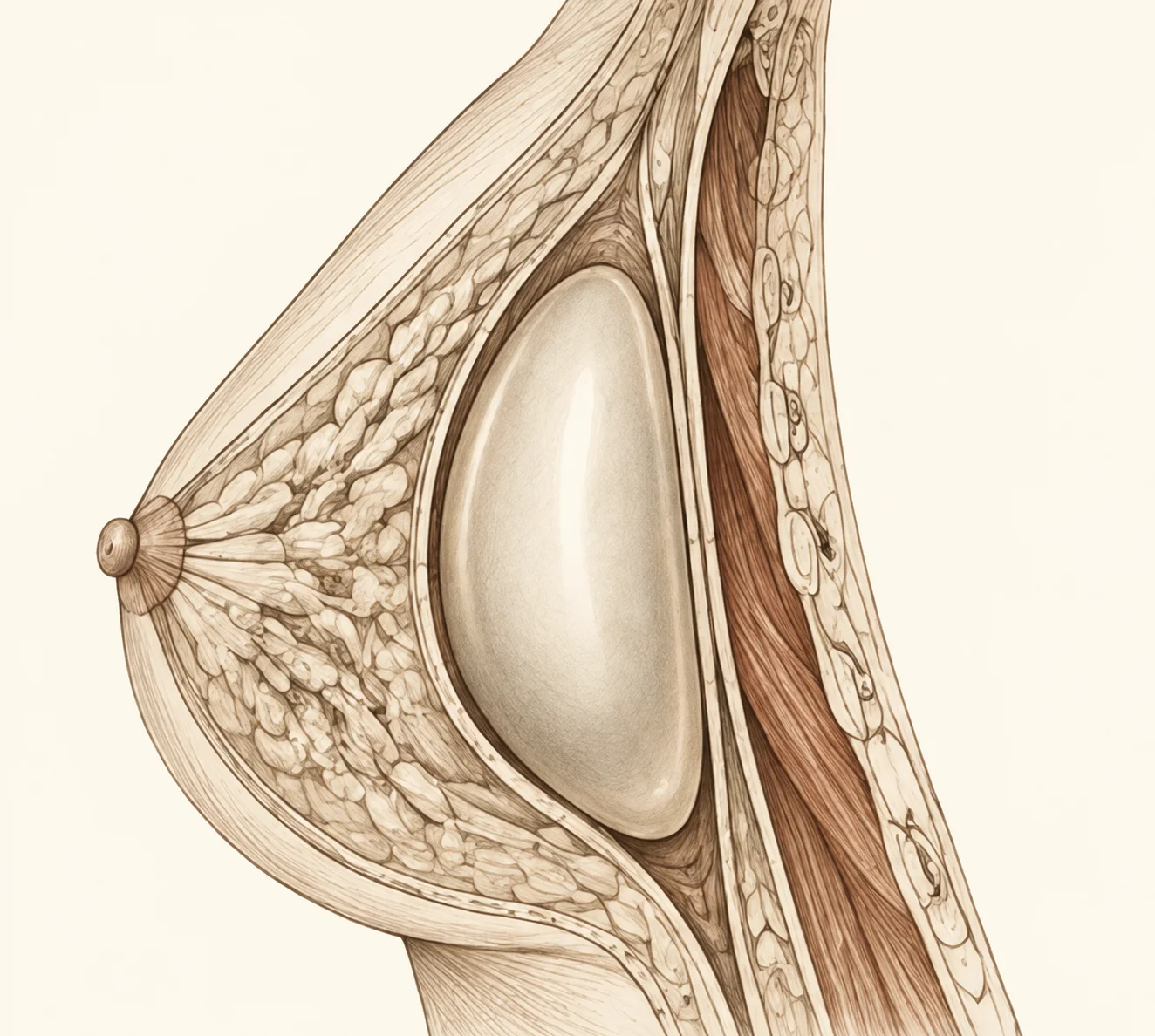
An implant is read through the tissue in front of it
In assessment I look at facial profile balance, at chin width and height as dimensions in their own right, at soft-tissue thickness, and at the neck–chin transition. Dental and bite considerations are relevant as well. Soft-tissue thickness deserves particular attention in implant planning, because the implant is never seen directly — it is seen through the tissue draped over it, and the same added projection does not read the same way in every face. This is one of the reasons the plan is built from the profile rather than from a target measurement.
Not every weak-looking chin is an implant candidate
Three things can each present as a weak chin: true skeletal retrusion, soft-tissue fullness in the submental region, and dental or bite-related considerations. An implant addresses only the first, and only when the shortfall is in projection.
This is where most disappointment originates — not in the implant, but in the classification that preceded it.
Where an implant sits on the candidacy gradient
| Feature | Implant is a coherent plan | Implant is possible but not the best answer | Implant is the wrong tool |
|---|---|---|---|
| What the anatomy shows | A modest projection deficiency, with anatomy that supports stable placement | Projection is deficient, but height or width also contributes to the appearance | The dominant issue is submental fullness, neck laxity, jawline structure beyond the chin, or a dental or bite-related pattern |
| What an implant would deliver | Improved projection and lower-face proportion | Part of the change, while leaving the remaining dimension unaddressed | Little or nothing that addresses the actual complaint |
| What is more likely appropriate | A conservative implant matched to the profile | Sliding genioplasty, where repositioning rather than addition is what the anatomy requires | A different category of treatment aimed at the structure that is actually creating the appearance |
| Why the distinction is worth making | An implant placed on a correct indication is a modest, stable structural change. The same implant placed on the wrong indication does not become a bigger operation — it becomes a permanent one that leaves the original concern in place | ||
Most disappointing implants were not the wrong implant. They were the wrong indication.
When an implant-based result looks obvious, the reason is almost never that a different implant would have looked natural. Over-projection is the main reason results look obvious, and mismatched indication is the main reason results feel irrelevant to the original complaint. Both are planning outcomes rather than manufacturing ones. This is why I spend the consultation on classification and on the amount, and comparatively little of it on the implant itself — the implant is the last decision in the sequence, not the first.
What a chin implant cannot be asked to do
An implant advances the chin point, which can improve the neck–chin angle in some patients. That is a real effect, and it is the source of the most common misplaced expectation: it does not remove submental fat and it does not tighten skin. Where fullness is dominant, additional strategies may be needed and the implant alone will not deliver the change.
Nor does it address neck laxity, or jawline structure beyond the chin where that is the dominant limitation. And it is not appropriate where expectations require a fixed photographic template — a chin implant is planned against your profile, not against a reference image.
Filler often answers the question before surgery does
Many patients arrive having already had chin filler, and that history is clinically useful rather than a complication. It tells us something: if adding projection produced the right direction of change but not the durability wanted, an implant is addressing the dimension that was genuinely deficient, and surgery can provide a more durable structural correction. If adding projection did not resolve the complaint, that is a signal worth respecting — it usually means projection was not the limitation, and a permanent implant would inherit the same mismatch. In either case, I assess your anatomy alongside what the filler achieved and what it did not, and the surgical plan that follows still has to be conservative.
I would rather place a small implant on a correct indication than a well-sized one on a wrong one
My planning is anatomy-led. I define the type of deficiency first, and only then decide whether adding structure or repositioning bone is the right method — weighing long-term stability as heavily as the immediate result. Where an implant is appropriate, I plan the amount from the profile rather than from a projection target, because a proportionate change is what makes the result look natural and an exaggerated one is what makes it look done. I am also willing to say that an implant is not the right tool for a particular chin. That is a clinical conclusion, not a reluctance.
Recovery is a sequence, not a single date.
- Early phaseSwelling, numbness and tightness
All three vary between patients. They are expected features of this phase rather than indications that something is wrong.
- Sensation and tightness phaseFeel changes before appearance does
Numbness and tightness can persist after the most visible swelling has begun to reduce, so how the chin feels and how it looks improve on different schedules.
- Settling and symmetry phaseEarly asymmetry usually resolves here
Early asymmetry can occur and often settles. I avoid fixed timelines, because healing depends on the technique used and on individual tissue behaviour.
The middle phase is worth naming, because it is the one patients most often misread. A chin that still feels tight or numb while the profile already looks close to the plan is following a normal sequence, not an abnormal one.
The long view: the implant is stable, the face is not
Structural changes can be long-lasting. The soft tissues, however, continue to age around them — which is the practical argument for conservative sizing rather than a philosophical one. A conservative augmentation tends to remain more natural over time, because it is not relying on the surrounding tissue staying exactly as it is today.
Implant malposition is a recognised risk where an implant is used, and where an implant is malpositioned, too prominent, or not suited to the anatomy, removal or a revised plan can be considered. Revision after an implant is a narrower conversation than the original one, which is a further reason for the initial plan to prioritise proportion.
Why this is often planned with the rest of the profile
Chin projection strongly influences facial profile balance, so combining chin augmentation with rhinoplasty or with other facial procedures is often appropriate — when planned coherently rather than accumulated. The two structures interact: a chin change alters how a nose reads, and a nose change alters how much chin projection is needed. Planning them together is frequently the only way to decide the correct amount of each.
What should be weighed in the decision?
An implant is a permanent added structure on the midline of the lower face, and its result is governed more by indication and amount than by the implant itself.
- Trade-off: the result depends on proportion rather than amount — over-projection is the main reason results look obvious.
- Trade-off: the implant is read through the soft tissue in front of it, so the same projection does not read the same way in every face.
- Trade-off: structural changes can be long-lasting, but the soft tissues continue to age around them.
- Trade-off: swelling, numbness and tightness vary between patients.
- Trade-off: early asymmetry can occur, and the chin’s midline position makes any difference easy to notice before it settles.
- Trade-off: combining with rhinoplasty or other facial procedures is often appropriate, but only when the combination is planned coherently.
- Limitation: implant malposition is a recognised risk where an implant is used.
- Limitation: risks include asymmetry, infection, changes in sensation, malposition, and dissatisfaction where expectations are unrealistic.
- Limitation: an implant adds projection; it does not correct a deficiency of chin height.
- Limitation: it does not remove submental fat.
- Limitation: it does not tighten skin.
- Limitation: it can improve the neck–chin angle in some patients, but it will not resolve a double chin where fullness is dominant.
- Limitation: it does not address neck laxity or jawline structure beyond the chin where those are dominant.
- Limitation: it is not compatible with expectations that require a fixed photographic template.
- Limitation: a fixed recovery schedule cannot be promised, because healing depends on the technique and on individual tissue behaviour.
- Alternative: where the deficiency is more complex, involves vertical height, or requires precise bony repositioning, sliding genioplasty is the more coherent plan.
- Alternative: where submental fullness is dominant, additional strategies may be needed rather than an implant.
- Alternative: where the dominant problem is dental or bite-related, that belongs to a different category of assessment.
- Alternative: where a permanent decision is not yet wanted, a non-surgical approach can give information about whether projection is genuinely the missing dimension.
How to think about the decision
The decision is sound when the deficiency has been classified as a projection deficiency rather than assumed to be one, when chin height and width have been assessed alongside projection, when soft-tissue thickness and the neck–chin transition have been examined, when dental and bite considerations have been accounted for, when the anatomy has been judged able to hold an implant in a stable position, when the amount has been planned from your profile rather than from a target, and when the concern has been stable over time.
A good candidate wants a natural improvement rather than a dramatic change, and accepts that individual tissue behaviour influences swelling and settling. An in-person assessment is the safest way to establish whether an implant — rather than a bony advancement, or a different category of treatment altogether — is the right answer for your facial framework.
Am I a candidate for a chin implant specifically?
An implant is a coherent plan when the main issue is a modest projection deficiency and the anatomy supports stable implant placement. I assess facial profile balance, chin width and height, soft-tissue thickness, and the neck–chin transition, and dental and bite considerations are relevant too. A good candidate has a concern that has been stable over time, wants a natural improvement rather than a dramatic change, and accepts that individual tissue behaviour influences swelling and settling.
Why would you recommend sliding genioplasty instead of an implant?
Because the two address different kinds of deficiency. If the shortfall is more complex, involves vertical height, or requires precise bony repositioning, repositioning the bone is the more coherent plan than adding a structure to the front of it. The safest choice is anatomy-led rather than technique-led.
How do you decide how much projection to add?
From the profile rather than from a number. Chin projection influences how the nose and lips read and how the neck–chin angle is defined, so the amount is chosen for facial balance. Over-projection is the main reason results look obvious, which is why the planning bias is towards a proportionate change.
Will an implant look obvious?
It should not, when the change is proportionate and conservative. When an implant-based result does look obvious, the usual reason is over-projection or a mismatched indication rather than the implant itself. Soft-tissue thickness is part of that judgement, because the implant is read through the tissue in front of it.
Will a chin implant fix my double chin?
It can improve the neck–chin angle in some patients by advancing the chin point, but it does not remove submental fat and it does not tighten skin. If fullness is dominant, additional strategies may be needed.
When is an implant the wrong tool altogether?
When the dominant issue is neck laxity, heavy submental fat, or jawline structure beyond the chin; when the appearance is driven by a dental or bite-related pattern; or when the deficiency is in chin height rather than projection. It is also inappropriate when expectations require a fixed photographic template.
What are the main risks?
Risks include asymmetry, infection, changes in sensation, implant malposition, and dissatisfaction if expectations are unrealistic. Conservative planning reduces risk but does not remove it.
How variable is recovery?
Swelling, numbness and tightness vary. Early asymmetry can occur and often settles. I avoid fixed timelines because healing depends on the technique used and on individual tissue behaviour.
Why does my chin still feel tight when it already looks close to the plan?
Because appearance and sensation improve on different schedules. Numbness and tightness can persist after the most visible swelling has begun to reduce. That sequence is normal rather than a sign that something has gone wrong.
Can an implant be removed or changed later?
Where an implant is malpositioned, too prominent, or not suited to the anatomy, removal or a revised plan can be considered. Revision is a narrower conversation than the original decision, which is a further reason for the initial plan to prioritise proportion over projection.
I have had chin filler — does that change anything?
It gives us information. If adding projection produced the right direction of change but not the durability you wanted, an implant is addressing the dimension that was genuinely deficient. If it did not resolve the complaint, projection may not have been the limitation, and a permanent implant would inherit the same mismatch. I assess your anatomy alongside what the filler achieved and what it did not.
How long-lasting is an implant result?
Structural changes can be long-lasting. However, the soft tissues continue to age around the implant, which is why a conservative augmentation tends to remain more natural over time.