

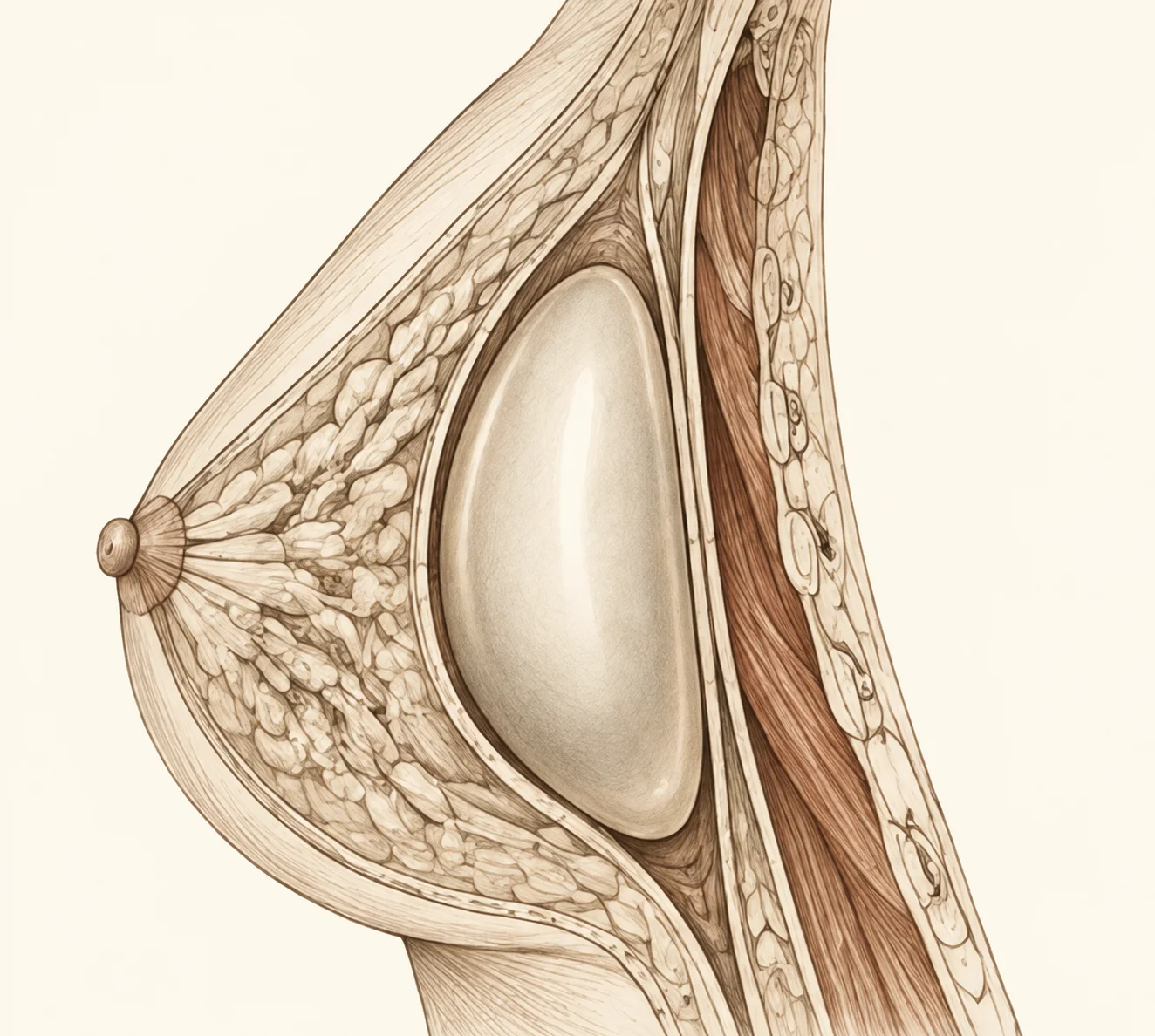
Breast implant malposition means that an implant no longer sits where the breast and pocket were intended to hold it. That sounds simple until we ask which direction it moved and why. An implant can sit too low, too high, too far laterally, too medially, or rotate within a pocket that no longer matches the device. The visible problem is position; the underlying problem may involve pocket dimensions, tissue stretch, capsule behaviour, implant selection or chest-wall anatomy.
“My implant has moved” needs a direction
A low implant creates a different breast from a lateral implant. A high implant can make the upper pole look excessively full while the nipple appears low on the mound. A lateral shift may become most obvious when the patient lies down or moves the arm.
Defining direction matters because revision surgery is fundamentally a pocket-reconstruction problem. The corrective force has to oppose the actual displacement rather than generically “tighten” the breast.
Bottoming out is not the same as breast sagging
When an implant descends too low, the inframammary relationship can stretch and the lower pole may become long. The nipple can appear relatively high on the breast. Patients may describe this as sagging, but true breast ptosis is a different relationship involving native breast tissue and nipple position.
If the implant is low but the native breast is also sagging, both mechanisms may need attention. Correcting the pocket alone can leave descended breast tissue behind; lifting the breast without repairing the implant position can leave the mechanical cause untouched.
A high implant can be early settling — or a persistent pocket problem
Early after augmentation, implants can sit relatively high while swelling resolves and tissues relax. The decision to intervene should therefore respect healing time.
A persistent high position later in recovery can reflect pocket limits, capsule tightening, muscle mechanics or implant characteristics. I do not want to treat normal early evolution as a revision indication, and I do not want to wait indefinitely when a stable structural malposition is clearly present.
Lateral displacement becomes visible in movement, not only in photographs
An implant can appear acceptable in a static front view and shift excessively toward the side when the patient lies down or moves. This can widen the central breast gap and make the breast feel unstable.
The pocket therefore needs to be assessed dynamically. A breast implant is not fixed to a rigid wall; it sits in living soft tissue that moves with posture and muscle activity.
Medial over-dissection can create the opposite problem
Patients often want closer cleavage, and aggressive medial pocket release may seem like the direct way to achieve it. But the medial chest has anatomical limits. If the pocket is taken too far toward the sternum, the implants can lose their normal separation and produce an unnatural central contour.
This is why cleavage cannot be engineered independently of the breast footprint and chest wall. The correct medial boundary is the safest boundary that belongs to the patient’s anatomy, not the narrowest gap technically achievable.
Implant size can overload a pocket that initially looked adequate
A large or heavy implant places more mechanical demand on skin and pocket support. In tissue with limited elasticity or after repeated surgery, that load can contribute to stretching and displacement over time.
This is one reason implant selection is not only an aesthetic volume decision. Width, projection, weight and tissue quality influence the long-term mechanics of the pocket.
Capsule and malposition can coexist
A tight capsule can displace an implant, and a distorted pocket can develop in a breast that also has abnormal capsule behaviour. The visible asymmetry may therefore have more than one source.
Breast implant revision should identify whether the main task is capsule management, pocket repair, implant exchange, native-tissue reshaping or a combination. One generic revision manoeuvre is unlikely to fit every direction of malposition.
Breast asymmetry may predate the implant
Rib-cage projection, breast base width, inframammary fold height and native volume often differ before augmentation. An implant can make those baseline differences more visible because it gives the breast a more defined shape.
This is where breast asymmetry correction becomes conceptually relevant. Revision may improve the most visible imbalance, but it cannot make the underlying chest wall symmetrical.
Removal is also an option when the patient no longer wants the implant system
Not every malposition must be answered with another implant. Some patients prefer breast implant removal, particularly after repeated revisions or a change in aesthetic goals.
The decision then shifts from “how do we repair this pocket?” to “what breast will remain after the implant is removed, and does that breast need reshaping?” The answer depends on tissue stretch, native volume, implant size and previous operations.
What I consider a successful revision
I want the implant to sit in a stable relationship with the breast footprint, nipple and inframammary fold, with motion that feels natural for that pocket and body. I do not want to create an over-tightened pocket merely to make the early result look fixed.
Revision should restore control, not stiffness. The breast must still behave like soft tissue around an implant rather than like an implant trapped inside scar.
Muscle-related movement is not automatically implant displacement
In patients with implants influenced by the pectoral muscle, contraction can change breast shape or move the implant temporarily. That dynamic appearance can be bothersome, but it is not necessarily the same as a pocket that has permanently migrated.
I examine the breast both relaxed and during muscle contraction. Revision aimed at a static pocket problem and revision aimed at an unacceptable animation pattern may involve different decisions. A breast that looks displaced only during one movement should not be diagnosed from the same photograph as a breast whose implant rests outside the intended footprint all the time.
What I map before recommending revision
I identify the direction and degree of displacement, breast and fold position, skin quality, implant dimensions, pocket plane, capsule behaviour, chest-wall asymmetry, prior operative history and how the implant changes with posture or movement.
That map determines whether the correction belongs mainly to the pocket, implant, capsule, breast envelope or several structures together. Malposition is a positional diagnosis; the operation only becomes coherent when we know what allowed that position to change.