
When an implant sits too high, too low, too far to the side, or moves unnaturally, the problem is rarely the implant itself. The problem is the space that holds it.
That distinction is the whole operation. Implant revision is usually discussed in terms of changing the implant, and in many dissatisfied augmentations the implant is not the variable that failed. The pocket is a surgically created environment with boundaries, and when those boundaries are too loose, too tight, or poorly aligned with the breast footprint, the implant migrates, rotates, sits asymmetrically, or moves in a way that does not look like breast tissue. Pocket change surgery exists to correct that architecture.
What is actually being changed
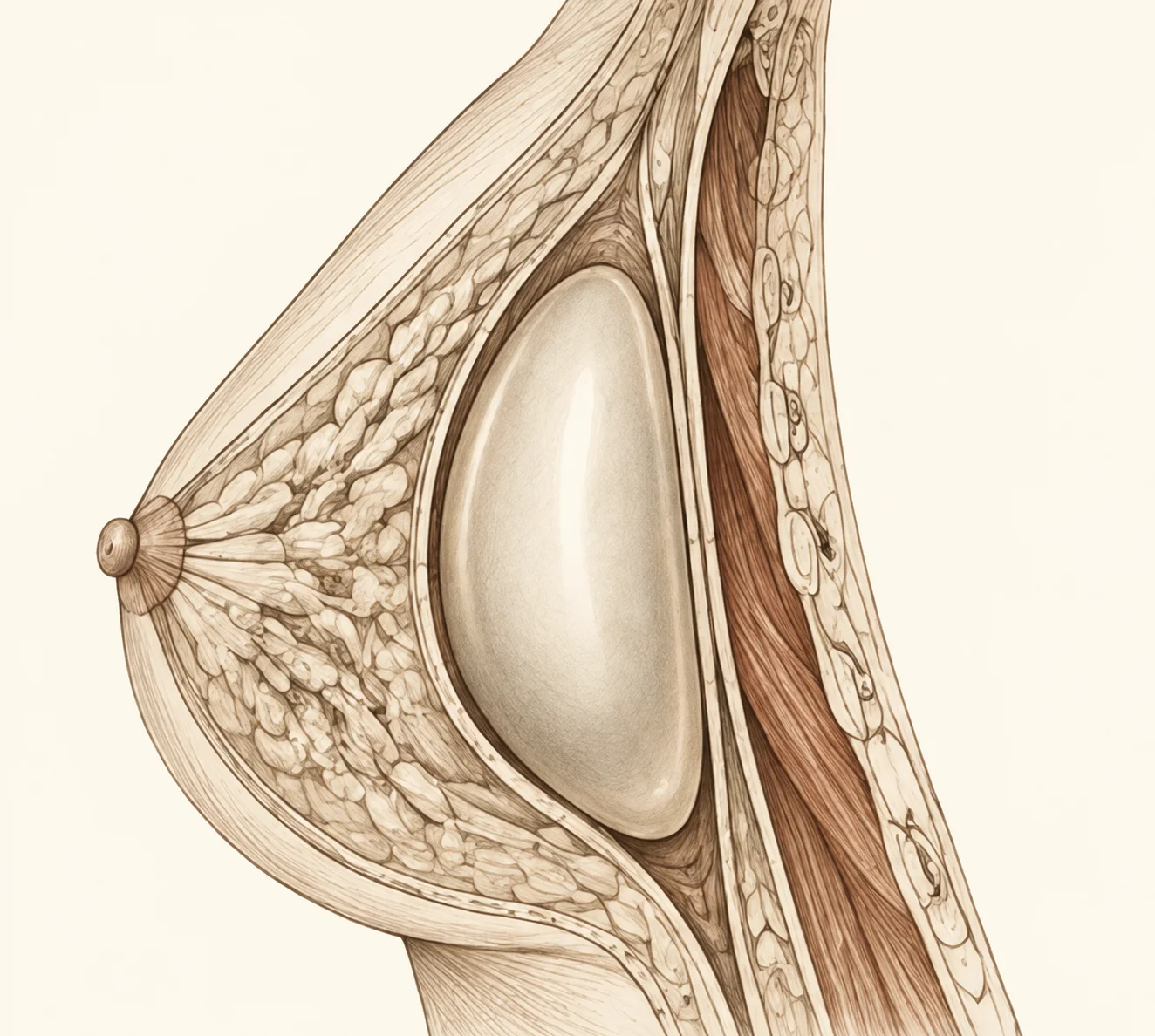
Breast implant pocket change is a revision procedure that alters the position and characteristics of the implant pocket to correct malposition, instability or discomfort. It may involve tightening or reinforcing parts of the pocket, releasing constricted areas, changing the implant plane, or redefining the breast footprint so the implant sits in a more stable, natural position.
It can be performed with an implant exchange or with the existing implant, depending on the diagnosis. That is worth stating plainly, because many patients arrive assuming a revision necessarily means a new implant. Sometimes the implant is the correct dimension and only its environment is wrong.
A pocket is a set of boundaries, not a cavity
The implant does not sit in a hole. It sits inside a space defined by borders that each do a different job: the fold supports the lower pole, the lateral border resists drift toward the side, the medial border maintains separation, and the upper limit governs how high the implant can ride. Malposition is therefore directional information. The direction the implant has gone identifies which boundary is not doing its work — and that is the finding the operation is planned around.
Malposition is not one problem
The anatomic complexity begins with identifying the specific pattern, because each one points to a different correction strategy and they are not interchangeable.
Five patterns, five different corrections
| Pattern | What the patient notices | What it actually reflects | Where correction is directed |
|---|---|---|---|
| High-riding implant | The implant sits too high and the lower breast looks empty | A tight lower pole or an overly restrictive pocket | Releasing the constricted area rather than tightening anything |
| Bottoming out | The implant has descended below the fold and the nipple appears high on the mound | Loss of lower pole support and an overstretched envelope | Redefining the inframammary fold and reinforcing the lower pole |
| Lateral displacement | The implant drifts toward the armpit, particularly when lying down | Weak lateral boundaries, or a chest wall dynamic that encourages lateral drift | Restoring the lateral boundary and accepting the chest wall as a fixed variable |
| Symmastia | The implants appear to meet in the middle with no separation | Loss of the medial boundary | Careful restoration of the medial border, with conservative expectations |
| Animation deformity | The breast distorts or moves unnaturally when the chest muscle contracts | A strong interaction between implant and pectoralis mechanics | Addressing the implant–muscle relationship, which may include a plane change |
Treating every malposition with more tightening is how revisions fail
Tightening is intuitive, because instability feels like looseness. But a high-riding implant is often a pocket that is already too restrictive, and tightening it makes the mechanism worse while appearing to address the complaint. Two of the five patterns above call for release rather than reinforcement, and one is not a boundary problem at all. This is why the diagnosis has to precede the technique: the same word — malposition — describes situations whose correct treatments move in opposite directions.
Tissue quality is the limiting factor
The pocket is held by soft tissue. If that tissue is thin, stretched, or scarred from multiple surgeries, stability is harder to achieve regardless of how well the boundaries are redesigned.
Individual tissue behaviour influences scar strength, stretching tendency, and how the pocket holds shape over time. A pocket can be reinforced. It cannot be made immune to biology, and revision planning has to be conservative for that reason rather than as a matter of style.
Why implants move in the first place
Movement can occur through tissue stretching, gravity, weight change, pregnancy, capsule behaviour, and the original pocket design. Larger and heavier implants place more stress on lower pole support. Thin tissue stretches more. Multiple surgeries change scar planes.
These are not separate risks so much as one recurring theme: the pocket carries a load, and long-term stability depends on whether that load was matched to the tissue asked to carry it.
Repeated size changes are not a substitute for structural correction
A common revision history looks like a sequence of size adjustments, each undertaken because the previous result did not feel right. If the underlying issue is pocket architecture, none of those adjustments addresses it — and each one is another operation on the tissue that is supposed to be holding the repair. So when a patient asks whether going larger or smaller will fix an implant that drifts, my answer is usually that size is a separate question from stability, and answering the wrong one first makes the right one harder to answer later.
What pocket change is not
It is not a guarantee that an implant will never shift again. It is not a guarantee of perfect symmetry. And it is not always the right answer to keep increasing implant size when the envelope is already unstable — sometimes the responsible choice is a smaller implant, a different plane, or additional support strategies.
Cleavage has an anatomic ceiling
Wide spacing between implants can be related to lateral drift, which is correctable, or to a naturally wide chest, which is not. Bone structure cannot be changed. Medial problems such as symmastia require careful restoration of the medial boundary and conservative expectations, because the medial border is being rebuilt in tissue that has already failed there once.
Pocket change is often one part of a combined plan
Implant exchange may be indicated if the implant is the wrong dimension for the anatomy, if the patient’s goals have changed, or if there are implant-specific issues. A lift may be indicated if the nipple–areola complex and skin envelope no longer match the implant position. In some cases capsular work is required where scar tissue is contributing to the distortion.
The correct combination depends on diagnosis, not preference. A plan assembled from what the patient would prefer to avoid rather than from what the anatomy shows tends to produce a revision that has to be revised.
I treat the first revision as a structural correction
Revision surgery has narrower margins than primary surgery. Scar planes are altered, and blood supply and tissue elasticity can be different. So the first revision is the one with the most tissue credit available, and I would rather spend it on identifying the true mechanism and correcting it conservatively than on chasing a specific look. Repeated pocket revisions reduce predictability, which means the value of getting this operation right is not only the result — it is not having to open the same tissue again.
Recovery and how stability is judged
Recovery is similar to other implant revisions, with swelling, firmness and gradual settling. Its duration and intensity vary with the amount of pocket work performed, whether a plane change was carried out, and whether a lift was included.
Recovery is a sequence, not a single date.
-
Early phase
Swelling and firmness are expected
Position at this stage reflects inflammation and tissue tension rather than the correction. Judgements made here are usually judgements about swelling.
-
Settling phase
The implant settles into the redefined boundaries
As the tissues relax, the implant takes up its position within the new pocket architecture and contour becomes smoother. This is gradual rather than an event.
-
Assessment phase
Stability is judged over time, not in the first weeks
Whether the repair holds is a question about behaviour under normal loading, which needs time to answer. I avoid fixed timeline guarantees, because healing depends on individual tissue behaviour and postoperative care.
If you have already had more than one revision
Multiple revisions reduce predictability and increase scar burden. That does not automatically exclude surgery, but it changes the strategy: the plan has to prioritise stability over fine aesthetic preferences, and sometimes a smaller implant or a different approach is the safer option.
Where prior revisions have left the tissue too compromised for stable correction, a more conservative goal, a size reduction, or implant removal may be the more responsible discussion. That is not a failure of the surgery available. It is an accurate reading of what the tissue can still support.
What should be weighed in the decision?
The central question is not which correction is available, but whether the mechanism has been correctly identified and whether the tissue can hold the repair once it is made.
- Trade-off: a stable revision may require accepting a smaller implant, a different plane, or additional support. Choosing the preferred size over the stable plan is choosing a result with a shorter horizon.
- Trade-off: combining pocket change with a lift or an exchange addresses more of the problem and increases the complexity and recovery of the operation.
- Trade-off: conservative correction is more likely to hold; aggressive correction aimed at a specific look is less predictable in altered tissue.
- Limitation: it is not a guarantee that the implant will never shift again.
- Limitation: perfect symmetry cannot be guaranteed, and expectations built around it are the wrong basis for this operation.
- Limitation: malposition can recur, particularly where tissue is thin, stretched or previously scarred.
- Limitation: a pocket can be reinforced but not made immune to biology. Ageing, weight change and ongoing tissue stretch continue.
- Limitation: bone structure cannot be changed, so cleavage and implant spacing have an anatomic ceiling.
- Limitation: revision surgery carries a higher complexity profile than primary augmentation because tissue planes are altered.
- Limitation: scarring-related distortion, changes in sensation and wound-healing variability are part of the risk profile.
- Limitation: individual tissue behaviour influences scar strength, stretching tendency and how the pocket holds shape, and it is not fully predictable in advance.
- Limitation: repeated pocket revisions reduce predictability and increase scar burden.
- Limitation: where multiple prior revisions have compromised the tissue, stable correction may not be achievable at all.
- Alternative: where the implant is the wrong dimension for the anatomy, exchange rather than pocket work alone is the correct discussion.
- Alternative: where the nipple–areola complex and skin envelope no longer match the implant position, a lift is part of the answer.
- Alternative: size reduction or implant removal may be the more responsible plan where the envelope cannot support what is currently in it.
- Alternative: declining further surgery is legitimate where expectations centre on perfect symmetry or where the tissue is too compromised for a stable result.
How long the correction holds
Results can be durable when the mechanism is corrected and the tissue can support the repair. They are not immune to ageing, weight change and ongoing tissue stretch.
A conservative revision tends to remain more stable than an aggressive attempt to force a specific look. That is the most reliable predictor of durability in this operation, and it is a planning decision rather than a technical one.
How to think about the decision
The useful question to bring to a consultation is not which implant you should have next. It is which boundary has failed, why it failed, and what the plan does differently from the one that produced the current situation.
When properly indicated, pocket change can restore a breast that looks and feels more natural: stable position, improved symmetry, and more coherent movement. The best outcomes come from precise diagnosis, conservative surgical design, and individualised planning that respects tissue behaviour and long-term stability.
What problems does a pocket change actually correct?
Pocket change is designed to address implant malposition and instability: implants that sit too high, too low, too lateral, too medial, or that move unnaturally with muscle activation. It can also address asymmetry related to pocket size differences and, in selected cases, discomfort related to pocket mechanics. The key is diagnosis, because each malposition pattern has a different correction strategy.
How do you tell whether the problem is the implant or the pocket?
By reading the direction and the behaviour rather than the appearance alone. If the implant is a reasonable dimension for the breast footprint but has drifted to one side, descended below the fold, or moves distinctly with muscle activation, the finding points to pocket architecture. If the implant is too wide, too projected or too heavy for the tissue it sits in, the implant itself is part of the problem. The two conclusions lead to different operations, which is why the assessment comes before any discussion of what to change.
Do I always need to change the implant as well?
Not always. If the implant is the correct dimension and the main issue is pocket architecture, pocket change may be performed with the existing implant. If the implant is too wide, too projected, too heavy for the tissue, or if goals have changed, implant exchange may be properly indicated. The decision is based on anatomy and mechanics, not routine.
Why do implants move over time?
Movement can occur due to tissue stretching, gravity, weight change, pregnancy, capsule behaviour, and the original pocket design. Larger and heavier implants place more stress on lower pole support. Thin tissue stretches more. Multiple surgeries change scar planes. This is why long-term stability depends on a plan that respects tissue limits.
Can a pocket change fix bottoming out?
Often, yes, but it depends on tissue quality. Bottoming out reflects loss of lower pole support. Correction usually involves redefining the inframammary fold and reinforcing the lower pole so the implant has a stable boundary. In some cases, a smaller implant or plane change is also needed.
Can a pocket change fix implants that are too far apart or too close?
In selected cases, yes. Wide spacing can be related to lateral drift or a naturally wide chest. Medial problems, such as symmastia, require careful restoration of the medial boundary and conservative expectations. Bone structure cannot be changed, so cleavage has an anatomic ceiling.
When is pocket change not the right answer?
It is not always the right answer when expectations are built around perfect symmetry or when the desired implant size exceeds what the tissue can support. It can also be inappropriate when multiple prior revisions have left tissue too compromised for stable correction. In those cases, a more conservative goal, size reduction, or implant removal may be more responsible.
Is implant removal ever the right answer instead?
Yes, in some situations. Where the envelope is unstable and cannot support what is currently in it, or where repeated revisions have left the tissue too compromised for a stable repair, removal or a significant size reduction can be the more responsible plan. That conclusion is not an admission that nothing can be done. It is a judgement that further attempts to hold an implant in that tissue are unlikely to produce a stable result.
How variable is recovery?
Recovery varies with the amount of pocket work, whether a plane change is performed, and whether a lift is included. Swelling and tightness are expected early. Settling occurs over time. I avoid fixed timeline guarantees because healing depends on individual tissue behaviour and postoperative care.
What are the main risks?
Risks include recurrence of malposition, asymmetry, scarring-related distortion, changes in sensation, and wound-healing variability. Revision surgery also has a higher complexity profile than primary augmentation because tissue planes are altered. Conservative planning reduces risk.
What if I have had more than one revision already?
Multiple revisions reduce predictability and increase scar burden. That does not automatically exclude surgery, but it changes the strategy. The plan must prioritise stability over fine aesthetic preferences, and sometimes a smaller implant or a different approach is the safer option.
How long-lasting are results?
Results can be durable when the mechanism is corrected and the tissue can support the repair, but they are not immune to aging, weight change, and ongoing tissue stretch. A conservative revision tends to remain more stable than an aggressive attempt to force a specific look.