
Target
Treatment / Non-Surgical
Liquid Rhinoplasty (Non-Surgical Nose Job)
A focused treatment page built around indication, mechanism, expected experience and realistic limits.
Individual assessment
Indication first
Realistic expectations
Clinical focus
Treat the right mechanism — not simply the visible sign.
Treatment snapshot
Primary goalIndividual indication
AppointmentVaries by treatment
DowntimeDepends on method and area
SessionsPersonalized plan
ResultsTreatment-specific timeline
These are orientation points, not promises. Timing and suitability depend on the treatment, anatomy and individual response.
Mechanism
Which method matches the underlying issue?
Plan
What intensity, timing and follow-up make sense?
Liquid rhinoplasty contains a paradox that should be understood before treatment.
Filler adds volume.
Many patients asking for non-surgical rhinoplasty want the nose to look smaller.
Both statements can be true because the eye does not judge the nose only by physical dimensions. It also reads lines, angles, shadows and the relationship between the bridge and tip.
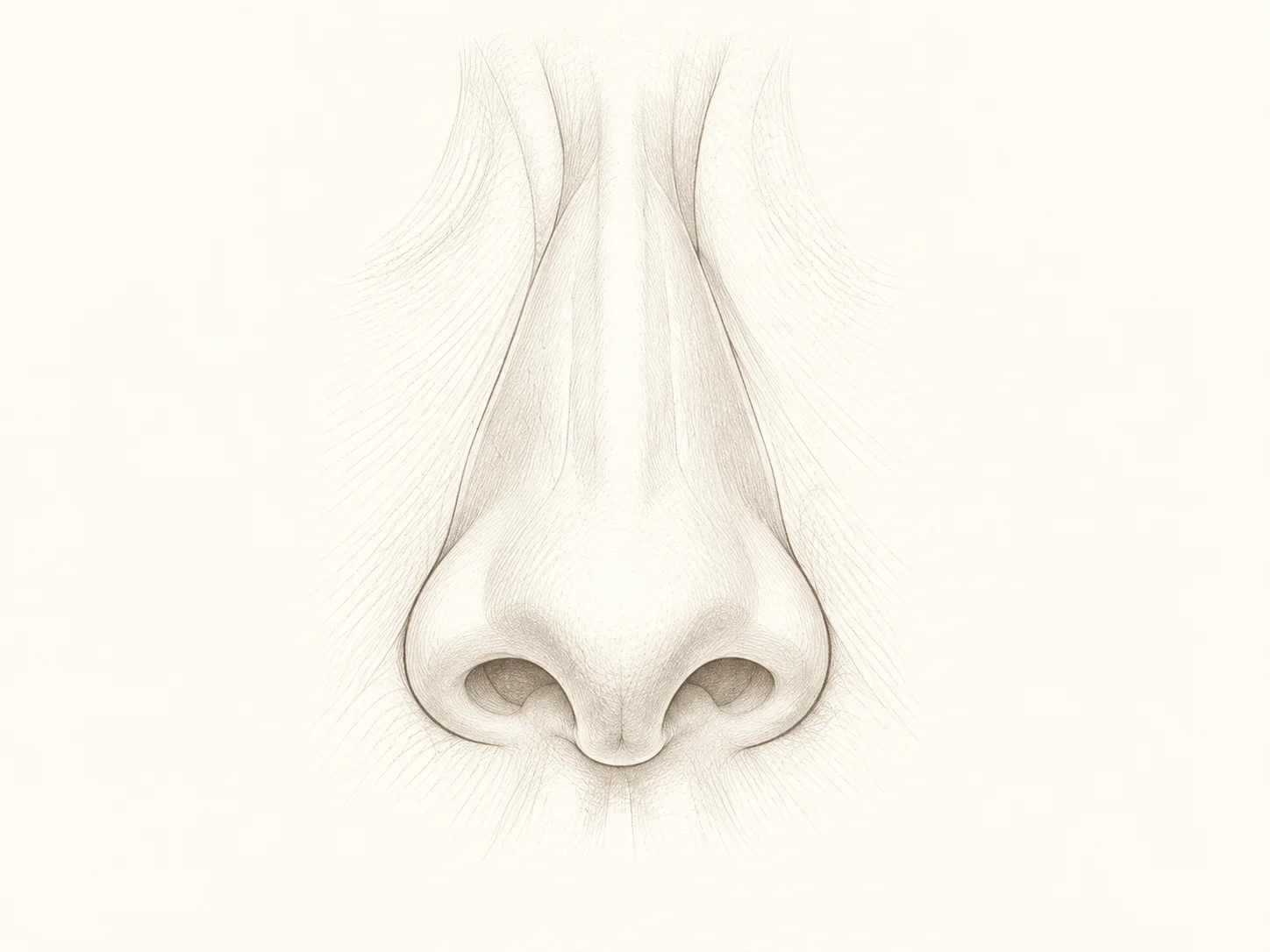
A small depression above a hump can make the hump appear more prominent. Adding a controlled amount of volume to that depression may create a straighter visual line, even though the nose has technically gained volume.
That can be a very effective camouflage in the right anatomy.
But it also gives us the central limitation immediately:
If the problem requires subtraction, filler cannot become a subtractive treatment.
A large nose cannot be physically reduced by adding more material to it.
Liquid rhinoplasty changes geometry, not the nasal skeleton
Hyaluronic acid filler can be placed selectively to alter certain external contours of the nose.
Depending on the anatomy, it may help soften a small dorsal irregularity, create the visual impression of a straighter bridge, improve a selected depression or modify limited aspects of tip support and projection.
What it cannot do is remove cartilage or bone.
| Patient concern | What filler can realistically do |
|---|---|
| Small bridge irregularity or modest hump | May camouflage surrounding contour and create a straighter visual line. |
| Small depression or asymmetry | May selectively add volume to improve continuity. |
| Limited tip-support concern | Selected cases may obtain a modest change in projection or apparent angle. |
| Large nose or large hump | Filler cannot remove the excess structure and may increase overall volume. |
| Wide nostrils or broad nasal bones | Filler does not physically narrow them. |
| Breathing problem | Cosmetic filler does not correct functional airway anatomy. |
Why a nose can look smaller after volume is added
Imagine a bridge with one visible interruption.
The eye tends to stop at that irregularity. The nose becomes visually dominant because its line is broken.
If a small amount of volume creates a smoother transition above and below the interruption, the eye may read one continuous line instead.
The measured nose has not become smaller.
Its visual geometry has become quieter.
This is the correct conceptual model for liquid rhinoplasty.
It is camouflage through proportion and contour, not reduction.
Camouflage has a limit
The larger the structural problem, the more filler is required to hide it.
At some point that logic begins working against the patient.
A substantial dorsal hump may be made straighter only by building the rest of the bridge high enough to meet it. The profile may become smoother but the nose itself becomes larger.
If the patient’s true objective is reduction, that is no longer a good trade.
I do not want to make a large nose larger just to make one line straighter.
That is the point at which rhinoplasty surgery becomes the more coherent treatment category.
The nose is not an area where indication should be casual
All filler injections carry vascular risk.
The nose deserves particular respect because of its vascular anatomy and its connections with the circulation supplying the skin and eye.
Rare vascular complications can be severe, including tissue injury and potentially vision-threatening events.
This changes my threshold for recommending treatment.
The question is not merely whether a small cosmetic improvement is possible.
It is whether that improvement is valuable enough to justify placing filler in a higher-stakes anatomical region.
A marginal indication is not improved by excellent technique.
Safety begins with saying no to the wrong nose
The strongest safety tool in liquid rhinoplasty is patient selection.
If a large structural problem needs surgery, I would rather say so.
If the patient’s nose is already proportionate and the requested change is extremely small, doing nothing may offer a better benefit–risk balance.
If the patient wants guaranteed perfection or perfect symmetry, an injectable treatment cannot honestly offer that.
If previous surgery has altered the tissue planes and vascular anatomy, the threshold for further filler should become even higher.
Risk should influence the indication, not just the injection technique.
Previous rhinoplasty changes the anatomy
A previously operated nose is not simply a normal nose with a small postoperative irregularity.
Surgery creates scar tissue and can alter tissue planes and vascular relationships.
This makes subsequent injectable treatment less predictable and potentially higher risk.
Selected postoperative contour irregularities may sometimes be considered for conservative camouflage, but I do not regard them as routine filler cases.
The surgical history, time since surgery, current anatomy and actual value of the proposed correction all need to be considered.
A drooping tip also needs mechanism classification
Patients may describe the tip as drooping, but that appearance can arise from several mechanisms.
The resting support may be limited. The tip may rotate downward during smiling because of muscular pull. The cartilaginous structure itself may create the appearance.
Filler can influence selected structural relationships.
Botulinum toxin may have a role in selected muscle-driven cases.
Surgery may be required for larger structural changes.
Again, one label does not create one treatment.
Liquid rhinoplasty cannot treat breathing
Aesthetic and functional nose concerns often coexist.
If a patient has nasal obstruction, airflow limitation or another breathing complaint, that deserves proper functional assessment.
External filler can change contour.
It does not correct a deviated septum, internal valve problem or other structural cause of impaired breathing.
I do not want a cosmetic camouflage treatment to delay evaluation of a functional problem.
How I think about the amount of filler
The nose is not an area where I want to create change through large volumes.
The useful corrections are usually small geometric adjustments.
This is one reason liquid rhinoplasty can work well for the right indication: a small amount of carefully selected structural change can produce a disproportionately visible improvement.
But once large volume becomes necessary, I reconsider whether filler is still the correct category.
The amount should remain subordinate to the anatomy.
The result should be evaluated from several views
A profile can improve while the front view becomes worse.
A bridge can look straighter from one side while appearing too wide or too high from another.
I therefore assess the nose in relation to the forehead, lips and chin as well as from frontal, oblique and profile views.
The central face is a three-dimensional system.
One attractive profile photograph is not enough to define success.
What should a good liquid rhinoplasty result look like?
I look for a quieter nose rather than a new nose.
A distracting break in the bridge line may become less obvious. A selected asymmetry may improve. Profile balance may become more coherent.
The patient should also understand that the procedure cannot deliver the same range of change as surgery.
That limitation is not a failure.
It is what makes the treatment useful for appropriately small problems.
Reversibility is valuable, but it does not erase risk
Hyaluronic acid can often be reduced with hyaluronidase.
This is an important advantage when correction is required.
But I do not describe that as an “undo button”.
Vascular complications require immediate clinical recognition and management; simply knowing that a dissolving enzyme exists does not make careless treatment safe.
Reversibility should support good judgment, not replace it.
Downtime and early assessment
Swelling, tenderness, redness or bruising can occur after treatment.
The change may be visible immediately, but the early result still contains swelling.
I therefore separate “immediate geometry” from “settled result”.
Small apparent irregularities during the early period should not automatically trigger additional filler before the tissue has stabilised.
Maintenance should not gradually enlarge the nose
One of the long-term risks of maintenance filler is forgetting the original mechanism.
If residual product remains and more is repeatedly added to preserve a straight bridge line, the nose can gradually acquire more volume.
Before maintenance, I want to assess what remains and whether the original correction still needs reinforcement.
If the accumulated volume begins to work against the patient’s desire for a smaller-looking nose, the logic has failed.
The questions I want answered before recommending liquid rhinoplasty
- What exactly bothers the patient about the nose?
- Does the problem require adding volume or removing structure?
- Is the irregularity small enough to camouflage coherently?
- Would straightening the line make the nose larger than the patient wants?
- Is there a functional breathing complaint?
- Has the nose been operated on before?
- Is the proposed benefit meaningful enough to justify filler in this anatomical region?
- Would surgery address the mechanism more directly?
- Is the patient comfortable with a temporary camouflage rather than structural correction?
- Would doing nothing have the better benefit–risk balance?
Liquid rhinoplasty can be one of the most effective examples of a small treatment producing a large visual return.
But only when the problem is also small enough for an additive treatment to solve.
The objective is not to use filler because surgery feels too large.
It is to use filler when a limited geometric correction genuinely belongs in the space between no treatment and surgery.
Frequently asked questions
Can liquid rhinoplasty make my nose smaller?
Not physically. Filler adds volume. In suitable anatomy, improving bridge continuity or tip proportion can make the nose look less visually dominant, but true size reduction requires a subtractive or structural approach.
Can it remove a dorsal hump?
No. It can sometimes camouflage a modest hump by smoothing the surrounding contour. Larger humps eventually require too much added volume for that strategy to remain coherent.
Can filler lift a drooping tip?
Selected cases may obtain a modest change in apparent support or angle. The mechanism of tip droop needs to be assessed because muscular and structural causes require different approaches.
Can it fix breathing problems?
No. Cosmetic filler does not correct internal airway problems. Breathing symptoms require appropriate functional nasal assessment.
Is nose filler risky?
The nose is a high-stakes filler region because of its vascular anatomy. Rare vascular complications can be severe, including skin injury and potentially vision-threatening events. Patient selection and medical expertise are therefore particularly important.
Can I have filler after rhinoplasty?
Sometimes selected postoperative irregularities can be considered, but operated noses have altered tissue and vascular anatomy. The risk–benefit threshold should therefore be higher and the surgical history needs careful review.
How much filler is needed?
The useful corrections are generally based on small, selective volume rather than large augmentation. If substantial volume is required, I reconsider whether filler remains the correct treatment.
Can nose filler be dissolved?
Hyaluronic acid filler can often be reduced with hyaluronidase when clinically appropriate. Reversibility is useful but does not eliminate the vascular risks of the original injection.
How long does the result last?
Duration varies according to product, dose, anatomy and individual tissue behaviour. Maintenance should be based on reassessment so that repeated treatments do not gradually increase nasal volume unnecessarily.
When would you recommend surgery instead?
I would favour structural assessment when the patient wants genuine size reduction, substantial hump reduction, narrowing, major tip change or functional correction. In those situations filler is being asked to perform a job it cannot do.
When would you recommend no treatment?
When the nose is already proportionate, the proposed improvement is too small to justify treating a high-risk filler region, or the expectation cannot be met without creating a larger or less coherent nose, no treatment is a valid recommendation.

Dr. Mert Demirel
Plastic, Reconstructive & Aesthetic Surgery
Anatomy first. Proportion over excess. Decisions built to remain coherent over time.
Next step
The best treatment is the one that matches the right indication.
You do not need to choose a device, injectable or technique before asking the question. Start with what you would like to improve.
Private consultation
Let’s start with your question.
Leave your number first. We can then continue privately on WhatsApp.


