

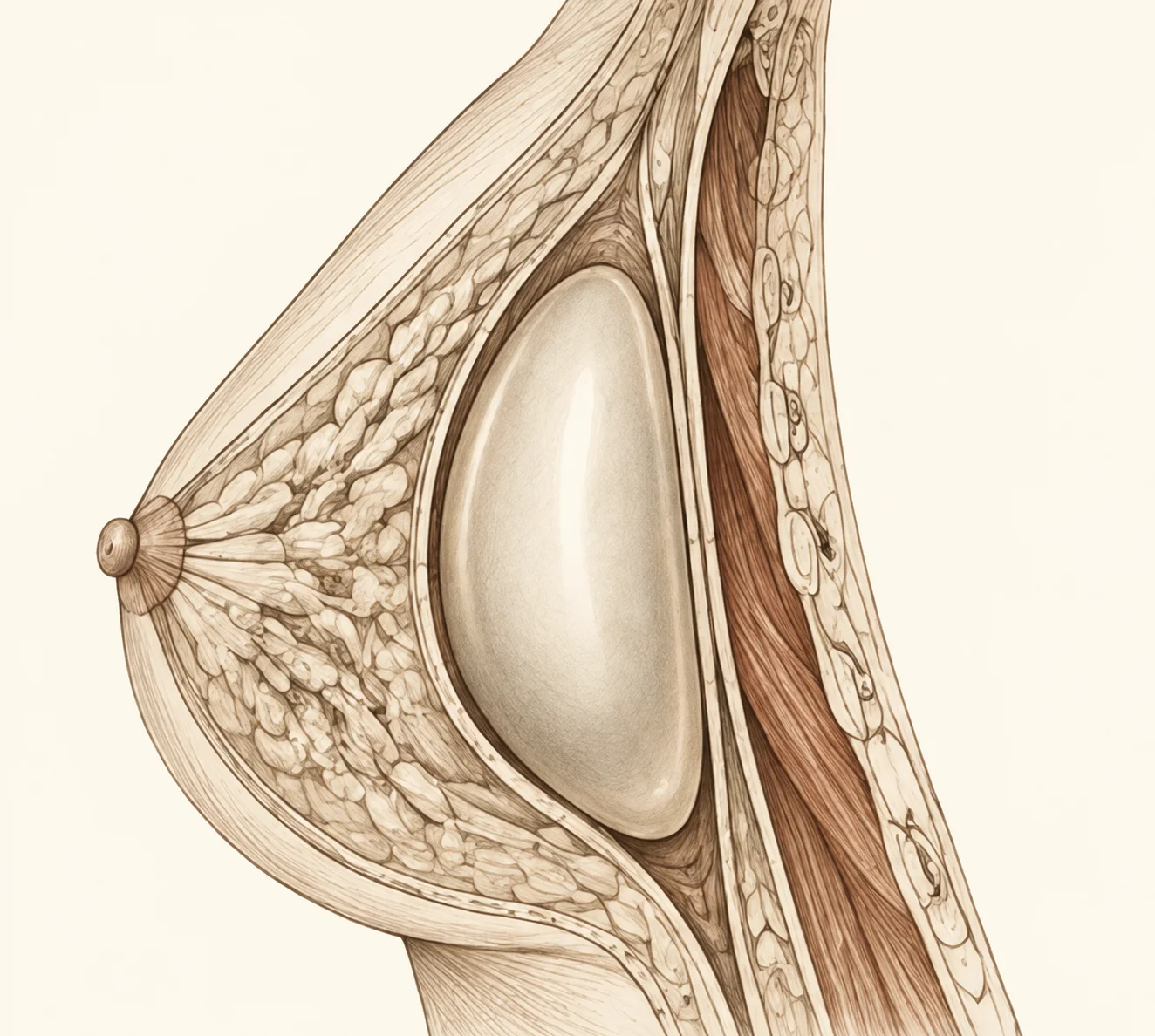
Revision surgery is usually described as changing implants. That phrase names the most visible step and hides the part that determines whether the correction holds.
The real work is diagnosing why the current result is unsatisfying: implant dimensions, pocket mechanics, capsule behaviour, or a skin envelope that has changed over time. A stable revision plan corrects the mechanism, not the symptom. Sometimes that means changing size. Sometimes it means changing the pocket, adding a lift, or addressing scar tissue. The aim is controlled refinement — a breast that looks natural, sits stably, and remains coherent as the body ages.
Revision is a diagnostic operation before it is a technical one
Implant revision is frequently presented as a straightforward exchange: remove the old implant and place a new one. That can be true in selected cases, but it is not a responsible default. Most revision problems are not caused by the implant alone. They are caused by the pocket that holds it, the capsule that forms around it, and the skin envelope that has evolved under the weight and shape of the implant over time.
Breast implant revision and exchange refers to surgical planning intended to improve an unsatisfactory implant-based breast result. The goals vary widely. Some patients want a size change. Some want correction of malposition. Some have capsular contracture, rippling, or discomfort. Others need a lift because the breast envelope has relaxed. The operation may involve implant exchange, pocket correction, capsular work, plane change, mastopexy, or a combination — and which of those applies is an outcome of the assessment rather than an input to it.
Four structures, and only one of them is the implant
An unsatisfactory implant-based result can originate in the implant’s dimensions, in the pocket that holds it, in the capsule that formed around it, or in an envelope that has relaxed under it. Those four contributors are anatomically distinct, they fail in different ways, and they require different corrections. A revision that changes only the implant addresses one of the four, which is why a technically clean exchange can leave a patient with the same complaint in a new size.
The failure mode has to be named before the plan exists
The anatomical complexity begins with defining the dominant failure mode, and the difficulty is that the patient’s description and the underlying mechanism often do not match. What is described as a size problem may be a width problem. What is described as drooping may be a position problem that no implant can solve.
What the complaint says, and what it may actually mean
| Complaint | “Too large” | “Droopy” | “Asymmetric” | “Tight” |
|---|---|---|---|---|
| What it may actually be | A width problem rather than a volume problem | Ptosis, which an implant cannot solve | Pocket size differences or chest wall asymmetry | Capsule behaviour |
| Where correction is directed | Implant dimensions, chosen against the breast base | The envelope and nipple position — a lift | The pocket, or acceptance of a fixed skeletal difference | The capsule, with pocket and plane strategy |
| If treated with a new implant instead | The breast becomes smaller and still poorly proportioned to the base | Volume is added to a breast that is sitting low, which can worsen the impression | The difference persists because the implant was never the asymmetric element | The mechanism is left in place and the tightness can return |
Treating every problem with a new implant is how revisions become repetitive
This is the single most useful idea in revision surgery, and the table above is its evidence. Of the four common presentations, only one is primarily an implant-dimension problem. The others are envelope, pocket, or capsule problems that happen to be visible through the implant. A patient on a third or fourth exchange has usually not had bad luck with devices — they have had the same undiagnosed mechanism treated four times with the one variable that was easiest to change.
Pocket mechanics are what make a revision last
The pocket is where durability is decided. If it is too loose, implants can migrate laterally or inferiorly. If it is too tight, implants can sit high or distort. If the medial boundary is weak, symmastia can occur. If muscle interaction is dominant, animation deformity can be present.
Pocket correction is structural work rather than aesthetic adjustment, and it is often the difference between a revision that lasts and a revision that recurs. It is also the element most frequently omitted from a plan built around a device, because a new implant is easier to specify than a boundary that has to be rebuilt.
Capsule behaviour cuts both ways
The capsule is scar tissue that forms around an implant. In some patients it is thin and quiet. In others it contracts, thickens, or distorts shape and comfort. Capsular management must be individualised, and it is one of the few areas in surgery where the error can be made in either direction.
Removing more tissue is not automatically safer or better. But ignoring a pathologic capsule leaves the mechanism unchanged, which means the revision has treated the appearance and left the cause in place. Neither maximalism nor conservatism is correct as a policy — both are correct only when the findings support them.
Tissue quality sets the ceiling
With time, pregnancy, weight change and ageing, the breast envelope can relax. A larger implant can accelerate this. In those cases revision often requires not only an exchange but an envelope correction such as a lift, and sometimes a more conservative implant dimension than the one already in place.
Individual tissue behaviour influences scar strength, stretching tendency and long-term shape, which is why two patients with identical implants and identical operations can arrive at revision for entirely different reasons.
Increasing size to fix an unstable envelope makes the next revision harder
When a breast has relaxed and the instinct is to restore fullness with a larger implant, the logic is understandable and the mechanics work against it. A larger implant loads a stretched envelope more heavily, and a more heavily loaded envelope relaxes further. This is the loop that produces patients on their third or fourth operation with progressively thinner tissue and progressively fewer options. Going smaller, or correcting the envelope instead of the volume, is often the plan that leaves the most room for the future.
What implant revision is not
It is not a guarantee of perfect symmetry. It is not a promise that implants will never require further surgery. And it is not always the right answer to keep increasing size when tissues are already unstable.
When revision should be reconsidered rather than planned
Revision is not the right answer when expectations are perfection-based, when repeated revisions have already compromised the tissue, or when the desired implant size exceeds what the envelope can support. In those situations downsizing or removal is the more responsible discussion, and presenting it as such is part of the operation rather than a refusal to perform it.
Sometimes the most responsible revision is a smaller implant, a plane change, or removal
Patients rarely arrive asking for less. They arrive asking for the result they expected, and it is tempting to answer that request with more volume because it sounds like progress. But the tissue keeps its own accounts. Where the envelope is already unstable, the correction that lasts is usually the one that reduces load, changes the plane, or accepts that an implant is no longer the right structural answer for this breast. I would rather present that plan honestly than perform the version that feels satisfying now and returns as a fourth operation.
Recovery after revision is not recovery after augmentation
Recovery is variable. Revision surgery often involves more scar planes than primary augmentation, and swelling and settling can take longer, particularly where pocket work or capsular work is extensive.
Recovery is a sequence, not a single date.
-
Early phase
Swelling and altered shape are expected
Early appearance is not final appearance. In revision this matters more than in primary surgery, because the tissue being asked to settle has been operated on before.
-
Settling phase
Swelling and position resolve in phases
The corrected pocket and the envelope adapt to the new configuration. Individual tissue behaviour influences both the timeline and scar maturation, which is why fixed dates are unhelpful here.
-
Assessment phase
Stability is judged, not appearance alone
Staged assessment is part of an honest revision process. The question at this point is not only how the breast looks but whether the corrected mechanism is holding.
Staging is built into revision surgery
Some patients need staging, especially when tissue quality is compromised or when multiple issues coexist. The goal is not to chase perfection in one step. It is a stable correction that looks natural and remains coherent over time.
Where several mechanisms are active at once — a tight capsule, a loose pocket and a relaxed envelope in the same breast — correcting them sequentially allows each correction to be judged on its own result rather than lost inside a combined outcome that cannot be attributed.
What should be weighed in the decision?
The useful question in revision is not which implant to choose. It is which mechanism is dominant, what correcting it requires, and whether the tissue can support that correction.
- Trade-off: revision surgery is usually more complex than primary surgery. Scar planes are altered, tissue may be thinner, and pocket mechanics are less predictable. Good outcomes remain possible; the plan must be more conservative and more diagnostic.
- Trade-off: addressing envelope relaxation properly means a lift, and a lift means scars. Exchange alone avoids scars and may not restore balance.
- Trade-off: correcting several mechanisms in one operation shortens the overall process and increases the surgical scope; staging reduces scope per operation and means more than one procedure.
- Trade-off: capsular work can address a pathologic capsule and adds to the extent of surgery. Removing more tissue is not automatically safer or better, and ignoring the capsule leaves the mechanism unchanged.
- Limitation: it is not a guarantee of perfect symmetry.
- Limitation: it is not a promise that implants will never require further surgery.
- Limitation: capsular contracture can often be improved, but recurrence is possible. The approach depends on severity, capsule behaviour, implant plane and tissue quality.
- Limitation: malposition can recur, particularly where tissue support is weak.
- Limitation: risks include recurrence of malposition, asymmetry, capsular issues, scarring-related distortion, changes in sensation and wound-healing variability.
- Limitation: risk increases with the number of prior operations, and predictability decreases with each one.
- Limitation: chest wall asymmetry is skeletal. Where it contributes to the appearance, it sets a limit that pocket or implant work cannot remove.
- Limitation: an implant cannot correct significant ptosis. Where nipple position and skin redundancy are dominant, exchange alone will under-deliver.
- Limitation: individual tissue behaviour influences scar strength, stretching tendency and long-term shape, and it is not fully predictable in advance.
- Limitation: durability depends on tissue quality, implant dimensions and pocket stability. A well-corrected mechanism can remain stable for years, but ageing and body changes continue.
- Alternative: where the pocket architecture is the problem and the implant is appropriate, correction can focus on the pocket without an exchange.
- Alternative: where the envelope is unstable, a smaller implant or a plane change is often the more durable correction than a larger one.
- Alternative: where repeated revisions have compromised the tissue, or where the desired size exceeds what the envelope can support, downsizing or implant removal is the more responsible plan.
- Alternative: where expectations are perfection-based, deferring surgery until the plan has been reframed protects both the tissue and the outcome.
How long a revision holds
Durability depends on tissue quality, implant dimensions and pocket stability. A well-corrected mechanism can remain stable for years, but ageing and body changes continue — which is why the correction that lasts longest is usually the one that placed the least demand on the tissue in the first place.
How to think about the decision
Before considering which implant, it is worth being able to answer three questions: which of the four structures is dominant in your case, what correcting that structure actually requires, and whether your tissue can support that correction now or would be better served by a staged or more conservative plan.
When properly indicated, implant revision or exchange can restore balance: improved implant position, better proportional dimensions, and a breast shape that feels more comfortable and more predictable. The best outcomes come from precise diagnosis, conservative implant selection and structural pocket planning — in that order.
Why do patients need implant revision?
Common reasons include size dissatisfaction, malposition, capsular contracture, rippling, asymmetry, discomfort, and changes in the breast envelope over time. Often, more than one factor is present. Revision planning starts by identifying the dominant mechanism rather than treating the appearance alone.
Why did my result change over time if the surgery was done well?
Because the breast continues to behave like living tissue after the operation. With time, pregnancy, weight change and ageing, the envelope can relax, and a larger implant can accelerate that. A result that has changed is not automatically evidence of a technical error — it can be evidence that the envelope reached its limit. That distinction matters, because it determines whether the correct revision is a device change or an envelope correction.
Is revision always more complex than primary surgery?
Usually, yes. Scar planes are altered, tissue may be thinner, and pocket mechanics can be less predictable. That does not mean good outcomes are not possible. It means the plan must be more conservative and more diagnostic.
Do I always need an implant exchange?
Not always. If the implant is appropriate and the problem is pocket architecture, correction may focus on the pocket. If the implant dimensions are part of the problem, exchange is appropriate. The decision is individualised.
Can revision fix capsular contracture?
Often, yes, but recurrence is possible. The approach depends on severity, capsule behaviour, implant plane, and tissue quality. Capsular work may be combined with implant exchange and pocket strategy changes.
When do you recommend a lift with revision?
When nipple position and skin redundancy are dominant issues. If the envelope has relaxed, implant exchange alone may not restore balance. A lift can correct position and improve shape when properly indicated.
When is revision not the right answer?
It is not always the right answer when expectations are perfection-based, when repeated revisions have compromised tissue, or when the desired implant size exceeds what the envelope can support. In some cases, downsizing or removal is more responsible.
How variable is recovery?
Revision recovery can be slower than primary augmentation, especially when pocket work or capsular work is extensive. Swelling and settling occur in phases. Individual tissue behaviour influences timeline and scar maturation.
What are the main risks?
Risks include recurrence of malposition, asymmetry, capsular issues, scarring-related distortion, changes in sensation, and wound-healing variability. Risk increases with the number of prior operations. Conservative planning reduces risk.
What if I have had multiple revisions already?
Predictability decreases with each operation. The plan must prioritise stability and safety, often with more conservative goals. Sometimes implant removal is part of the discussion.
How long-lasting are revision results?
Durability depends on tissue quality, implant dimensions, and pocket stability. A well-corrected mechanism can remain stable for years, but aging and body changes continue.
Is revision the same thing as a pocket change or an implant removal?
They overlap, and they are not interchangeable. Revision is the wider diagnostic framework: it establishes which structure is responsible and then selects the correction. A pocket change is one of the possible corrections within that framework, appropriate when the pocket architecture is the dominant problem. Implant removal is another, appropriate when an implant is no longer the right structural answer for the breast. Deciding between them is the purpose of the assessment rather than something to settle beforehand.