Patient Safety in Plastic Surgery: What to Look For in Istanbul
Introduction
Of all the questions an international patient can ask before plastic surgery, the most important one is also the simplest: is this going to be safe? In our practice, we meet patients every week who have read dozens of websites, scrolled through hundreds of before-and-after images, and still cannot tell whether a given clinic is offering them a medically serious experience or a packaged transaction. That uncertainty is not the patient’s fault — the cosmetic surgery market often uses marketing language that obscures rather than clarifies patient safety. The aim of this article is to slow that down: to explain, in calm and medically grounded terms, what patient safety in plastic surgery in Istanbul actually means, what the foundations look like in practice, and how a thoughtful patient can recognize them — or their absence.
Patient safety in plastic surgery in Istanbul is the combination of a board-certified plastic surgeon, qualified anesthesia, an accredited hospital facility, an appropriate preoperative workup, clear informed consent, and continuity of care through recovery. Location alone is not a substitute for these foundations, and any single one of them missing should slow the decision down.
What Patient Safety Actually Means in Plastic Surgery
Patient safety culture is not a single feature you can tick off a checklist; it is a system of interlocking elements that begins long before the operating room and continues long after the procedure ends. It includes who the surgeon is, where the surgery happens, who delivers the anesthesia, what is checked before surgery, how risks are discussed, how the operation is conducted, how the early postoperative period is monitored, and how the patient is supported in the weeks and months that follow. Safety is built before, during, and after surgery — not only inside the operating room. A clinic that emphasizes one part of this system while quietly skipping another is not offering safety; it is offering a marketing image of safety. The patient’s job is to evaluate the system, not its branding.
Surgeon Credentials: Board Certification and Society Memberships
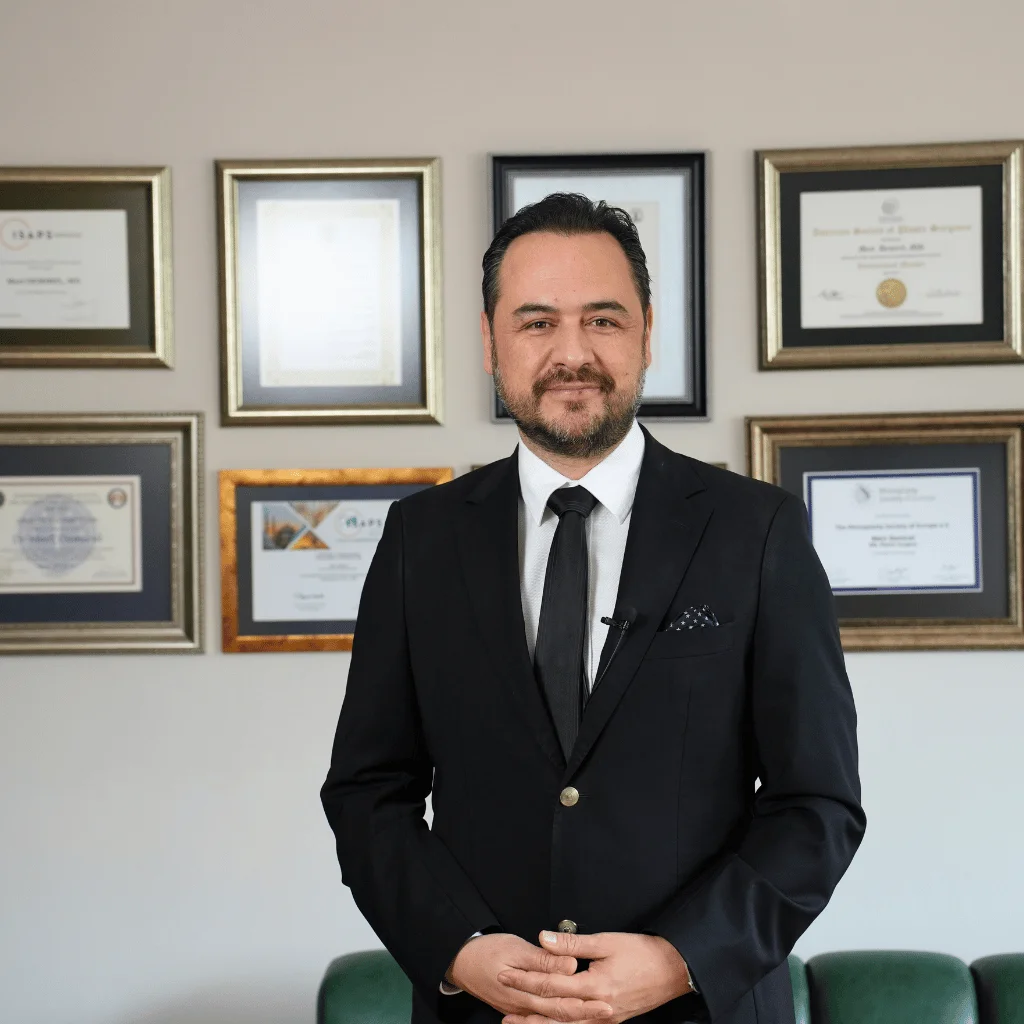
The most fundamental element of patient safety is the surgeon’s training and certification. In plastic surgery, that means board certification in plastic, reconstructive and aesthetic surgery — not certification in a different specialty that happens to also perform some aesthetic procedures. In Europe, the relevant credential is often EBOPRAS (European Board of Plastic, Reconstructive and Aesthetic Surgery), which reflects documented completion of a recognized training pathway and an ongoing standard of professional conduct. Society memberships such as ISAPS (International Society of Aesthetic Plastic Surgery) and ASPS (American Society of Plastic Surgeons) are not magic credentials, but they do reflect active engagement with international standards and continuing education. Patients should also understand that in many countries, practitioners certified in different specialties can legally perform some aesthetic procedures — which is precisely why credential verification matters and why the surgeon’s specific board certification deserves explicit confirmation, not assumption.
Anesthesia and the Surgical Facility
No discussion of patient safety is complete without addressing anesthesia and the facility. Anesthesia for plastic surgery should be administered by a qualified anesthesiologist — a physician with formal training in anesthesia — not by ad-hoc personnel and not by a surgeon also managing the operation. The surgical environment itself should be an accredited hospital facility with proper monitoring, recovery, and emergency capabilities: intensive care backup, blood products if needed, qualified nursing staff, and clear protocols for managing intraoperative and postoperative events. These elements are non-negotiable, regardless of how a clinic packages its prices or how attractive the marketing materials are. When anesthesia or facility standards are unclear, the responsible move is not to negotiate — it is to walk away. A surgeon whose work depends on these foundations will not be offended by careful questions; a surgeon who is offended is communicating something important.
Preoperative Workup and Medical Fitness
A second pillar of patient safety is the preoperative workup. Plastic surgery, even when it is elective, is real surgery, and patients deserve the same medical seriousness given to any other operation. That includes a careful history (prior surgeries, chronic illnesses, medications and supplements, allergies, smoking status, lifestyle factors), targeted laboratory tests, cardiac and pulmonary assessment where indicated, and medical optimization of relevant conditions before surgery is scheduled. Individualized medical fitness assessment protects patients far more than a one-size-fits-all package can. When a clinic is willing to operate without genuinely understanding a patient’s medical background, it is offering speed, not safety. Conversely, a surgeon who delays surgery to optimize a relevant medical issue — or who declines to operate because the risk profile is wrong — is offering the kind of judgment that protects patients in the long run.
Informed Consent and Transparent Risk Discussion
Informed consent is one of the most misunderstood parts of plastic surgery. Properly understood, consent is a conversation, not a signature: it is the careful discussion in which the surgeon explains what the procedure can realistically do, what it cannot do, what the alternatives are, what the risks are, and what the recovery will look like, in language the patient genuinely understands. A safe consultation feels unhurried. The patient is encouraged to ask questions and to think before deciding. The surgeon offers options, including the option of doing nothing. And the surgeon is willing to say no when the indications are not right — because of medical risk, unrealistic expectations, or a mismatch between what the patient wants and what the anatomy can deliver. This willingness to say no is one of the clearest signs of a patient safety culture, because it places the patient’s long-term wellbeing above the immediate transaction.
Continuity of Care and Follow-Up (Especially for International Patients)
The element of patient safety most often invisible in marketing is continuity of care. Plastic surgery does not end when the operation is finished; it continues through scheduled follow-up appointments, careful monitoring of healing, management of any complications that arise, and — for international patients — a clear plan for remote check-ins once the patient has traveled home. A safe practice will speak openly about what complications can occur, how they are managed, and how the patient can reach the surgical team after returning to their own country. A practice that avoids the topic of complications is not offering safety; it is offering a fragile narrative that will not survive contact with reality. A clear plan for managing complications is a hallmark of a safe practice — not a sign that something is expected to go wrong.
Red Flags in Marketing and Packaging
Patients should also learn to recognize the patterns that consistently correlate with lower-quality care. None of these is automatically a sign of malpractice, but together they should make any patient slow down and ask more questions:
- Rigid stay-duration promises like “in and out in five days,” regardless of the procedure or the patient.
- Fixed online prices and aggressive discounts that move faster than any real consultation could.
- Vague credentials — surgeon names hidden, training pathway not stated, certifications not specified.
- Undisclosed surgical teams, where the patient does not know in advance who will actually perform the operation.
- Social-media-only communication, with no formal medical records, written treatment plan, or accessible clinic.
- Packages that minimize follow-up, treating recovery as an afterthought rather than a clinical priority.
- Exaggerated transformation imagery that promises results no surgery can ethically guarantee.
Read these patterns as signals to ask more questions, not as accusations. A clinic with nothing to hide will welcome questions; a clinic that responds to questions with pressure or vagueness is telling the patient something important about its safety culture.
How to Verify What a Clinic Tells You
Many of the most important patient-safety claims can be verified independently. Patients can check medical board registration through the relevant national medical association, look up society membership directories (ISAPS, ASPS, EBOPRAS publish member lists), confirm facility accreditation with the hospital, and ask directly who will administer anesthesia and what their qualifications are. Direct questions about who exactly will perform the surgery are entirely reasonable and a surgeon should answer them clearly: not “our team,” but a specific named surgeon with verifiable credentials. Beyond formal verification, patients should trust their own observations during the consultation: clarity of explanation, time taken, willingness to answer hard questions, and the basic respect with which they are treated. These soft signals are often as reliable as the formal credentials.
Patient Safety Culture in Istanbul: What to Look For
It is important to be honest about patient safety in plastic surgery in Istanbul: the city is not a single market. It contains board-certified plastic surgeons working in accredited hospitals with qualified anesthesia teams and structured follow-up, and it also contains less rigorous operators promoting inexpensive packages with limited credentials. The presence of both, side by side, is precisely why the patient’s evaluation has to be careful. Patient safety in Istanbul depends on the same fundamentals as anywhere else: a board-certified plastic surgeon, an accredited facility, qualified anesthesia, individualized planning, transparent consent, and structured follow-up. The city does not provide these foundations on its own — the specific surgeon and the specific facility do. Approached with that understanding, Istanbul is one of the places in the world where excellent, ethical plastic surgery happens routinely; approached without it, any city is risky.
Questions Patients Should Ask
A short, useful set of questions to bring into any consultation, in Istanbul or anywhere else:
- What is your specific board certification and society memberships, and where can I verify them?
- Is the surgery performed in an accredited hospital, and who exactly administers the anesthesia?
- What preoperative workup do you require for someone with my history?
- What are the realistic risks of this procedure, and how do you manage complications if they occur?
- What is your revision policy if the result needs refinement later?
- What is your follow-up plan for international patients after they return home?
- Who will perform my surgery — specifically, not as a team — and will that person be present from start to finish?
The quality of the answers matters more than the number of questions asked. Clear, unhurried answers are a strong sign; vagueness or pressure is a strong sign in the opposite direction.
Realistic Expectations as Part of Safety
Finally, it is worth recognizing that realistic expectations are themselves a safety factor. No surgery is risk-free, and no outcome can be guaranteed. Healing varies between individuals, even with identical procedures performed by the same surgeon, and revision surgery is a recognized part of plastic surgery, not a failure label. Patients who hold realistic expectations tend to be calmer through recovery, more compliant with postoperative instructions, and statistically more satisfied with their results in the long term. Expectation management is not a marketing concern; it is a clinical safety concern, because it shapes how the patient experiences healing and how the patient and surgeon work together when something needs adjustment.
Final Thoughts
Patient safety is a system, not a slogan. It is built from credentials, accreditation, qualified anesthesia, individualized planning, transparent consent, structured follow-up, honest risk discussion, and realistic expectations — working together, not in isolation. Ethical plastic surgery in Istanbul is entirely possible, and frequently excellent, when these foundations are in place. The patient’s job is not to trust marketing language but to look for these foundations and to recognize when they are missing. Approached this way, the question “is this going to be safe?” becomes answerable — not through reassurance, but through the visible structure of the care being offered.
This content is for general educational purposes and does not replace an in-person consultation.
Op. Dr. Mert Demirel
European Board Certified Plastic Surgeon (EBOPRAS)
ISAPS & ASPS Member
Istanbul, Turkey
Quick Links
Book a Consultation
Get a clear, personalized assessment based on your anatomy and goals.
Dr. Mert Demirel
Dr. Mert Demirel is a European Board Certified Plastic, Reconstructive and Aesthetic Surgeon based in Istanbul, with over 20 years of medical experience and a strong focus on natural, balanced outcomes.
He approaches aesthetic surgery as a medically guided decision process, prioritizing anatomical suitability, long-term safety, and individualized treatment planning for each patient.