
Men often notice the same changes that women do—just sometimes a little later, and sometimes with more hesitation to talk about it. A tired-looking face, under-eye bags, a softer jawline, a growing abdomen, or fullness in the chest can all affect confidence and quality of life. In many cultures, men are taught to “ignore it” or to treat aesthetic concerns as something to hide. But from a medical perspective, these concerns are common, understandable, and worth discussing in a respectful, realistic way.
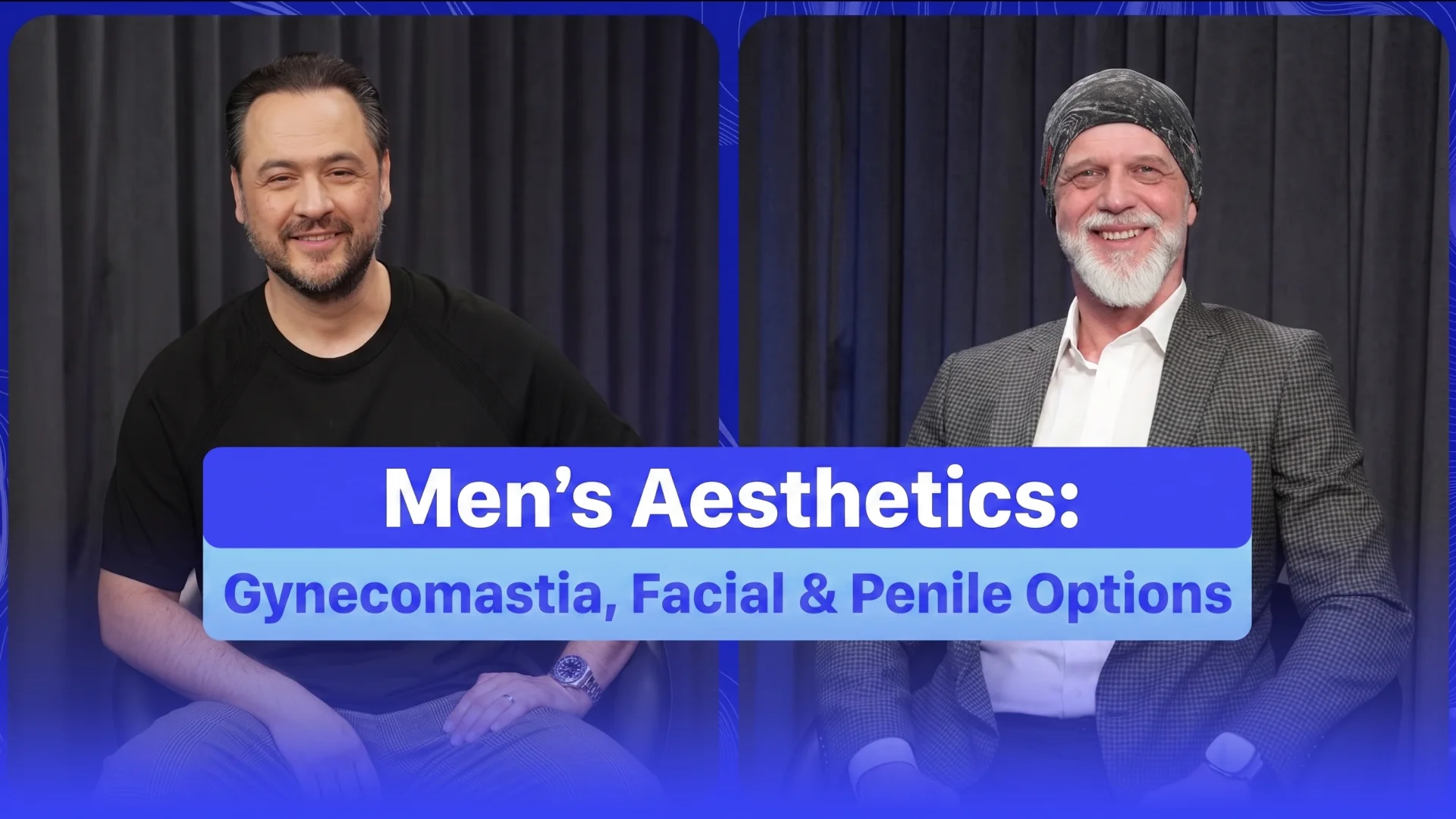
This article is adapted from an educational podcast conversation focused on men’s health and aesthetics, where urology and plastic surgery perspectives meet. The goal is not to push anyone toward procedures, but to clarify what these concerns often mean, what options exist, and why an individualized consultation is the safest way to make decisions—especially when concerns involve sensitive areas.
Men’s aesthetic concerns often include chest fullness (gynecomastia), a tired facial appearance, and questions about penile “size” that may actually be related to pubic fat and skin descent. This article explains the most common causes, realistic treatment options, and why consultation and individualized planning—sometimes with a multidisciplinary urology + plastic surgery approach—matter for safety and satisfaction.
Key takeaways
- Many men experience aesthetic concerns but hesitate to talk about them; it’s normal to seek a medical perspective.
- Gynecomastia can involve gland tissue, fat, or both—and evaluation helps define the right approach.
- Facial concerns in men often center on “tiredness” (under-eye bags, laxity, jawline/neck changes) and typically benefit from conservative planning.
- Some penile “shortening” complaints are actually visibility issues caused by pubic fat and skin descent (“buried” appearance), not true anatomical change.
- In selected cases, combining approaches (e.g., pubic fat reduction + lift, alongside urology-based procedures when indicated) can improve appearance—often by improving visibility.
- Safe outcomes depend on individualized assessment, realistic expectations, and appropriate follow-up planning.
Men’s aesthetics: what men commonly notice (and why they don’t always talk about it)
Plastic surgery is often stereotyped as “for women,” but that view doesn’t reflect real life. Men look in the mirror too, and many notice changes that come with aging, stress, work patterns, and lifestyle. The difference is often social: men may feel embarrassed to voice concerns about their appearance, or they may worry they won’t be taken seriously. As a result, a concern can quietly grow for years before someone asks a professional question.
In the conversation this article is based on, the themes are familiar: under-eye bags and fatigue around the eyes; skin laxity that changes how the face frames the eyes and jaw; chest fullness that affects clothing choices and confidence at the beach or gym; and abdominal or “love handle” fat that disrupts the overall proportions many men associate with a more athletic, masculine silhouette. Importantly, these aren’t “vanity” issues in a simplistic sense. For many patients, appearance intersects with self-esteem, social comfort, intimate confidence, and even motivation to maintain healthy habits.
The medical approach should be practical and non-judgmental: understand the concern, evaluate the anatomy and health context, and then discuss options ranging from lifestyle optimization to minimally invasive treatments to surgery—always with realistic expectations.
Gynecomastia (male chest fullness): overview and treatment options
Gynecomastia vs. chest fat: why the distinction matters
“Gynecomastia” is often used to describe any fullness in the male chest, but medically it can refer to glandular tissue enlargement, while some cases are primarily fat prominence, and many are a combination. This distinction matters because the best treatment depends on what is actually present. Two men may look similar in a T-shirt, yet one may have mostly fat tissue that responds to weight changes, while another may have a firmer gland component that does not improve with diet alone.
Because of that, a proper evaluation is a helpful starting point. It typically includes a medical history, a focused physical examination, and discussion of factors like weight changes, medications, hormonal history, and the timeline of symptoms. In selected situations—especially if there are unusual symptoms, pain, sudden changes, or asymmetry—further evaluation may be considered.
Treatment spectrum: from lifestyle to surgery
If chest fullness is strongly related to overall weight gain, lifestyle changes may improve it, particularly when combined with resistance training and a structured nutrition plan. That said, it’s also common for men to find that even with weight loss, the chest retains a shape they dislike, especially if gland tissue is part of the issue or if the skin quality has changed.
When surgery is appropriate, the approach is individualized. Many cases can be treated with liposuction, sometimes combined with gland excision when firmer tissue is present. The goal is to create a chest contour that looks natural on a male frame, without over-flattening or leaving irregularities. As with any aesthetic procedure, the plan should fit the patient’s anatomy and lifestyle, not a one-size-fits-all aesthetic.
Recovery: the importance of realistic expectations
Recovery varies. In general terms, men are often surprised that the early postoperative period can include swelling and firmness that temporarily makes the chest look “worse” before it looks better. Compression garments are commonly used to support the tissue while healing progresses, and activity restrictions are individualized. This is why a consultation should include clear discussion about timelines, variability, and what “normal” healing can look like.
Facial aesthetics in men: tired appearance, under-eye bags, skin laxity
Many men describe their facial concern not as “I want to look different,” but as “I look tired,” “my eyes look heavy,” or “my face looks older than I feel.” This often points to changes around the eyes and midface, skin laxity, and shifts in facial volume distribution over time. Under-eye bags can become more noticeable, and the jawline can soften due to a combination of skin laxity, fat distribution changes, and sometimes neck aging.
A key principle in men’s facial aesthetics is conservative, anatomy-based planning. Men often prefer outcomes that preserve a natural masculine appearance and avoid an “overdone” look. This is also why thoughtful evaluation matters: different men can have the same complaint (for example, under-eye bags) but for different reasons—skin quality, fat herniation, midface volume, or other factors. The safest path is not to chase trends, but to match the treatment approach to the underlying anatomy and the patient’s preferences.
Penile aesthetics and the “buried” appearance: a responsible discussion
Concerns about penile appearance are extremely sensitive, and they should be handled with care, privacy, and a medically grounded tone. In practice, a common scenario is a patient saying, “My penis got smaller.” True anatomical shrinkage is not usually the primary explanation for most men who bring this concern. More commonly, what changes is visibility—how much of the penile shaft is externally visible—especially when there is pubic fat accumulation and/or skin descent in the pubic region.
Visibility vs. true size: the “illusion” concept
A major point emphasized in the discussion is that much of what people perceive as “size” in day-to-day life is actually context. When the abdomen and pubic area have increased fat volume, or when pubic skin descends with age or body changes, the penis can appear “buried” or less visible. This can create the strong impression of loss of size, even when the anatomical length has not meaningfully changed.
Put simply: if the surrounding area is more prominent, the visible portion can look smaller. When that surrounding tissue is reduced or lifted, more of the shaft can become visible, and the perceived size can improve—often without changing the underlying anatomy.
Pubic fat reduction and pubic lift: what the conversation highlights
From a plastic surgery perspective, one of the most practical interventions—when appropriate—is reducing pubic fat (often via liposuction) and addressing excess skin or descent. For some men, especially in middle age, there can be both fat and skin laxity in the pubic region. In selected cases, procedures that function like a pubic lift or a limited lower abdominal tightening approach may be discussed to improve contour and reduce the “burying” effect.
This is not about extreme change or aggressive manipulation. The goal is often to restore proportions and visibility. Many men report improved confidence when more of the penis is visible, even if true anatomical size is not “increased.”
Multidisciplinary approach: urology + plastic surgery
Another key theme is that some concerns benefit from a multidisciplinary approach, especially when patients are seeking evaluation in the context of both function and appearance. Urology typically prioritizes function and medical appropriateness, while plastic surgery focuses on contour, soft tissue management, and aesthetic balance. When both perspectives are relevant, coordinated planning can help ensure that the approach is safe, realistic, and aligned with the patient’s goals.
Importantly, conservative guidance matters here. The discussion includes a cautionary stance: don’t “overdo it,” and don’t chase unrealistic expectations. There are clinical guidelines and responsible indications, and any plan should be individualized.
Safety-focused section: consultation and individualized planning
Across gynecomastia, facial aesthetics, and intimate-area concerns, the unifying principle is the same: individual assessment is essential. What a patient “needs” can’t be decided from a photo, a quick message, or a generic checklist. Anatomy varies. Health history varies. Healing patterns vary. And perhaps most importantly, personal goals vary.
A high-quality consultation includes:
– Understanding the specific concern and what “success” means to the patient
– Reviewing medical history and any factors that affect safety
– Examining anatomy (and, when appropriate, discussing whether additional evaluation is warranted)
– Explaining realistic outcomes and limitations
– Aligning the plan with the patient’s lifestyle, recovery capacity, and follow-up needs
When men feel respected and informed, decision-making becomes clearer—and safer.
Risks and limitations (brief)
All aesthetic procedures, from minimally invasive treatments to surgery, involve trade-offs and potential risks. Swelling, bruising, temporary asymmetry, and variability in scar behavior are common examples. Some outcomes take time to mature, and early results are not the final result. For that reason, medically responsible planning focuses on safety, appropriate indications, and honest discussion of limitations.
The goal should never be “perfect.” The goal is a realistic improvement that fits the patient’s anatomy and can be achieved safely.
International patient guidance (Istanbul / Turkey)
Many patients considering aesthetic surgery in Istanbul travel internationally. While remote communication can help with early planning, it does not replace an in-person evaluation. For safe and ethical care:
Remote assessment may help but does not replace in-person consultation. Travel plans should allow time for consultation, procedure, early recovery, and follow-up. Flying should be discussed individually. Avoid rigid promises about required stay duration—safety and follow-up matter more than speed.
Final thoughts
Men’s aesthetics is not a single procedure or trend—it’s a set of concerns that often intersect with aging, body changes, and confidence. Whether the issue is gynecomastia, facial fatigue, or questions about penile appearance, the best outcomes come from calm, medically grounded evaluation and individualized planning.
When concerns involve sensitive topics, the most helpful step is often the simplest: a professional conversation. With the right approach, men can get clear answers, realistic options, and a plan that prioritizes safety and long-term satisfaction.
This content is for general educational purposes and does not replace an in-person consultation.
Op. Dr. Mert Demirel
European Board Certified Plastic Surgeon (EBOPRAS)
ISAPS & ASPS Member
Istanbul, Turkey
A question about your own case?
Reading is useful. Personal evaluation is the next step.
Start with your phone number and continue the conversation on WhatsApp.
Number saved first · WhatsApp next

